

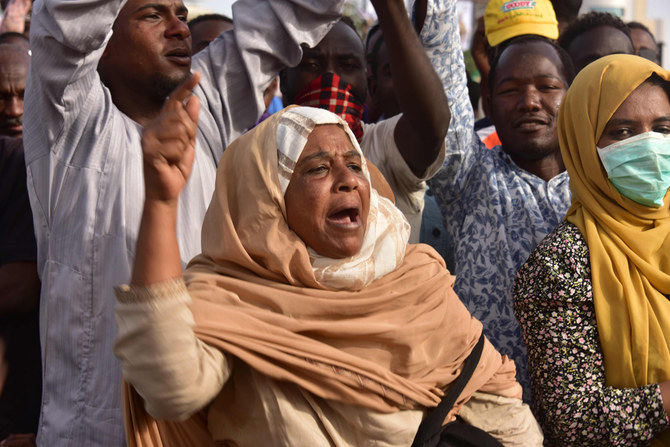
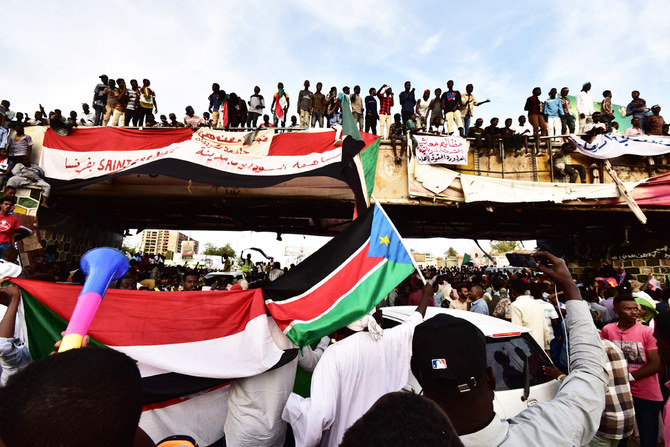

KHARTOUM/CAIRO: Sudan’s new military rulers on Sunday rejected a demand by protest leaders to hand over power immediately to a civilian government that will bring deposed leader Omar Al-Bashir to justice.
Thousands of protesters remained camped outside army headquarters in Khartoum to keep up pressure on the transitional military council that took power after ousting Bashir on Thursday.
As the protesters made their demands, Saudi Arabia, the UAE and Bahrain pledged their support for the transitional council in bringing stability to Sudan. Riyadh also announced a package of humanitarian aid, including petroleum products, wheat and medicines.
The Sudanese Professionals Association, which is organizing and leading the protests, called on the military council “to immediately transfer power to a civilian government.”
It also urged the next “transitional government and the armed forces to bring Bashir and all the chiefs of the National Intelligence and Security Service (NISS)... to justice.
“The Sudanese Professionals Association calls on its supporters to continue with the sit-in until the revolution achieves its demands.”
The political parties and movements behind the four months of protests said in a joint statement late on Saturday that they will remain in the streets until their demands are met. They said the handover to civilian rule would be the “first step toward the fall of the regime.”
The army has appointed a military council that it says will rule for two years or less while elections are being organized. The council met with a delegation of protest organizers on Saturday.
Omer El-Digair, leader of the opposition Sudanese Congress Party, told the protests outside the military headquarters in Khartoum after Saturday’s meeting that the atmosphere was “positive.”
“We demanded restructuring the current security apparatus,” he said. “We do not need a security apparatus that detains people and shuts off newspapers.”
The political parties and movements behind the four months of protests said in a joint statement late on Saturday that they will remain in the streets until their demands are met. They said the handover to civilian rule would be the “first step toward the fall of the regime.”
The army has appointed a military council that it says will rule for two years or less while elections are being organized. The council met with a delegation of protest organizers on Saturday.
The military overthrew Al-Bashir on Thursday, ending his nearly 30-year reign and placing him under house arrest in the capital, Khartoum. The protesters fear that the military, which is dominated by Al-Bashir appointees, will cling to power or select one of its own to succeed him.
However, the military council stuck to its previous insistence that handing over power could take up to two years, although it was committed to doing so.
The council was “keen on maintaining international and regional relations with countries who have Sudan’s best interests at heart,” the foreign ministry said. It urged the international community to back the military council “to achieve the Sudanese goal of democratic transition.”
The council chief Gen. Abdel Fattah Burhan was “committed to having a complete civilian government and the role of the council will be to maintain the sovereignty of the country,” the ministry said.
Earlier the military council met political parties and urged them to agree on an independent figure to be prime minister.
“We want to set up a civilian state based on freedom, justice and democracy,” said a council member, Lt. Gen. Yasser Al-Ata.
The protesters have insisted civilian representatives must join the military council.
Talks between protest leaders and the council were followed on Sunday by a meeting between Washington’s top envoy to Khartoum, Steven Koutsis, and the military council’s deputy leader, Mohammad Hamdan Daglo, widely known as Himeidti.
Himeidti is a field commander for the Rapid Support Forces (RSF) counter-insurgency unit.
The protesters have modeled their movement on the Arab Spring uprisings in 2011 that swept leaders from power in Egypt, Tunisia, Libya and Yemen. They have incorporated many of its slogans, and established a sit-in outside the military headquarters in Khartoum earlier this month.
Those uprisings left a mixed legacy, with only Tunisia emerging as a democracy. In Egypt, the military overthrew an elected but divisive Islamist president in 2013 and authorities have since cracked down hard on dissent. Yemen slid into civil war, and Libya is on the verge of another major conflict as militias fight for control of the capital, Tripoli.


