KARACHI: Members of Pakistan’s Hazara community continued their sit-in for a third consecutive day against Friday’s suicide attack in the southwestern city of Quetta and demanded on Sunday that Prime Minister Imran Khan personally visit them to ensure better security.
The Hazar Ganji blast which ripped through a busy outdoor marketplace on the outskirts of Quetta killed at least 20 people, including eight members of the Hazara community and wounded another 48 people, and was claimed by the militant group Daesh on Saturday, according to the group’s news agency.
“The sit-in will continue till Prime Minister Imran Khan, who praised New Zealand’s Prime Minister Jacinda Ardern for standing with victims of Christchurch mosque, visits and assures us better security,” said Jalila Haider, one of the sit-in organizers.
Protesters have said that no one from the federal government has visited the mourning families. Information Minister Fawad Chaudhry did not respond to questions but an interior ministry spokesperson said Interior Minister Shehryar Afridi had no visit scheduled.
Iftikhar Durrani, spokesperson for Prime Minister Imran Khan said he would share details if the premier was to make plans to visit Quetta, capital of Pakistan’s resource-rich southwestern Balochistan province.
Following the blast, Prime Minister Khan said in a post on Twitter that he had called an “immediate inquiry” into the attack.
Balochistan’s provincial chief minister Jam Kamal Khan on Saturday visited the families of victims and asked protesters to end their sit-in at the western bypass but his request was turned down.
“We are taking responsible steps to root out terrorist activities from the province in order to ensure the protection of citizens,” he said.
Balochistan province which borders both Iran and Afghanistan, has increasingly become a flashpoint for sectarian violence between Pakistan’s majority Sunni Muslims and Shias, who account for around a fifth of the country’s 200 million people. The province has been rocked by militant attacks by Taliban, Al-Qaeda and Daesh which have claimed hundreds of lives since 2001.
Last year, Daesh claimed responsibility for an attack on an election rally in Balochistan in which at least 128 people were killed.
Balochistan is the focus of the $57-billion China Pakistan Economic Corridor, a transport and energy link planned between western China and Pakistan’s southern deepwater port of Gwadar.
The attack in Quetta came after a year’s lull in violence against the mainly Shi’ite Hazara minority in the province, though there have been isolated shootings.
Federal minister for maritime affairs, Ali Haider Zaidi also urged protesters to end their sit-in during a visit to Quetta on Saturday.
“I represented the federal government...visited the sit-in to condole, express solidarity and assure them (the protesters) of strict security in future, so they should now end the dharna,” Zaidi told Arab News.
“There would be frequent attacks on the community... (but) there is now peace since last one year. Security agencies are working hard and will make the Hazara colony also safe,” he said.
According to a 2018 report released by the National Commission for Human Rights, 509 ethnic Hazaras were killed and 627 wounded in a spate of attacks against the community between January 2012 and Dec 2017.
The deadliest attacks took place in 2013 when three separate bombings killed more than 200 members of the community in Balochistan. After those attacks, it became standard practice for security officials to escort Hazara buses out of the two protected enclaves where they mostly live and work, including to markets like the one where Friday’s attack occurred.


![]()
![]()

Protesters vow to continue sit-in against suicide attack in Quetta till PM Khan personally visits
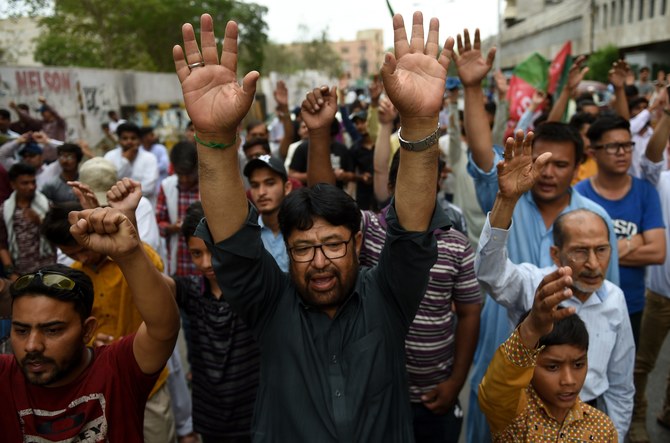

Protesters vow to continue sit-in against suicide attack in Quetta till PM Khan personally visits
- Eight members of the Hazara community were among 20 killed in Quetta’s fruit market on Friday morning
- The community has entered its third consecutive day of protest
Latest updates


© 2026 SAUDI RESEARCH & PUBLISHING COMPANY, All Rights Reserved And subject to Terms of Use Agreement.