

Trump reaffirms North Korea sanctions

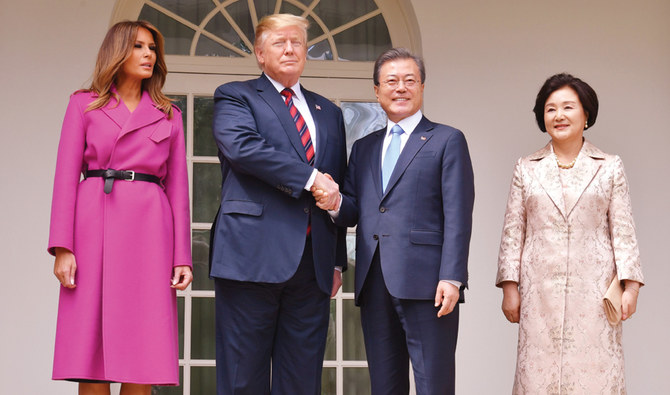
US President Donald Trump and first lady Melania Trump welcome South Korean President Moon Jae-in and his wife Kim Jung-sook to the White House. (AFP)
Updated 12 April 2019
Follow

Trump reaffirms North Korea sanctions

  • President rejects concessions to facilitate inter-Korean economic projects

SEOUL: US President Donald Trump has rejected suggestions that he could allow concessions on North Korean sanctions, during discussions in Washington with South Korean President Moon Jae-in.

At a press conference at the White House, Trump suggested that he would be open to dialogue with Pyongyang on the condition of complete denuclearization.

“I think that sanctions are, right now, at a level that’s a fair level. And I really believe something very significant is going to happen,” he said. “We could always increase them, but I didn’t want to do that at this time.”

There had been suggestions that some sanctions could be eased in order to facilitate cross-border economic projects, but Trump stated: “This isn’t the right time.”

Inter-Korean initiatives, including an industrial park, railway link and tourism opportunities, have been suspended as a result of the North conducting a series of intercontinental ballistic missile and nuclear warhead tests.

Moon expressed hope that a new summit with North Korean leader Kim Jong Un could jump-start the denuclearization process, after the collapse of the Trump-Kim summit in Hanoi in February.

“The important task that I face is to maintain dialogue and also express to the international community that a third US-North Korea Summit will be held in the near future,” Moon told reporters in the Oval Office. “The Republic of Korea is absolutely on the same page when it comes to the complete denuclearization of North Korea.”

Trump remained cautious about a third encounter with Kim, but did not rule it out.

“A third summit could happen. It’s step by step, it’s not a fast process … If it goes fast, it’s not going to be a proper deal.”

There remain doubts over the South’s optimism for progress, however. Moon Keun-shik, an analyst at the Korea Defense and Security Forum, said: “Moon was not able to hear what he had wanted from Trump, but he has cemented his role as the mediator over the nuclear issue.”

Many North Korea experts, though, also queried Moon’s ability to bridge the gap between Trump and Kim.

“Moon and Trump failed to narrow a gap over practical issues, including sanctions on North Korea,” said Chung Se-hyun, a former minister for Korean unification. “If you say there was no deal at the Hanoi Summit, there is also no deal from this Moon-Trump summit.”

Shin Bum-cheol, director of the Center for Security and Unification at the Asan Institute for Policy Studies, said Moon’s pursuit of a “good enough deal” for partial relief of sanctions in exchange for gradual denuclearization was rebuffed by Trump, leaving Seoul little option but to persuade Pyongyang to meet US terms.

“I question if Kim will accept Moon’s proposal to hold a summit, as he has shown his resolution to respond to the current sanctions,” Shin said.

North Korean state media reported Kim had vowed a “serious blow” to those imposing sanctions on his regime prior to the Trump-Moon Summit, during an address to the central committee of the ruling Workers’ Party in Pyongyang on Wednesday.

The remark was construed as a firm stance against economic and trade sanctions imposed by the international community, rather than a threat, as it did not explicitly mention the South, the US, nor threaten military action.

Heavy shelling, explosions spark fear along Pakistan-Afghanistan border 

Updated 04 March 2026
Follow

Heavy shelling, explosions spark fear along Pakistan-Afghanistan border 

  • Residents fear for their safety amid border clashes
  • 1,500 Afghan families displaced ‌due to heavy shelling and explosions
  • Pakistan denies targeting civilians, says its strikes focus on militants

LAL PUR, Afghanistan/PESHAWAR, Pakistan: People living along Pakistan’s border with Afghanistan said they ​were considering fleeing their homes because of heavy shelling and explosions as fighting between troops from both sides entered a seventh day on Wednesday.
The South Asian allies-turned-foes have engaged in their worst fighting in years following Pakistani airstrikes on major Afghan cities last week, increasing volatility in a region also on edge over US and Israeli strikes on Iran.
Islamabad has said its airstrikes, which have at times directly targeted the Taliban government, are aimed at ending Afghan support for militants carrying out attacks on Pakistan. The Taliban has denied aiding militant groups.

SHELLING ‌STARTS AS VILLAGERS ‌ARE BREAKING RAMADAN FAST
Residents of towns and villages in ​Pakistan’s ‌northwest ⁠said fighting between ​border ⁠forces starts in the evenings, placing their homes in the line of fire, often at sunset when families are breaking their fast in the holy month of Ramadan.
“There is complete silence in the day, but the moment we sit for iftar dinner, the two sides start shelling,” Farid Khan Shinwari from Landi Kotal, a town near the Torkham border crossing, told Reuters.
“We open our fast in extremely difficult situations, as you never know when a shell can hit your house.”
Residents ⁠in the town and nearby villages said there had been heavy ‌shelling and some explosions heard in the past ‌few days, prompting many to flee their homes.
On the other ​side of the border, Afghans shared similar stories ‌of skirmishes and families fleeing their homes.
Hundreds had been displaced to an open ‌dirt field under makeshift tents, while others had no shelter at all. Officials say around 1,500 families have fled their homes.
Fighting along the 2,600-km (1,615-mile) border has ebbed and flowed over the week-long conflict, with both sides saying they have inflicted heavy losses on the other country and gained ground in the fighting.
Reuters ‌has been unable to verify these accounts.

TURKEY HAS OFFERED TO MEDIATE
Turkish President Recep Tayyip Erdogan told Pakistani Prime Minister Shehbaz Sharif that ⁠Ankara would help ⁠reinstate a ceasefire, the Turkish Presidency said on Tuesday, as other countries that had offered to mediate have since been hit by the conflict in the Gulf.
On Wednesday, both countries reported exchanges of heavy fire, with Afghanistan’s defense ministry saying Taliban forces shot down a Pakistani drone and captured seven border posts.
A spokesperson for the ministry said 110 civilians, including 65 women and children, had been killed since the fighting began and another 123 were wounded. The United Nations mission for Afghanistan has listed 42 deaths so far.
Pakistan’s Information Minister Attaullah Tarar disputed both figures, saying: “Pakistan exercises great care in only targeting terrorists and support infrastructure. No civilian structures have been targeted.”
On Saturday, Pakistan struck “ammunition and critical equipment” at the Bagram air base north ​of Kabul, Tarar said, a key American command ​center through the 20-year Afghan war.