COVENTRY, United Kingdom: Nigel Farage launched his Brexit Party’s campaign Friday for the European Parliament elections — a vote Britain was never meant to take part in but which is now being seen as a referendum on its stalled drive out of the EU.
The former UK Independence Party (UKIP) leader was a leading light of the pro-Brexit camp in a bitterly divisive 2016 referendum that voted to pull Britain out of the European Union after nearly half a century.
He now hopes to transform Prime Minister Theresa May’s failure to complete the split by its original March 29 deadline into big gains for Brexit supporters.
“I genuinely believe right now this nation, we are lions led by donkeys,” Farage told his maiden campaign event in Conventry — a mediaeval central England city left in ruins by World War II bombing raids.
“We can win these European elections and... start to put the fear of God into our members of parliament in Westminster — they deserve nothing less.”
Britain has found itself in the embarrassing position of having to prepare for a European vote three years after deciding to leave the bloc.
May’s struggle to get her EU divorce terms approved by parliament forced the other 27 nations at a summit earlier this week to grant Britain a second Brexit extension that could run up to October 31.
This requires the UK to field candidates for the May 23 European Parliament election.
Farage said the chaos showed that Britain’s leaders were “pretty much incompetent.”
Not everything went smoothly at the launch for the 55-year-old former commodities trader in London’s bustling financial district.
It turned out that Farage forgot to register thebrexitparty.com website and a campaign group calling themselves “Led By Donkeys” grabbed it instead.
“Nobody is more responsible than Farage for the diminished state of our nation,” thebrexitparty.com site now says.
“It’s time to stop Farage.”
Those out to do just that include a new group of prominent pro-European lawmakers who broke from May’s Conservatives and the main opposition Labour Party in February.
The Independent Group (TIG) is re-branding itself as “Change UK” and commands 11 of the 650 seats in the House of Commons.
Its overarching ambition is to keep Britain in Europe by forcing a new Brexit referendum that includes the option of reversing the first one’s results.
“We are clear: Brexit is proving to be undeliverable,” Change UK spokesman Chuka Umunna — a telegenic 40-year-old native Londoner who quit Labour — said in an introductory campaign statement.
“We believe the people should have the final say on this matter, and the best option is for the UK to remain a full member of the European Union.”
The European vote offers startup parties a rare chance to grab the national limelight — and secure treasured funding should they actually win seats in Strasbourg.
An outfit called The Renew Party kicked off its campaign by promising to give a voice to “people from outside politics” who still view themselves as Europeans and believers in causes such as fighting climate change.
It said it was “ready to speak up for disenfranchised voters who cannot rely on the Conservative and Labour parties.”
The elections pose a major headache for both major parties.
May’s Conservatives will have to face supporters frustrated by the party’s inability to lead the way on the biggest issue to face Britain in generations.
Brexit Secretary Stephen Barclay admitted last week that “asking the public to hold elections for an organization we are meant to have left would damage trust in politics.”
Labour meanwhile is splintered over whether to back a second Brexit vote.
The party includes both Brexit backers and opponents — a division that has left leader Jeremy Corbyn trying to navigate a vague middle ground.
“It is hard to imagine a worse time for Labour and the (Conservatives) to face the only UK-wide proportional electoral contest,” said Anand menon, European politics professor at King’s College London.
“These elections could accelerate the fragmentation of a fragile two-party stalemate, providing an institutional foothold for new parties forged on the issue of Europe.”


![]()


Nigel Farage launches Brexit Party’s campaign for European Parliament elections
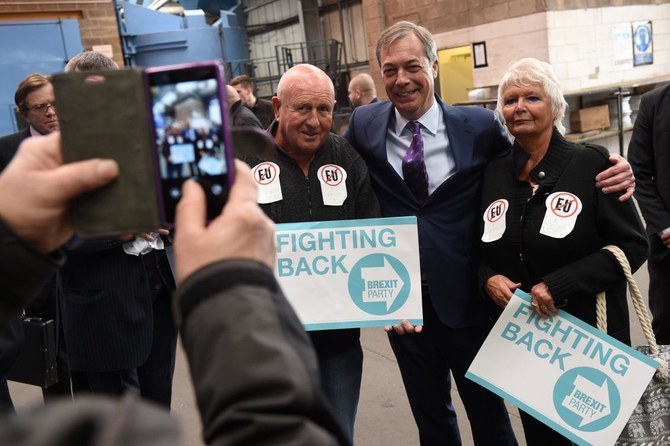
Nigel Farage launches Brexit Party’s campaign for European Parliament elections
- The former UK Independence Party (UKIP) leader was a leading light of the pro-Brexit camp in a bitterly divisive 2016 referendum that voted to pull Britain out of the European Union
- He now hopes to transform Prime Minister Theresa May’s failure to complete the split by its original March 29 deadline into big gains for Brexit supporters


Greenland crisis boosts Danish apps designed to identify and help boycott US goods
- Boycott campaigns are usually short-lived and real change often requires an organized effort rather than individual consumers
COPENHAGEN: The makers of mobile apps designed to help shoppers identify and boycott American goods say they saw a surge of interest in Denmark and beyond after the recent flare-up in tensions over US President Donald Trump’s designs on Greenland.
The creator of the “Made O’Meter” app, Ian Rosenfeldt, said he saw around 30,000 downloads of the free app in just three days at the height of the trans-Atlantic diplomatic crisis in late January out of more than 100,000 since it was launched in March.
Apps offer practical help
Rosenfeldt, who lives in Copenhagen and works in digital marketing, decided to create the app a year ago after joining a Facebook group of like-minded Danes hoping to boycott US goods.
“Many people were frustrated and thinking, ‘How do we actually do this in practical terms,’” the 53-year-old recalled. “If you use a bar code scanner, it’s difficult to see if a product is actually American or not, if it’s Danish or not. And if you don’t know that, you can’t really make a conscious choice.”
The latest version of “Made O’Meter” uses artificial intelligence to identify and analyze several products at a time, then recommend similar European-made alternatives. Users can set preferences, like “No USA-owned brands” or “Only EU-based brands.” The app claims over 95 percent accuracy.
“By using artificial intelligence, you can take an image of a product … and it can make a deep dive to go out and find the correct information about the product in many levels,” Rosenfeldt told The Associated Press during a demonstration at a Copenhagen grocery store. “This way, you have information that you can use to take decisions on what you think is right.”
‘Losing an ally’
After an initial surge of downloads when the app was launched, usage tailed off. Until last month, when Trump stepped up his rhetoric about the need for the US to acquire Greenland, a strategically important and mineral-rich Arctic island that is a semiautonomous territory of Denmark.
Usage peaked Jan. 23, when there were almost 40,000 scans in one day, compared with 500 or so daily last summer. It has dropped back since but there were still around 5,000 a day this week, said Rosenfeldt, who noted “Made O’Meter” is used by over 20,000 people in Denmark but also by people in Germany, Spain, Italy, even Venezuela.
“It’s become much more personal,” said Rosenfeldt, who spoke of “losing an ally and a friend.”
Trump announced in January he would slap new tariffs on Denmark and seven other European countries that opposed his takeover calls, only to abruptly drop his threats after he said a “framework” for a deal over access to mineral-rich Greenland was reached with NATO Secretary-General Mark Rutte’s help. Few details of that agreement have emerged.
The US began technical talks in late January to put together an Arctic security deal with Denmark and Greenland, which say sovereignty is not negotiable.
Rosenfeldt knows such boycotts won’t damage the US economy, but hopes to send a message to supermarkets and encourage greater reliance on European producers.
“Maybe we can send a signal and people will listen and we can make a change,” he added.
The protest may be largely symbolic
Another Danish app, “NonUSA,” topped 100,000 downloads at the beginning of February. One of its creators, 21-year-old Jonas Pipper, said there were over 25,000 downloads Jan. 21, when 526 product scans were performed in a minute at one point. Of the users, some 46,000 are in Denmark and around 10,000 in Germany.
“We noticed some users saying they felt like a little bit of the pressure was lifted off them,” Pipper said. “They feel like they kind of gained the power back in this situation.”
It’s questionable whether such apps will have much practical effect.
Christina Gravert, an associate professor of economics at the University of Copenhagen, said there are actually few US products on Danish grocery store shelves, “around 1 to 3 percent”. Nuts, wines and candy, for example. But there is widespread use of American technology in Denmark, from Apple iPhones to Microsoft Office tools.
“If you really want to have an impact, that’s where you should start,” she said.
Even “Made O’Meter” and “NonUSA” are downloaded from Apple’s App Store and Google’s Play Store.
Gravert, who specializes in behavioral economics, said such boycott campaigns are usually short-lived and real change often requires an organized effort rather than individual consumers.
“It can be interesting for big supermarket brands to say, OK, we’re not going to carry these products anymore because consumers don’t want to buy them,” she said. “If you think about large companies, this might have some type of impact on the import (they) do.”
On a recent morning, shoppers leaving one Copenhagen grocery store were divided.
“We do boycott, but we don’t know all the American goods. So, it’s mostly the well-known trademarks,” said Morten Nielsen, 68, a retired navy officer. “It’s a personal feeling … we feel we do something, I know we are not doing very much.”
“I love America, I love traveling in America,” said 63-year-old retiree Charlotte Fuglsang. “I don’t think we should protest that way.”
The creator of the “Made O’Meter” app, Ian Rosenfeldt, said he saw around 30,000 downloads of the free app in just three days at the height of the trans-Atlantic diplomatic crisis in late January out of more than 100,000 since it was launched in March.
Apps offer practical help
Rosenfeldt, who lives in Copenhagen and works in digital marketing, decided to create the app a year ago after joining a Facebook group of like-minded Danes hoping to boycott US goods.
“Many people were frustrated and thinking, ‘How do we actually do this in practical terms,’” the 53-year-old recalled. “If you use a bar code scanner, it’s difficult to see if a product is actually American or not, if it’s Danish or not. And if you don’t know that, you can’t really make a conscious choice.”
The latest version of “Made O’Meter” uses artificial intelligence to identify and analyze several products at a time, then recommend similar European-made alternatives. Users can set preferences, like “No USA-owned brands” or “Only EU-based brands.” The app claims over 95 percent accuracy.
“By using artificial intelligence, you can take an image of a product … and it can make a deep dive to go out and find the correct information about the product in many levels,” Rosenfeldt told The Associated Press during a demonstration at a Copenhagen grocery store. “This way, you have information that you can use to take decisions on what you think is right.”
‘Losing an ally’
After an initial surge of downloads when the app was launched, usage tailed off. Until last month, when Trump stepped up his rhetoric about the need for the US to acquire Greenland, a strategically important and mineral-rich Arctic island that is a semiautonomous territory of Denmark.
Usage peaked Jan. 23, when there were almost 40,000 scans in one day, compared with 500 or so daily last summer. It has dropped back since but there were still around 5,000 a day this week, said Rosenfeldt, who noted “Made O’Meter” is used by over 20,000 people in Denmark but also by people in Germany, Spain, Italy, even Venezuela.
“It’s become much more personal,” said Rosenfeldt, who spoke of “losing an ally and a friend.”
Trump announced in January he would slap new tariffs on Denmark and seven other European countries that opposed his takeover calls, only to abruptly drop his threats after he said a “framework” for a deal over access to mineral-rich Greenland was reached with NATO Secretary-General Mark Rutte’s help. Few details of that agreement have emerged.
The US began technical talks in late January to put together an Arctic security deal with Denmark and Greenland, which say sovereignty is not negotiable.
Rosenfeldt knows such boycotts won’t damage the US economy, but hopes to send a message to supermarkets and encourage greater reliance on European producers.
“Maybe we can send a signal and people will listen and we can make a change,” he added.
The protest may be largely symbolic
Another Danish app, “NonUSA,” topped 100,000 downloads at the beginning of February. One of its creators, 21-year-old Jonas Pipper, said there were over 25,000 downloads Jan. 21, when 526 product scans were performed in a minute at one point. Of the users, some 46,000 are in Denmark and around 10,000 in Germany.
“We noticed some users saying they felt like a little bit of the pressure was lifted off them,” Pipper said. “They feel like they kind of gained the power back in this situation.”
It’s questionable whether such apps will have much practical effect.
Christina Gravert, an associate professor of economics at the University of Copenhagen, said there are actually few US products on Danish grocery store shelves, “around 1 to 3 percent”. Nuts, wines and candy, for example. But there is widespread use of American technology in Denmark, from Apple iPhones to Microsoft Office tools.
“If you really want to have an impact, that’s where you should start,” she said.
Even “Made O’Meter” and “NonUSA” are downloaded from Apple’s App Store and Google’s Play Store.
Gravert, who specializes in behavioral economics, said such boycott campaigns are usually short-lived and real change often requires an organized effort rather than individual consumers.
“It can be interesting for big supermarket brands to say, OK, we’re not going to carry these products anymore because consumers don’t want to buy them,” she said. “If you think about large companies, this might have some type of impact on the import (they) do.”
On a recent morning, shoppers leaving one Copenhagen grocery store were divided.
“We do boycott, but we don’t know all the American goods. So, it’s mostly the well-known trademarks,” said Morten Nielsen, 68, a retired navy officer. “It’s a personal feeling … we feel we do something, I know we are not doing very much.”
“I love America, I love traveling in America,” said 63-year-old retiree Charlotte Fuglsang. “I don’t think we should protest that way.”
Latest updates


Recommended


© 2026 SAUDI RESEARCH & PUBLISHING COMPANY, All Rights Reserved And subject to Terms of Use Agreement.