

Crude oil touted as health cure in Azerbaijan

1 / 3
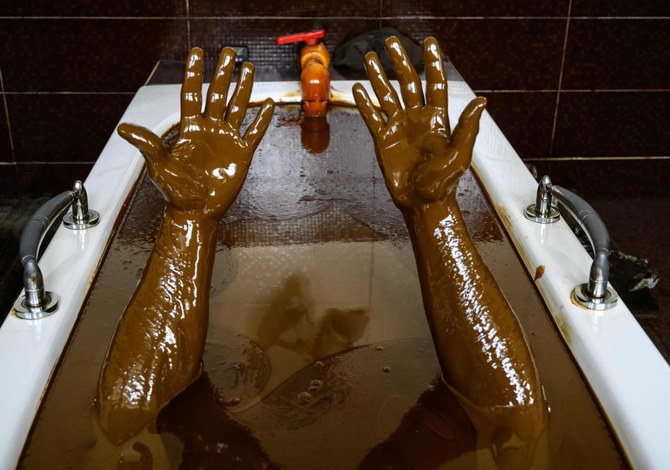
The petroleum spa resort in the oil-rich Caucasus country is a draw for visitors. (AFP)
2 / 3
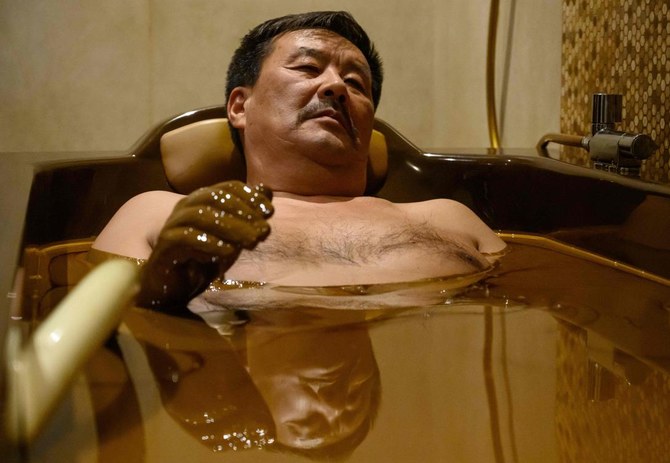
The treatment is offered at Qarabag luxury resort in Naftalan, some 300 kilometers (186 miles) from capital Baku. (AFP)
3 / 3
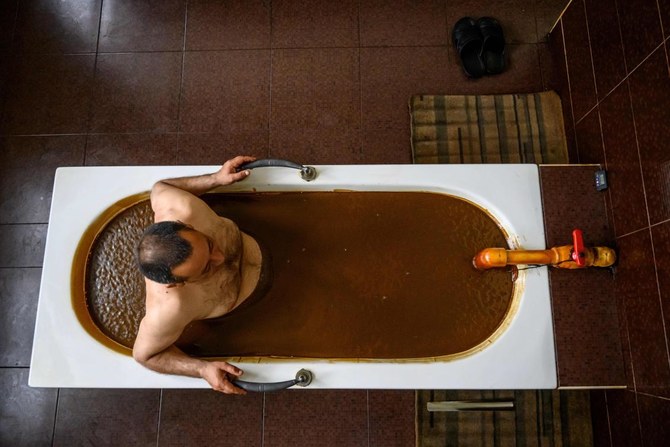
Azerbaijan’s vast oil deposits were discovered in the mid-19th century. (AFP)
Updated 12 April 2019
Follow

Crude oil touted as health cure in Azerbaijan

  • The local oil is used to treat muscular, skin and bone conditions as well as gynaecological and neurological problems
  • According to a legend the healing properties of Naftalan’s “miraculous oil” were discovered by accident when a camel left to die near a pool of oil was cured

NAFTALAN: Immersed up to her neck in a dark viscous liquid, Sulfiya smiles in delight, confident that the fetid substance will cure her painful condition.
Sulfiya, a Russian woman in her 60s, has traveled to Azerbaijan’s north-western city of Naftalan in the hope that crude oil baths at a local sanatorium will end her years of suffering from polyarthritis, a disease affecting the joints.
“This is so pleasant,” she enthuses, despite the reek of engine oil.
Her naked dip in oil heated to just above body temperature lasts 10 minutes, after which an attendant scrapes the brown oil off her skin and sends her into a shower.
The native of Russia’s Tatarstan region said she and her friends “have long dreamed of coming” for treatment in Naftalan.
The petroleum spa resort in the oil-rich Caucasus country is a draw for visitors despite its proximity to Nagorny Karabakh, a region disputed between Azerbaijan and Armenia in a long-running armed conflict.
After 10 days of bathing in crude oil Sulfiya says she now feels “much better” and has even reduced her medication for the polyarthritis that she has had for 12 years.
“It is a gift from God,” agrees 48-year-old Rufat, an Azerbaijani journalist and opposition party member who is undergoing treatment in the sanatorium called Sehirli, or “magic” in Azerbaijani.
Azerbaijan’s vast oil deposits were discovered in the mid-19th century, making what was at the time part of the Russian Empire one of the first places in the world to start commercial oil production.
Oil exports to markets all over the world are the largest sector of Azerbaijan’s economy, but the crude that comes from subsoil reservoirs in Naftalan is not suitable for commercial use.
Instead the local oil is used to treat to cure muscular, skin and bone conditions as well as gynaecological and neurological problems.
According to a legend, which spa staff readily tell clients, the healing properties of Naftalan’s “miraculous oil” were discovered by accident when a camel left to die near a pool of oil was cured.
The small town of Naftalan some 300 kilometers (185 miles) from the capital Baku became a popular health resort for Soviet citizens in the 1920s.

“In the past, when there weren’t any hotels or sanatoriums, people would come to Naftalan and stay with locals,” said one of the doctors at the Sehirli sanatorium, Fabil Azizov, sitting in her office under a portrait of strongman President Ilham Aliyev.
“But as time passed, sanatoriums were built and treatment methods developed.”

Some specialists warn the method has dangerous side effects.
“Despite the stories of past cures, the use of crude oil for medicinal purposes has been condemned by Western doctors as potentially carcinogenic,” former journalist Maryam Omidi wrote in a 2017 book published in Britain about Soviet-era sanatoriums.
In fact, the oil at Naftalan is almost 50 percent naphthalene, a carcinogenic substance found in cigarette smoke and mothballs that in large amounts can damage or destroy red blood cells.
But doctors and patients at Naftalan brush aside any misgivings and the sanatorium even has a small museum displaying crutches that once belonged to patients who have recovered from their illnesses.

During its heyday in the 1980s, Naftalan would host more than 70,000 visitors a year.
But in 1988, a bloody war began with neighboring Armenia for the control of Azerbaijan’s separatist Nagorny Karabakh region, which unilaterally proclaimed independence from Baku in 1991.
The conflict claimed the lives of some 30,000 people from both sides and forced hundreds of thousands to flee their homes.
A 1994 cease-fire agreement ended hostilities, but the arch foes have yet to reach a definitive peace deal and there are frequent skirmishes along the volatile frontline.
During the war, the sanatoriums in Naftalan — a few kilometers from the frontline — were converted into hospitals for wounded soldiers and temporary accommodation for refugees.
Over the last two decades, the Azerbaijani authorities have worked hard to re-establish Naftalan’s reputation as a health resort.
They resettled refugees in other regions, demolished decrepit Soviet-era sanatoriums and built brand-new tourist facilities.
Modern Naftalan is a blend of kitsch-looking high-end spas where a week’s treatment costs some 1,000 euros, and modest sanatoriums where a week’s treatment costs around 100 euros.
The simmering Karabakh conflict may be out of sight, but guests can still feel uncomfortably close to the military action.
During one of the deadliest recent bouts of fighting in April 2016, “we heard gunshots,” said a member of staff at Naftalan’s luxurious Garabag spa, adding quickly that “everyone stayed on.”


Burkinabe teen behind viral French ‘coup’ video has no regrets

Updated 20 December 2025
Follow

Burkinabe teen behind viral French ‘coup’ video has no regrets

  • “Coup d’etat in France,” declared the video, posted by the 17-year-old, showing what appeared to be journalists reporting on an ongoing takeover by an unidentified colonel
  • Posted on December 9 on TikTok, then shortly afterwards on Facebook, the post went viral, garnering more than 12 million views and tens of thousands of “likes”

PARIS: A Burkinabe teenager who used artificial intelligence to post fake news of a French coup on Facebook got more than he bargained for.
As well as millions of views and tens of thousands of “likes,” he also acquired a certain notoriety — and French President Emmanuel Macron, for one, was not amused.
And what he had planned as a money-making scheme only netted him seven euros, he said. But he has no regrets.
“Coup d’etat in France,” declared the video, posted by the 17-year-old, showing what appeared to be journalists reporting on an ongoing takeover by an unidentified colonel.
In one shot, the Eiffel Tower and the blue lights from a police car flashed in the background.
“Demonstrators have gathered to support the colonel who seems to have taken power yesterday,” said the reporters.
It was all fake, of course: the product of his online training in the use of artificial intelligence.
Posted on December 9 on TikTok, then shortly afterwards on Facebook, the post went viral, garnering more than 12 million views and tens of thousands of “likes.”
Last Tuesday, when Macron was asked about the video during a visit to Marseille, he spoke of his frustration at not having been able to force Facebook to take it down.
They had told him that it did not violate their rules, he said.

Money-making goal

In the end, it was the creator himself who deleted it, shortly after the French news media started contacting him.
Speaking to AFP, he explained that he had got into creating AI-generated videos last year after finding a training course on YouTube. But he only really started producing in October 2025.
He was taken aback by his sudden celebrity and that the French media was reporting on and even interviewing him.
He laughed about all the fuss in a video posted to his Facebook page.
But the teenager, who preferred to remain anonymous, was clear that his real aim had been to make money from advertising attached to his posts.
Not that he was living in poverty, he added.
“I eat, I can get to school, my parents take good care of me, thank God,” he told AFP.
But he wanted more to gain “financial independence,” he added.
He had seen “loads of pages that get millions of views” and had heard that TikTok paid money to producers, so he jumped into social media to see what he could do.
After a bit of trial and error, he latched on to AI-generated fake news because it generated more online traffic.
“I haven’t yet made a lot of money that way,” he admitted.
His Facebook page was not yet monetised, though he had made a little money from TikTok.
Normally, Africa is not a region that is eligible for monetization on the platform but he said he had found a way around that.
While his viral video on the fake coup in France may not have been a moneyspinner, he has used it to promote an offer of online training in AI-generated content on Facebook.
“There are people who have got in touch with me after this video, at least five people since last week,” he said.
For one hour’s coaching, he makes 7,000 CFA francs (10 euros).

No regrets 

France is frequently the target of disinformation, in particular from the Alliance of Sahel States (AES) — Mali, Niger and Burkina Faso.
Since a string of military coups there, all three countries have distanced themselves from France, the former colonial power, and moved instead toward Russia.
The Burkinabe junta in particular has become adept at AI-generated propaganda videos. They have included false clips of celebrities such as singer Beyonce or Pope Leo XIV singing the praises of Ibrahim Traore, the military government’s leader.
Burkina Faso also has a group of influential cyberactivists who promote the government’s propaganda online, known as the “Rapid-Intervention Communication Battalion.”
The teenager behind the fake French coup video told AFP he was not part of that group.
But while his main motivation was far from being political, he was happy to take a passing shot at France.
“I also created this video to scare people,” he said.
Some French media personalities and politicians do not present a fair view of what is going on in Africa’s Sahel region, instead broadcasting “fake news,” he said.
He cited recent reports that the Malian capital, Bamako, was on the point of falling to jihadist forces.
Informed sources agree that if the military government there was in difficulty recently from a jihadist blockage of supply routes, it has not so far been threatened to the point of losing power.
The French authorities “have no regrets about publishing false statements on the AES,” said the teenager.
“So I’m not going to regret publishing false things about them!“