

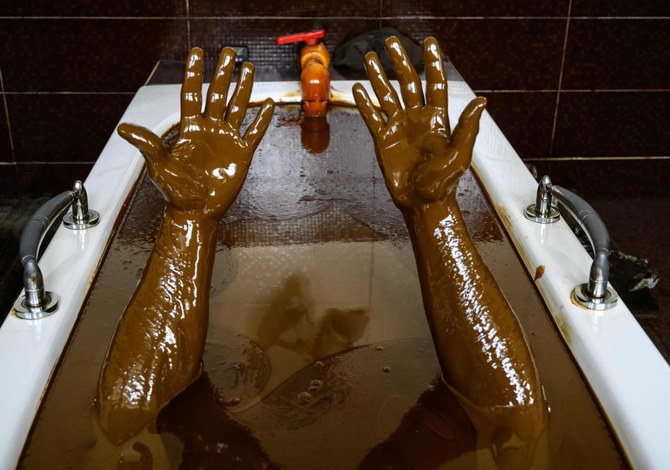
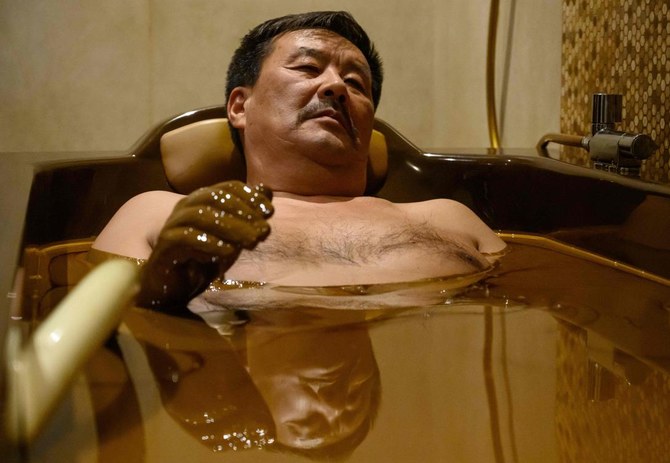
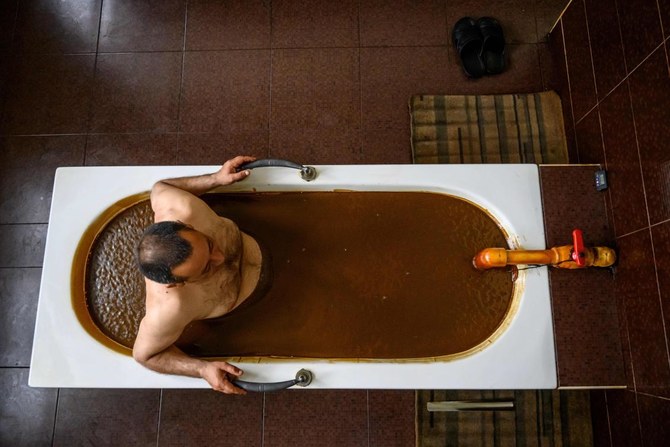

NAFTALAN: Immersed up to her neck in a dark viscous liquid, Sulfiya smiles in delight, confident that the fetid substance will cure her painful condition.
Sulfiya, a Russian woman in her 60s, has traveled to Azerbaijan’s north-western city of Naftalan in the hope that crude oil baths at a local sanatorium will end her years of suffering from polyarthritis, a disease affecting the joints.
“This is so pleasant,” she enthuses, despite the reek of engine oil.
Her naked dip in oil heated to just above body temperature lasts 10 minutes, after which an attendant scrapes the brown oil off her skin and sends her into a shower.
The native of Russia’s Tatarstan region said she and her friends “have long dreamed of coming” for treatment in Naftalan.
The petroleum spa resort in the oil-rich Caucasus country is a draw for visitors despite its proximity to Nagorny Karabakh, a region disputed between Azerbaijan and Armenia in a long-running armed conflict.
After 10 days of bathing in crude oil Sulfiya says she now feels “much better” and has even reduced her medication for the polyarthritis that she has had for 12 years.
“It is a gift from God,” agrees 48-year-old Rufat, an Azerbaijani journalist and opposition party member who is undergoing treatment in the sanatorium called Sehirli, or “magic” in Azerbaijani.
Azerbaijan’s vast oil deposits were discovered in the mid-19th century, making what was at the time part of the Russian Empire one of the first places in the world to start commercial oil production.
Oil exports to markets all over the world are the largest sector of Azerbaijan’s economy, but the crude that comes from subsoil reservoirs in Naftalan is not suitable for commercial use.
Instead the local oil is used to treat to cure muscular, skin and bone conditions as well as gynaecological and neurological problems.
According to a legend, which spa staff readily tell clients, the healing properties of Naftalan’s “miraculous oil” were discovered by accident when a camel left to die near a pool of oil was cured.
The small town of Naftalan some 300 kilometers (185 miles) from the capital Baku became a popular health resort for Soviet citizens in the 1920s.
“In the past, when there weren’t any hotels or sanatoriums, people would come to Naftalan and stay with locals,” said one of the doctors at the Sehirli sanatorium, Fabil Azizov, sitting in her office under a portrait of strongman President Ilham Aliyev.
“But as time passed, sanatoriums were built and treatment methods developed.”
Some specialists warn the method has dangerous side effects.
“Despite the stories of past cures, the use of crude oil for medicinal purposes has been condemned by Western doctors as potentially carcinogenic,” former journalist Maryam Omidi wrote in a 2017 book published in Britain about Soviet-era sanatoriums.
In fact, the oil at Naftalan is almost 50 percent naphthalene, a carcinogenic substance found in cigarette smoke and mothballs that in large amounts can damage or destroy red blood cells.
But doctors and patients at Naftalan brush aside any misgivings and the sanatorium even has a small museum displaying crutches that once belonged to patients who have recovered from their illnesses.
During its heyday in the 1980s, Naftalan would host more than 70,000 visitors a year.
But in 1988, a bloody war began with neighboring Armenia for the control of Azerbaijan’s separatist Nagorny Karabakh region, which unilaterally proclaimed independence from Baku in 1991.
The conflict claimed the lives of some 30,000 people from both sides and forced hundreds of thousands to flee their homes.
A 1994 cease-fire agreement ended hostilities, but the arch foes have yet to reach a definitive peace deal and there are frequent skirmishes along the volatile frontline.
During the war, the sanatoriums in Naftalan — a few kilometers from the frontline — were converted into hospitals for wounded soldiers and temporary accommodation for refugees.
Over the last two decades, the Azerbaijani authorities have worked hard to re-establish Naftalan’s reputation as a health resort.
They resettled refugees in other regions, demolished decrepit Soviet-era sanatoriums and built brand-new tourist facilities.
Modern Naftalan is a blend of kitsch-looking high-end spas where a week’s treatment costs some 1,000 euros, and modest sanatoriums where a week’s treatment costs around 100 euros.
The simmering Karabakh conflict may be out of sight, but guests can still feel uncomfortably close to the military action.
During one of the deadliest recent bouts of fighting in April 2016, “we heard gunshots,” said a member of staff at Naftalan’s luxurious Garabag spa, adding quickly that “everyone stayed on.”


