

African, Syrian migrants in crosshairs of Libya’s war

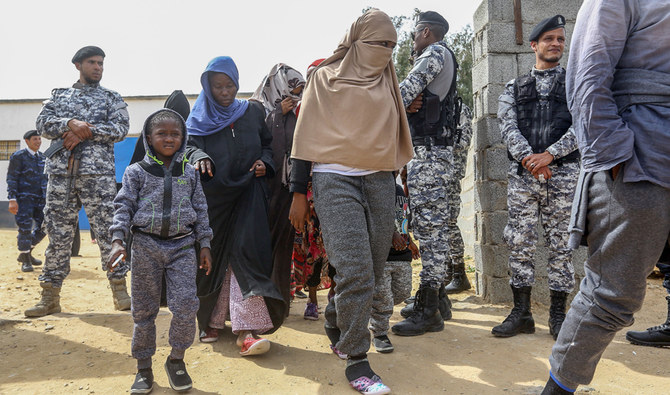
Migrants walk to meet UN chief Antonio Guterres (unseen) during his visit to the Ain Zara detention center for migrants in Tripoli on April 4. (AFP)
Updated 11 April 2019
Follow

African, Syrian migrants in crosshairs of Libya’s war

  • The UN wants to move them urgently to safety

TRIPOLI, GENEVA: They trekked through the Sahara in hope of crossing the Mediterranean to a better life in Europe — but instead ended up in squalid detention centers and are now engulfed by war.

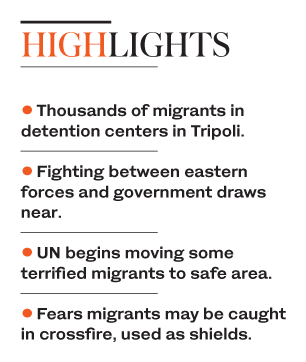
Thousands of African and Syrian migrants and refugees are trapped in Tripoli as a battle for the city draws closer.

The UN wants to move them urgently to safety, but this week only managed to relocate 150 to a protected facility with proper shelter, food and space for children.

So desperate is the situation that one detention center manager said he flung open the doors as fighting drew near.

“They can hear the clashes. And many are really scared,” UNHCR spokesman Babar Baloch said of the migrants.
They are crammed into disused warehouses, hangars and prisons where armed groups with no experience of handling refugees guard them, say witnesses and rights reports.

On the northern edge of Africa with a long Mediterranean coastline, Libya hosts more than 700,000 people who have fled their homelands, often trekking through desert in pursuit of their dream of crossing to a better life in Europe.

About 7,000 of them are in detention centers — mostly in Tripoli — where conditions were awful even before they began hearing gunfire and shelling as eastern forces approached a week ago.

Sleeping shoulder-to-shoulder, sometimes under steel roofs in baking heat and without proper food, water or medical assistance, the detainees wait for a visit by international organizations or the chance of a laboring job, according to visitors, rights groups and UN officials. 

They are seldom allowed out for fresh air, and sometimes given just one meal a day, of pasta or bread, the sources said.

Many of the detainees were captured on arrival through the Sahara, or forcibly returned by patrols stopping their flimsy vessels in the Mediterranean.

‘Terrible deprivations’

Repeatedly warning of their plight, the UN refugee agency UNCHR took more than 150 Somali, Ethiopian, Eritrean and Syrian refugees from the Ain Zara detention center in south Tripoli on Tuesday to its own facility in a nearby “safe zone.”

“Many refugees and migrants in Libya endure terrible deprivations. They are now at grave additional risk,” said Matthew Brook, UNHCR deputy chief of mission in Libya. At Ain Zara, the manager told Reuters he opened the doors on Wednesday to let another 150 terrified migrants into the streets as gunfire drew close. 

Qasr ben Gashir, Gharyan and Abu Salim detention centers are others closest to the front lines, as the LNA forces take southern suburbs of Tripoli.

“I let them go for their safety,” he said.

Qasr ben Gashir, Gharyan and Abu Salim detention centers are others closest to the front lines, as the eastern Libyan National Army (LNA) forces of Khalifa Haftar take southern suburbs of Tripoli.

According to UN figures, there are an estimated 660,000 migrants in Libya, and a further 58,000 classed as refugees or asylum-seekers fleeing home because of violence or persecution.

The UN human rights office has expressed fears the warring parties may use migrants as human shields of forcibly recruit them. It cites unconfirmed reports that some were coerced last year into fighting in Tajoura, just east of Tripoli, which is controlled by pro-militant armed groups.

Haftar’s forces accuse the Tripoli-based government of using migrants and criminals as human shields and fighters — though they have not provided evidence or given details.

“After the end of the battles, we will show this to the world,” spokesman Ahmad Mesmari told Reuters in Benghazi.

Spokespeople for the Tripoli government of Prime Minister Fayez Al-Serraj and its allied forces, which control the detention centers, did not respond to repeated requests by Reuters for comment on the migrants’ situation.

In past meetings with UN officials, however, they have insisted they are providing adequate conditions.

According to one UN report last December, migrants and refugees in Libya suffer a “terrible litany of violations” by a combination of state officials, armed groups and traffickers. “These include unlawful killings, torture, arbitrary detention, gang rape, slavery, forced labor and extortion,” it said.

A study last month by the Women’s Refugee Commission, a US-based charity, said refugees and migrants trying to reach Italy through Libya were victims of horrific sexual violence.

The abuse was commonplace along routes through North Africa: At border crossings and check points, during random stops by armed groups, and when migrants were kidnapped and held for ransom, said the report, titled “More Than One Million Pains.”


Foreign women linked to Daesh group in Syrian camp hope for amnesty after government offensive

Updated 8 sec ago
Follow

Foreign women linked to Daesh group in Syrian camp hope for amnesty after government offensive

  • Many of the women are either wives or widows of Daesh fighters who were defeated in Syria
  • “There were changes in the behavior of children and women. They became more hostile,” the camp’s director said

ROJ CAMP, Syria: Foreign women linked to the Daesh group and living in a Syrian camp housing more than 2,000 people near the border with Iraq are hoping that an amnesty may be on the horizon after a government offensive weakened the Kurdish-led force that guards the camp.
The women spoke to The Associated Press on Thursday in northeast Syria’s Roj camp, where hundreds of mostly women and children linked to Daesh have been held for nearly a decade.
The camp remains under control of the Kurdish-led Syrian Democratic Forces, which until recently controlled much of northeastern Syria. A government offensive this month captured most of the territory the group previously held, including the much larger Al-Hol camp, which is holding nearly 24,000 mostly women and children linked to Daesh.
Many of the women are either wives or widows of Daesh fighters who were defeated in Syria in March 2019, marking the end of what was once a self-declared caliphate in large parts of Iraq and Syria.
The most well-known resident of the Roj camp, Shamima Begum, was 15 when she and two other girls fled from London in 2015 to marry Daesh fighters in Syria. Begum married a Dutch man fighting for Daesh and had three children, who all died.
Last month, Begum lost her appeal against the British government’s decision to revoke her UK citizenship. Begum refused to speak to AP journalists at the camp.
The director of the Roj camp, Hakmiyeh Ibrahim, said that the government’s offensive on northeast Syria has emboldened the camp residents, who now tell guards that soon they will be free and Kurdish guards will be jailed in the camp instead.
“There were changes in the behavior of children and women. They became more hostile,” the camp’s director said. “It gave them hope that the Daesh group is coming back strongly.”
Since former Syrian President Bashar Assad was toppled in a lightning rebel offensive in December 2024, the country’s new army is made up of a patchwork of former insurgent groups, many of them with Islamist ideologies.
The group led by now-interim President Ahmad Al-Sharaa was once linked to Al-Qaeda although Al-Sharaa’s group and Daesh were rivals and fought for years. Since becoming president, Al-Sharaa — formerly known by the nom de guerre Abu Mohammed Al-Golani — has joined the global coalition against Daesh.
Camp residents hope for amnesty
One woman from Tunisia who identified herself only as Buthaina, pointed out that Al-Sharaa was removed from the UN and US lists of terrorists.
“People used to say that Al-Golani was the biggest terrorist. What happened to him later? He became the president of Syria. He is not a terrorist any more,” she said. “The international community gave Al-Golani amnesty. I should be given amnesty too.”
She added, “I did not kill anyone or do anything.”
The camp director said more than 2,300 people are housed in the Roj camp. They include a small number of Syrians and Iraqis, but the vast majority of them — 742 families — come from nearly 50 other countries, the bulk of them from states in the former Soviet Union.
That is in contrast to Al-Hol camp, where most residents are Syrians and Iraqis who can be more easily repatriated. Other countries have largely been unwilling to take back their citizens. Human rights groups have for years cited poor living conditions and pervasive violence in the camps.
The US military has begun moving male Daesh detainees from Syrian prisons to detention centers in Iraq, but there is no clear plan for the repatriation of women and children at the Roj Camp.
“What is happening now is exactly what we have been warning about for years. It is the foreseeable result of international inaction,” said Beatrice Eriksson, the cofounder of the children rights organization Repatriate the Children in Sweden. “The continued existence of these camps is not an unfortunate by-product of conflict, it is a political decision.”
Some women don’t want to go home
Some of the women interviewed by the AP said they want to go back home, while others want to stay in Syria.
“I did not come for tourism. Syria is a Muslim country. Germany is all infidels,” said a German woman who identified herself only as Aysha, saying that she plans to stay.
Another woman, a Belgian who identified herself as Cassandra, said she wants to get out of the camp but would like to stay in the Kurdish-controlled area of Syria.
She said that her French husband was an Daesh fighter killed in the northern city of Raqqa, once considered the de facto capital by Daesh. She said Belgium has only repatriated women who had children, unlike her. She was 18 when she came to Syria, she said.
Cassandra added that when fighting broke out between government forces and Kurdish fighters, she started receiving threats from other camp residents because she had good relations with the Kurdish guards.
Future of the camps in limbo
The government push into northeast Syria led to chaos in some of the more than a dozen detention centers where nearly 9,000 members of Daesh have been held for years.
Syrian government forces are now in control of Al-Aqtan prison near Raqqa as well as the Shaddadeh prison near the border with Iraq, where more than 120 detainees managed to flee amid the chaos before most of them were captured again.
Part of an initial ceasefire agreement between Damascus and the SDF included the Kurdish-led group handing over management of the camps and detention centers to the Syrian government.
Buthaina, the Tunisian citizen, said her husband and her son are held in a prison. She said her husband worked in cleaning and did not fight, while her son fought with the extremists.
She has been in Roj for nine years and saw her other children grow up without proper education or a childhood like other children.
“All we want is freedom. Find a solution for us,” Buthaina said.
She said the Tunisian government never checked on them, but now she hopes that “if Al-Golani takes us there will be a solution.”
She said those accused of crimes should stand trial and others should be set free.
“I am not a terrorist. The mistake I made is that I left my country and came here,” she said. “We were punished for nine years that were more like 90 years.”