

African, Syrian migrants in crosshairs of Libya’s war

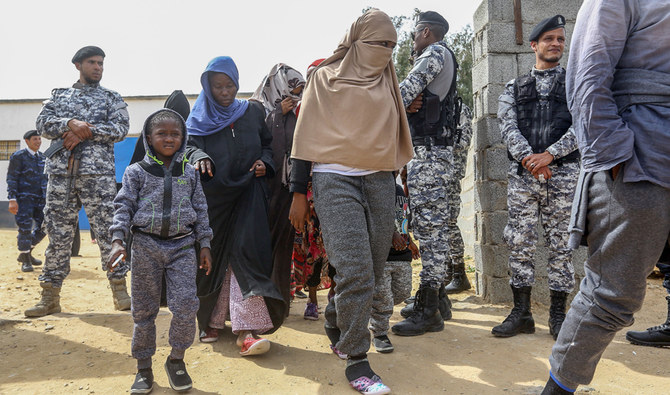
Migrants walk to meet UN chief Antonio Guterres (unseen) during his visit to the Ain Zara detention center for migrants in Tripoli on April 4. (AFP)
Updated 11 April 2019
Follow

African, Syrian migrants in crosshairs of Libya’s war

  • The UN wants to move them urgently to safety

TRIPOLI, GENEVA: They trekked through the Sahara in hope of crossing the Mediterranean to a better life in Europe — but instead ended up in squalid detention centers and are now engulfed by war.

Thousands of African and Syrian migrants and refugees are trapped in Tripoli as a battle for the city draws closer.

The UN wants to move them urgently to safety, but this week only managed to relocate 150 to a protected facility with proper shelter, food and space for children.

So desperate is the situation that one detention center manager said he flung open the doors as fighting drew near.

“They can hear the clashes. And many are really scared,” UNHCR spokesman Babar Baloch said of the migrants.
They are crammed into disused warehouses, hangars and prisons where armed groups with no experience of handling refugees guard them, say witnesses and rights reports.

On the northern edge of Africa with a long Mediterranean coastline, Libya hosts more than 700,000 people who have fled their homelands, often trekking through desert in pursuit of their dream of crossing to a better life in Europe.

About 7,000 of them are in detention centers — mostly in Tripoli — where conditions were awful even before they began hearing gunfire and shelling as eastern forces approached a week ago.

Sleeping shoulder-to-shoulder, sometimes under steel roofs in baking heat and without proper food, water or medical assistance, the detainees wait for a visit by international organizations or the chance of a laboring job, according to visitors, rights groups and UN officials. 

They are seldom allowed out for fresh air, and sometimes given just one meal a day, of pasta or bread, the sources said.

Many of the detainees were captured on arrival through the Sahara, or forcibly returned by patrols stopping their flimsy vessels in the Mediterranean.

‘Terrible deprivations’

Repeatedly warning of their plight, the UN refugee agency UNCHR took more than 150 Somali, Ethiopian, Eritrean and Syrian refugees from the Ain Zara detention center in south Tripoli on Tuesday to its own facility in a nearby “safe zone.”

“Many refugees and migrants in Libya endure terrible deprivations. They are now at grave additional risk,” said Matthew Brook, UNHCR deputy chief of mission in Libya. At Ain Zara, the manager told Reuters he opened the doors on Wednesday to let another 150 terrified migrants into the streets as gunfire drew close. 

Qasr ben Gashir, Gharyan and Abu Salim detention centers are others closest to the front lines, as the LNA forces take southern suburbs of Tripoli.

“I let them go for their safety,” he said.

Qasr ben Gashir, Gharyan and Abu Salim detention centers are others closest to the front lines, as the eastern Libyan National Army (LNA) forces of Khalifa Haftar take southern suburbs of Tripoli.

According to UN figures, there are an estimated 660,000 migrants in Libya, and a further 58,000 classed as refugees or asylum-seekers fleeing home because of violence or persecution.

The UN human rights office has expressed fears the warring parties may use migrants as human shields of forcibly recruit them. It cites unconfirmed reports that some were coerced last year into fighting in Tajoura, just east of Tripoli, which is controlled by pro-militant armed groups.

Haftar’s forces accuse the Tripoli-based government of using migrants and criminals as human shields and fighters — though they have not provided evidence or given details.

“After the end of the battles, we will show this to the world,” spokesman Ahmad Mesmari told Reuters in Benghazi.

Spokespeople for the Tripoli government of Prime Minister Fayez Al-Serraj and its allied forces, which control the detention centers, did not respond to repeated requests by Reuters for comment on the migrants’ situation.

In past meetings with UN officials, however, they have insisted they are providing adequate conditions.

According to one UN report last December, migrants and refugees in Libya suffer a “terrible litany of violations” by a combination of state officials, armed groups and traffickers. “These include unlawful killings, torture, arbitrary detention, gang rape, slavery, forced labor and extortion,” it said.

A study last month by the Women’s Refugee Commission, a US-based charity, said refugees and migrants trying to reach Italy through Libya were victims of horrific sexual violence.

The abuse was commonplace along routes through North Africa: At border crossings and check points, during random stops by armed groups, and when migrants were kidnapped and held for ransom, said the report, titled “More Than One Million Pains.”


Syrian military tells civilians to evacuate contested area east of Aleppo amid rising tensions

Updated 15 January 2026
Follow

Syrian military tells civilians to evacuate contested area east of Aleppo amid rising tensions

  • Syria’s military has announced it will open a “humanitarian corridor” for civilians to evacuate from an area in Aleppo province
  • This follows several days of intense clashes between government forces and the Kurdish-led Syrian Democratic Forces

DAMASCUS: Syria’s military said it would open a corridor Thursday for civilians to evacuate an area of Aleppo province that has seen a military buildup following intense clashes between government and Kurdish-led forces in Aleppo city.
The army’s announcement late Wednesday — which said civilians would be able to evacuate through the “humanitarian corridor” from 9 a.m. to 5 p.m. Thursday — appeared to signal plans for an offensive in the towns of Deir Hafer and Maskana and surrounding areas, about 60 kilometers (40 miles) east of Aleppo city.
The military called on the Kurdish-led Syrian Democratic Forces and other armed groups to withdraw to the other side of the the Euphrates River, to the east of the contested zone.
Syrian government troops have already sent troop reinforcements to the area after accusing the SDF of building up its own forces there, which the SDF denied. There have been limited exchanges of fire between the two sides, and the SDF has said that Turkish drones carried out strikes there.
The government has accused the SDF of launching drone strikes in Aleppo city, including one that hit the Aleppo governorate building on Saturday shortly after two Cabinet ministers and a local official held a news conference there.
The tensions in the Deir Hafer area come after several days of intense clashes last week in Aleppo city that ended with the evacuation of Kurdish fighters and government forces taking control of three contested neighborhoods. The fighting killed at least 23 people, wounded dozens more, and displaced tens of thousands.
The fighting broke out as negotiations have stalled between Damascus and the SDF, which controls large swaths of northeast Syria, over an agreement to integrate their forces and for the central government to take control of institutions including border crossings and oil fields in the northeast.
Some of the factions that make up the new Syrian army, which was formed after the fall of former President Bashar Assad in a rebel offensive in December 2024, were previously Turkiye-backed insurgent groups that have a long history of clashing with Kurdish forces.
The SDF for years has been the main US partner in Syria in fighting against the Daesh group, but Turkiye considers the SDF a terrorist organization because of its association with the Kurdistan Workers’ Party, or PKK, which has waged a long-running insurgency in Turkiye. A peace process is now underway.
Despite the long-running US support for the SDF, the Trump administration has also developed close ties with the government of interim Syrian President Ahmad Al-Sharaa and has pushed the Kurds to implement the integration deal. Washington has so far avoided publicly taking sides in the clashes in Aleppo.
The SDF in a statement warned of “dangerous repercussions on civilians, infrastructure, and vital facilities” in case of a further escalation and said Damascus bears “full responsibility for this escalation and all ensuing humanitarian and security repercussions in the region.”
Adm. Brad Cooper, commander of US Central Command, said in a statement Tuesday that the US is “closely monitoring” the situation and called for “all parties to exercise maximum restraint, avoid actions that could further escalate tensions, and prioritize the protection of civilians and critical infrastructure.” He called on the parties to “return to the negotiating table in good faith.”
Al-Sharaa blasts the SDF
In a televised interview aired Wednesday, Al-Sharaa praised the “courage of the Kurds” and said he would guarantee their rights and wants them to be part of the Syrian army, but he lashed out at the SDF.
He accused the group of not abiding by an agreement reached last year under which their forces were supposed to withdraw from neighborhoods they controlled in Aleppo city and of forcibly preventing civilians from leaving when the army opened a corridor for them to evacuate amid the recent clashes.
Al-Sharaa claimed that the SDF refused attempts by France and the US to mediate a ceasefire and withdrawal of Kurdish forces during the clashes due to an order from the PKK.
The interview was initially intended to air Tuesday on Shams TV, a broadcaster based in Irbil — the seat of northern Iraq’s semi-autonomous Kurdish region — but was canceled for what the station initially said were technical reasons.
Later the station’s manager said that the interview had been spiked out of fear of further inflaming tensions because of the hard line Al-Sharaa took against the SDF.
Syria’s state TV station instead aired clips from the interview on Wednesday. There was no immediate response from the SDF to Al-Sharaa’s comments.