

What the Gulf’s Indians want from their election at home

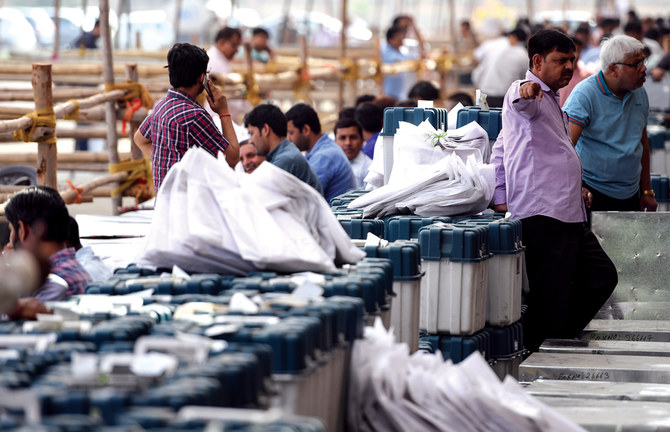
Indian officials prepare election-related material at a distribution centre in Noida in India’s northern state of Uttar Pradesh on Wednesday. (AFP)
Updated 11 April 2019
Follow

What the Gulf’s Indians want from their election at home

  • The election in the world’s largest democracy will begin on April 11, with voting at one million polling stations across India
  • Those who remain in the Gulf region will not be able to vote, but that doesn’t stop them from having opinions about it

DUBAI: For the first time this year, Mukesh Kalvaniya will not be able to vote in India’s general election, which starts on Wednesday. That’s because he moved to the UAE from his hometown in Rajasthan three years ago, joining millions of Indians in the Gulf who cannot cast a ballot outside of their country.

“I am feeling frustrated that my vote would be wasted,” said the 43-year-old mason, who is working on a private construction project in Dubai. “My country is going to have one of the most crucial elections of recent history. I want the right person (to) be elected from my hometown. If I want the right people to rule my country, then I should also vote.”

The election in the world’s largest democracy will begin on April 11, with voting at one million polling stations across India. About 900 million people, almost triple the entire population of the US, are eligible to vote, including as many as 84.3 million youths for the first time.

However, there is no system for about 8.5 million Indians, the largest non-resident Indian (NRI) population in the world, to vote online or designate a proxy vote, as there is for many expats from other countries who work in the Gulf Cooperation Council (GCC).

“We have been reduced to becoming passive watchers. We have no choice but to bear the consequences of the decisions others make,” said Kalvaniya. 

Shankar Ram, a 20-year-old mechanic in Riyadh, is also regretting that he won’t be able to cast his first vote. “I just turned 20 last month. I wanted to go home and cast a vote. But I won’t get holidays in my probation period,” said Ram, who joined his new job three months ago. 

Ram said that he hears a lot of Indians in Riyadh complaining about their country and its system. “If you have a problem, then find a solution. Criticism won’t give you the solution. As an Indian, this is our responsibility to make our country a better place whether we live there or work outside.” 

Like many other overseas Indians, Ram said that he was expecting the government to arrange a way for them to vote, but it didn’t happen. “My vote is important for my country,” he said. “I hope my government also realizes that soon.”


However, many Indians will vote while they are visiting their homes during the election. “I will be in India on vacation when my city goes to the polls,” said Umaid Khan, a cyber-security professional in Dubai. “Instead of getting carried away by the frenzy created by politicians and the media, I will cast my vote based on the qualifications and background of the candidate.”

Khan, who has been based in Dubai for 16 years, believes that the election in India will decide the country’s future. He said that in recent years there has been a disturbing spike in hate crimes in India because of religious extremism. “I want my government to take severe action against intolerance irrespective of the community they belong to,” he said.

Khan said that it was shameful that India has the world’s highest number of malnourished children, despite being one of the world’s largest economies. “Issues such as education, health care, infrastructure, corruption, pollution, ease of doing business, safety and security etc. get submerged when political parties build the narrative based on religions, castes and regional biases.”

According to Surender Singh Kandhari, chairman of Al-Dobowi Group and head of Sikh Gurudwara in Dubai, millions of Indians living in the Gulf want a “clean government” that can address real issues on the ground. “Most non-resident Indians (NRIs) living in the Gulf closely follow what is happening in India. They follow every single action and step taken by the politicians,” he said.

“We need to uplift the weaker sections of the society. We need the per-capita income to go up so that all Indians become prosperous. Each one of them should have shelter, food and good health.”
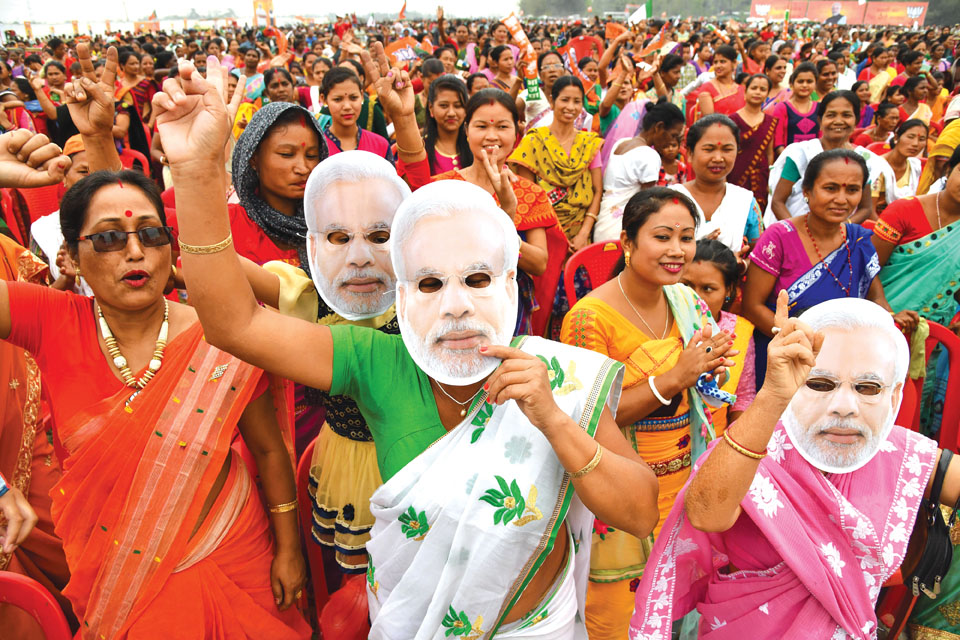


Bharatiya Janata Party (BJP) voters in the lead-up to the election. (AFP)

Kandhari described the present electoral landscape in India as very messy. “The ruling party and the opposition are by hook and crook trying to woo the voters just to be in power. None of them mean anything they say,” he said.

If Kandhari is to be believed, NRIs in the Gulf are not pleased with the situation back home, especially with the country’s politicians. “All of them have skeletons in their cupboards. They really do not mean to do good for the country. The motive itself is very selfish,” he said.

Rizwan Sajan, founder and chairman of the Dubai-based Danube Group, is more hopeful. He said that elections in India are a celebration of the world’s largest democracy. 

According to Sajan, most NRIs are long-term investors, and their investment goals and objectives are directed toward creating a future for their children through education and retirement planning. “Hence, such schemes will definitely boost investment by us in the economy of India,” he said, adding that the government should focus more on the rural economy to provide people outside cities with a better future.

Entrepreneur Rehan Khan, who is based in Dubai, said voters must act smartly to send a message to politicians. “Most politicians come from the most uneducated backgrounds, and they take the public for granted,” he said. “Unfortunately, the whole atmosphere this time is so polarized that people are looking at issues only through the prism of religion.” 

He said politicians should focus less on religion and talk only about development. “Only then the country can move ahead. We may be one of the biggest democracies for sure, but we are not the most mature yet.”


Judge bars federal prosecutors from seeking the death penalty against Luigi Mangione

Updated 3 sec ago
Follow

Judge bars federal prosecutors from seeking the death penalty against Luigi Mangione

  • Judge Margaret Garnett’s Friday ruling foiled the Trump administration’s bid to see Mangione executed
  • Garnett dismissed a federal murder charge against Mangione, finding it technically flawed. She left in place stalking charges that could carry a life sentence
NEW YORK: Federal prosecutors can’t seek the death penalty against Luigi Mangione in the killing of UnitedHealthcare CEO Brian Thompson, a federal judge ruled Friday, foiling the Trump administration’s bid to see him executed for what it called a “premeditated, cold-blooded assassination that shocked America.”
Judge Margaret Garnett dismissed a federal murder charge that had enabled prosecutors to seek capital punishment, finding it technically flawed. She wrote that she did so to “foreclose the death penalty as an available punishment to be considered by the jury” as it weighs whether to convict Mangione.
Garnett also dismissed a gun charge but left in place stalking charges that carry a maximum punishment of life in prison. To seek the death penalty, prosecutors needed to show that Mangione killed Thompson while committing another “crime of violence.” Stalking doesn’t fit that definition, Garnett wrote in her opinion, citing case law and legal precedents.
In a win for prosecutors, Garnett ruled they can use evidence collected from his backpack during his arrest, including a 9mm handgun and a notebook in which authorities say Mangione described his intent to “wack” an insurance executive. Mangione’s lawyers had sought to exclude those items, arguing the search was illegal because police hadn’t yet obtained a warrant.
During a hearing Friday, Garnett gave prosecutors 30 days to update her on whether they’ll appeal her death penalty decision. A spokesperson for the US attorney’s office in Manhattan, which is prosecuting the federal case, declined to comment.
Garnett acknowledged that the decision “may strike the average person — and indeed many lawyers and judges — as tortured and strange, and the result may seem contrary to our intuitions about the criminal law.” But, she said, it reflected her “committed effort to faithfully apply the dictates of the Supreme Court to the charges in this case. The law must be the Court’s only concern.”
Mangione, 27, appeared relaxed as he sat with his lawyers during the scheduled hearing, which took place about an hour after Garnett issued her written ruling. Prosecutors retained their right to appeal but said they were ready to proceed to trial.
Outside court afterward, Mangione attorney Karen Friedman Agnifilo said her client and his defense team were relieved by the “incredible decision.”
Jury selection in the federal case is set for Sept. 8, followed by opening statements and testimony on Oct. 13. The state trial’s date hasn’t been set. On Wednesday, the Manhattan district attorney’s office urged the judge in that case to schedule a July 1 trial date.
“That case is none of my concern,” Garnett said, adding that she would proceed as if the federal case is the only case unless she hears formally from parties involved in the state case. She also said the federal case will be paused if the government appeals her death penalty ruling.
Thompson, 50, was killed on Dec. 4, 2024, as he walked to a midtown Manhattan hotel for UnitedHealth Group’s annual investor conference. Surveillance video showed a masked gunman shooting him from behind. Police say “delay,” “deny” and “depose” were written on the ammunition, mimicking a phrase used by critics to describe how insurers avoid paying claims.
Mangione, an Ivy League graduate from a wealthy Maryland family, was arrested five days later at a McDonald’s in Altoona, Pennsylvania, about 230 miles (about 370 kilometers) west of Manhattan.
Following through on Trump’s campaign promise to vigorously pursue capital punishment, Attorney General Pam Bondi ordered Manhattan federal prosecutors last April to seek the death penalty against Mangione.
It was the first time the Justice Department sought the death penalty in President Donald Trump’s second term. He returned to office a year ago with a vow to resume federal executions after they were halted under his predecessor, President Joe Biden.
Garnett, a Biden appointee and former Manhattan federal prosecutor, ruled after hearing oral arguments earlier this month.
Besides seeking to have the death penalty rejected on the grounds Garnett cited, Mangione’s lawyers argued that Bondi’s announcement flouted long-established Justice Department protocols and was “based on politics, not merit.”
They said her remarks, followed by posts to her Instagram account and a TV appearance, “indelibly prejudiced” the grand jury process resulting in his indictment weeks later.
Prosecutors urged Garnett to keep the death penalty on the table, arguing that the charges were legally sound and Bondi’s remarks weren’t prejudicial, as “pretrial publicity, even when intense, is not itself a constitutional defect.”
Prosecutors argued that careful questioning of prospective jurors would alleviate the defense’s concerns about their knowledge of the case and ensure Mangione’s rights are respected at trial.
“What the defendant recasts as a constitutional crisis is merely a repackaging of arguments” rejected in previous cases, prosecutors said. “None warrants dismissal of the indictment or categorical preclusion of a congressionally authorized punishment.”