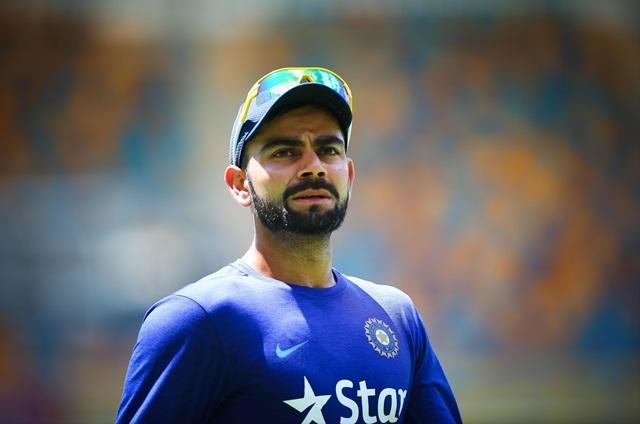
Virat Kohli named among Wisden's Cricketers of the Year

Virat Kohli, who is top of the Test and one-day international rankings, scored 2,735 runs in all formats in 2018. (AFP/Getty Images)
Updated 10 April 2019
Follow

Virat Kohli named among Wisden's Cricketers of the Year

  • India captain put to bed questions over his ability to thrive in English conditions last year
  • Other cricketers of the year were England's Sam Curran, Jos Buttler and Rory Burns

LONDON: Virat Kohli was Wednesday named as one of Wisden's Five Cricketers of the Year and also became the first player to win the award for leading cricketer in the world in three successive years.
The India captain put to bed questions over his ability to thrive in English conditions last year, topping the Test run charts with 593 runs and two centuries even though his side lost the series 4-1.
Kohli, who is top of the Test and one-day international rankings, scored 2,735 runs in all formats in 2018, outstripping nearest rival, England's Joe Root, by more than 700 runs.
"His struggles in English conditions were consigned to history, and Kohli banished any doubt about being regarded as the outstanding player of the era," Wisden said in a statement announcing its awards.
The other cricketers of the year were England's Sam Curran, Jos Buttler and Rory Burns, plus prolific England women's player Tammy Beaumont.
Players can only receive Wisden's cricketer of the year award, given primarily for feats achieved during the preceding English domestic season, once in their career.
Kohli was also named as the leading men's player in the world for a third straight year.
"In making hundreds in South Africa, England and Australia, as well as at home, he showed a mastery of all conditions and bowling attacks," Wisden said. "The pressure never cowed him."
India's Smriti Mandhana scooped the women's award, with Afghanistan leg-spinner Rashid Khan retaining his title as leading Twenty20 cricketer in the world.
The latest edition of Wisden Cricketers' Almanack, considered the "Bible" of the game, is published on April 11.


Australia’s Green becomes IPL’s most expensive overseas player

Updated 16 December 2025
Follow

Australia’s Green becomes IPL’s most expensive overseas player

  • Kolkata Knight Riders sign Cameron Green for $2.77 million at player auction for 2026 season
  • Aussie cricketer is set to play in the third Ashes test against England starting on Wednesday

Australia all-rounder Cameron Green became the most expensive overseas player in the Indian Premier League (IPL), after Kolkata Knight Riders signed him for 252 million Indian rupees ($2.77 million) at the player auction for the 2026 season in Abu Dhabi on Tuesday.

Green, who was initially registered as a batsman due to an error, was the subject of intense bidding between Kolkata and Chennai Super Kings before being purchased by the three-times champions.

The 26-year-old is the third most expensive player in IPL history, after India’s Rishabh Pant (270 million Indian rupees) and Shreyas Iyer (267.5 million). “We are very happy. This is something that we were really focused on... I think he adds a lot to our team,” Kolkata CEO Venky Mysore said.

Australian Mitchell Starc, the previous most expensive foreign player in the competition, attracted a bid of 247.5 million Indian rupees in 2024 from Kolkata, who have made three of the five most expensive buys in IPL history.

Green, who missed the IPL this year as he was recovering from back surgery, is set to play in the third Ashes test against England starting on Wednesday.

Kolkata also spent big on Sri Lankan seamer Matheesha Pathirana and Bangladesh’s Mustafizur Rahman.

Five-time champions Chennai splurged 142 million Indian rupees each on wicketkeeper-batter Kartik Sharma, who has hit 16 sixes in this season’s Ranji Trophy, and all-rounder Prashant Veer, making them the most expensive uncapped signings in IPL history.

Delhi Capitals bought England batter Ben Duckett and South Africa’s David Miller for 20 million Indian rupees each.

The 19th edition of the IPL begins on March 26, after India co-hosts the Twenty20 World Cup starting in February.