

70,000 ordered to flee their homes in Iran flood disaster

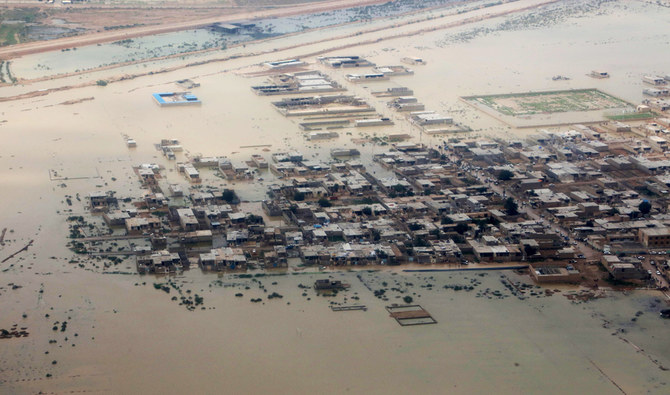
The disaster has left aid agencies struggling to cope. (AFP)
Updated 10 April 2019
Follow

70,000 ordered to flee their homes in Iran flood disaster

  • The governor said the disaster was unprecedented
  • Nearly 80 people have died in the past three weeks in floods described as the worst since the 1940s

JEDDAH: Iranian authorities ordered nearly 70,000 people to flee their homes on Wednesday as floodwater poured into the city of Ahvaz, capital of Khuzestan province.

Provincial governor Gholamreza Shariati pleaded for young men to volunteer to “help us in building dykes and to assist in the evacuation of women, children and the elderly.”

The governor said the disaster was unprecedented. “The Dez and Karkheh rivers have for the first time joined each other near Ahvaz and are now flowing toward the city,” he said.

“These two rivers are far away from each other, but the huge volume of floodwater caused them to join up.”

Nearly 80 people have died in the past three weeks in floods described as the worst since the 1940s, devastating about 1,900 cities and villages in 20 of Iran’s 31 provinces.

The northeast was first swamped on March 19 before the west and southwest were hit on March 25. On April 1, the west and southwest were again swamped by floods when heavy rain returned.

The huge inflow of water forced authorities to release large volumes of water from Khuzestan province’s largest dams, which is now threatening some of the cities downstream, including the Ahvaz region, where 1.3 million people live.

The disaster has left aid agencies struggling to cope, and the armed forces have been deployed to help victims. Emergency services have been left scrambling to prevent further loss of life and to provide relief to flood-stricken residents.

“Delivering food and hygienic goods to camps is our primary priority and we have provided emergency accommodation for about 44,000 people,” said Morteza Salimi, the Iran Red Crescent’s head of Relief and Rescue.

In the city of Susangerd, swamped by floodwater, people are living in tents on the roofs of their homes as what had previously been roads were turned into canals.

Red Crescent helicopters were providing food and basic goods to regions cut off by floods, with villagers rushing to receive the help as they approached.

Iran’s leaders have been widely criticized for their response to the flooding and the loss of life. “Clearly the regime was caught unaware and unprepared for the disaster,” said Borzou Daragahi, of the Atlantic Council’s Middle East Security Initiative.

“Mostly bigwigs showed up at the flood zone for infuriating photo ops, in what will likely be remembered throughout Iran as the country’s Hurricane Katrina moment.”


UN force in Lebanon says peacekeeper wounded by Israeli fire

Updated 27 December 2025
Follow

UN force in Lebanon says peacekeeper wounded by Israeli fire

  • UNIFIL reiterated its call to the Israeli army to “cease aggressive behavior and attacks on or near peacekeepers working for peace and stability along the Blue Line”

BEIRUT, Lebanon: The United Nations Interim Force in Lebanon said an Israeli attack near their position in the country’s south wounded a peacekeeper on Friday, reiterating a call for Israel to “cease aggressive behavior.”
It is the latest incident reported by the peacekeepers in southern Lebanon, where UNIFIL acts as a buffer between Israel and Lebanon and has been working with Lebanon’s army to support a year-old truce between Israel and militant group Hezbollah.
“This morning, heavy machine gunfire from Israel Defense Forces (IDF) positions south of the Blue Line impacted close to a UNIFIL patrol inspecting a roadblock in the village of Bastarra. The gunfire followed a grenade explosion nearby,” UNIFIL said in a statement.
The force added that “the sound of the gunfire and the explosion left one peacekeeper slightly injured with ear concussion.”
Also on Friday, UNIFIL said “another patrol carrying out a routine operational task also reported machine gunfire from the Israeli side in immediate proximity to their position” in Kfarshuba, south Lebanon.
The peacekeeping force said it had informed the Israel army of its activities in these areas.
Earlier this month, UNIFIL said Israeli forces fired on its peacekeepers in southern Lebanon.
Last month it said Israeli soldiers shot at its troops in the south, while Israel’s military said it mistook blue helmets for “suspects” and fired warning shots.
In October, UNIFIL said one of its members was wounded by an Israeli grenade dropped near a UN position in the country’s south, the third incident of its kind in just over a month.
“Attacks on or near peacekeepers are serious violations of Security Council resolution 1701,” the peacekeeping force added, referring to the 2006 resolution that formed the basis of the November 2024 truce.
UNIFIL reiterated its call to the Israeli army to “cease aggressive behavior and attacks on or near peacekeepers working for peace and stability along the Blue Line.”
Israel carries out regular attacks on Lebanon despite the truce, usually saying it is targeting sites and operatives belonging to Hezbollah, which it accuses of rearming.
It has also kept troops in five south Lebanon areas it deems strategic.