Pakistan summons Indian envoy, warns against ‘misadventure’

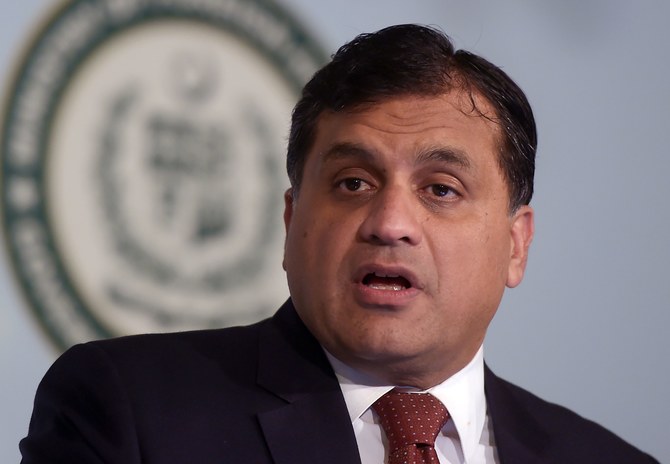
Pakistan's Foreign Ministry spokesman Mohammad Faisal speaks to the media at the Foreign office in Islamabad on March 28, 2019. Pakistan on March 28 said it had found no links between militants swept up in a recent dragnet and a suicide attack in Indian-administered Kashmir last month that brought the nuclear-armed rivals to the brink of war. (AFP)
Updated 08 April 2019
Follow

Pakistan summons Indian envoy, warns against ‘misadventure’

  • Says it has “reliable intelligence” India is planning an attack
  • Shares its concern with UNSC members

ISLAMABAD: India’s deputy high commissioner was summoned to the foreign office on Sunday in protest against what Pakistan claimed was “reliable intelligence” that New Delhi was planning yet another attack against it within the next few days.
“Indian deputy high commissioner was summoned for demarche in line with Foreign Minister’s briefing of today and warned against any misadventure,” foreign office spokesperson Dr. Muhammad Faisal said in his tweet later during the day.
Foreign Minister Shah Mehmood Qureshi had earlier said that India could launch an attack between April 16 and 20, adding that Pakistan had shared the information with the five permanent members of the United Nations Security Council.


Pakistan and India found themselves on the brink of war in February this year after a suicide bomber killed 40 paramilitary troops in Indian-administered Kashmir. A Pakistan-based militant group, Jaish-e-Muhammed, claimed responsibility of the attack, making India launch an airstrike against Pakistan.
As tensions soared between the two nuclear-armed neighbors, Pakistan shot down an Indian fighter jet and captured its pilot who was later returned to his country.
The two sides, however, remained reluctant to say that the danger of war was over.
Prime Minister Imran Khan recently accused India of whipping up “war hysteria,” and many Pakistani officials had previously proclaimed that the administration in New Delhi was putting regional peace and stability in jeopardy to win the forthcoming elections.


World Bank president in Pakistan to discuss development projects, policy issues

Updated 01 February 2026
Follow

World Bank president in Pakistan to discuss development projects, policy issues

  • Pakistan, World Bank are currently gearing up to implement a 10-year partnership framework to grant $20 billion loans to the cash-strapped nation
  • World Bank President Ajay Banga will hold meetings with Pakistan Prime Minister Shehbaz Sharif and other senior officials during the high-level visit

ISLAMABAD: World Bank President Ajay Banga has arrived in Pakistan to hold talks with senior government officials on development projects and key policy issues, Pakistani state media reported on Sunday, as Islamabad seeks multilateral support to stabilize economy and accelerate growth.

The visit comes at a time when Pakistan and the World Bank are gearing up to implement a 10-year Country Partnership Framework (CPF) to grant $20 billion in loans to the cash-strapped nation.

The World Bank’s lending for Pakistan, due to start this year, will focus on education quality, child stunting, climate resilience, energy efficiency, inclusive development and private investment.

"World Bank President Ajay Banga arrives in Pakistan for a high-level visit," the state-run Pakistan TV Digital reported on Sunday. "During his stay, he will meet Prime Minister Shehbaz Sharif and other senior officials to discuss economic reforms, development projects, and key policy issues."

Pakistan, which nearly defaulted on its foreign debt obligations in 2023, is currently making efforts to stabilize its economy under a $7 billion International Monetary Fund (IMF) program.

Besides efforts to boost trade and foreign investment, Islamabad has been seeking support from multilateral financial institutions to ensure economic recovery.

“This partnership fosters a unified and focused vision for your county around six outcomes with clear, tangible and ambitious 10-year targets,” Martin Raiser, the World Bank vice president for South Asia, had said at the launch of the CPF in Jan. last year.

“We hope that the CPF will serve as an anchor for this engagement to keep us on the right track. Partnerships will equally be critical. More resources will be needed to have the impact at the scale that we wish to achieve and this will require close collaboration with all the development partners.”

In Dec., the World Bank said it had approved $700 million in ​financing for Pakistan under a multi-year initiative aimed at supporting the country's macroeconomic stability and service delivery.

It ‍followed a $47.9 ‍million World Bank grant ‍in August last year to improve primary education in Pakistan's most populous Punjab province.