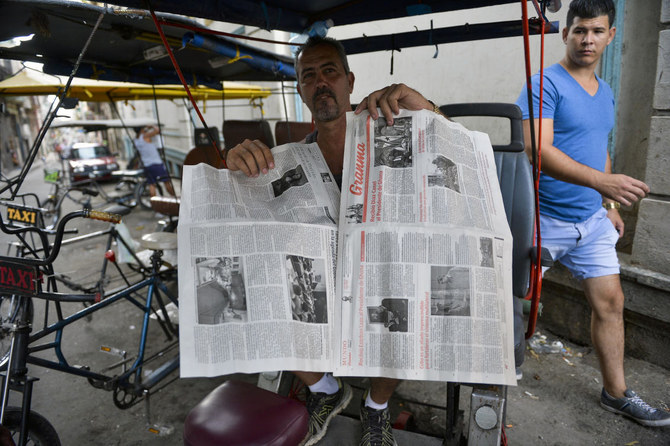
HAVANA: The newsprint shortages which forced Cuba’s Communist daily to run a trimmed-down edition on Friday would pass off as a simple supply glitch in most other countries, but in Havana they carry chilling memories of the not-so-distant past.
The last time the government cut back on newspapers because of a lack of newsprint was in the early 1990s, when Fidel Castro ushered in a “Special Period” of drastic belt-tightening in the wake of the collapse of his main sponsor, the Soviet Union.
Today, the Caribbean state is facing difficulties once again, with US President Donald Trump — who has lashed out at Cuba for its support of Venezuela’s socialist regime — determined to tighten Washington’s six-decade trade embargo.
Meager growth of 1.2 percent is not enough to cover the needs of an island nation that imports 80 percent of what it eats.
Amid shortages, the government is being forced to ration basics like flour, cooking oil and chicken, leading to long lines outside stores.
Tania, a 49-year-old nurse, has come to buy rice at a Havana grocery store but she’s going away empty-handed.
“It’s like that with everything. Sometimes you look for a product and you can find it in one place, then you go somewhere else and you can’t get it,” she said, summing up the average Cuban’s daily struggle to fill their shopping basket.
“What’s happening now doesn’t look like the Special Period, because at that time it was really a disaster,” she said.
Suddenly deprived of its big brother in Moscow — responsible for 85 percent of Havana’s foreign trade — the economy on the Caribbean archipelago ground to a standstill as it struggled to absorb the shock of Soviet collapse in the early 1990s.
Cubans suffered shortages of food and fuel and the emergence of diseases linked to malnutrition. Thousands fled, if they could.
For long since, the country has relied on medical and teaching services supplied to countries like Brazil and, in particular, Venezuela, in return for cheap oil imports. But trade with Caracas has plummeted as sanctions-struck Venezuela’s economic crisis deepens.
Tourism has been a bright spot but that has suffered after hurricane damage and a new US sanctions squeeze.
“For three years, Cuba has been trying to offset the impact of the slump in trade with Venezuela and the rise in tourism, private activity and foreign investment projects have helped cushion the economic shock,” said Pavel Vidal, a Cuban economist at the Javeriana University in Colombia.
“But the measures and threats of the Trump administration are posing obstacles to these three factors that have helped keep the economy afloat.”
Cuba recently defaulted on a portion of its debt to Brazil, a big supplier of poultry.
At the end of 2018, Havana had accumulated short-term debt of $1.5 billion, according to former economy minister Jose Luis Rodriguez.
“There is a level of debt that we will not be able to pay (in 2019) and that’s affecting the smooth running of the economy,” the current portfolio-holder Alejandro Gil said.
In Havana, 90-year-old Leandro Lopez has seen it all before and isn’t overly concerned, expressing confidence in President Miguel Diaz-Canel — elected in 2018, the first of a new breed of leaders born after the revolution.
“Diaz-Canel is trying to strengthen the economy so where he can reduce costs, we reduce them, so much the better. I do not think it will hurt the news.”
The cuts, announced on Thursday, saw Friday’s edition of the mouthpiece Granma daily slashed from 16 pages to a pamphlet-thin eight.
The measure will mean drastically shortened editions twice a week and also affect other publications.
“Yes, there are shortages, long lines, especially for chicken, soap, these kinds of things,” said Nelson Flores, turning away from a long line of shoppers waiting to buy poultry.
So far, the crisis has spared the sacrosanct “libreta” — the ration book which entitles Cubans to buy basics like rice, beans and bread at subsidized prices, though in insufficient quantities to last a month.
Worryingly, the tourist industry is beginning to feel the pinch. A hotel manager in one of the outlying island beach paradises said that tourists on all-inclusive holiday packages were unhappy about a lack of eggs, fruit and bread.


![]()

Cuba newsprint shortage sounds alarm for economy
Cuba newsprint shortage sounds alarm for economy
- The last time the government cut back on newspapers because of a lack of newsprint was in the early 1990s
- Cuba is facing difficulties once again, with President Donald determined to tighten US’s six-decade trade embargo


Latest updates


© 2026 SAUDI RESEARCH & PUBLISHING COMPANY, All Rights Reserved And subject to Terms of Use Agreement.