

Court blocks Pakistan's anti-graft agency from arresting Shehbaz Sharif’s son

1 / 2
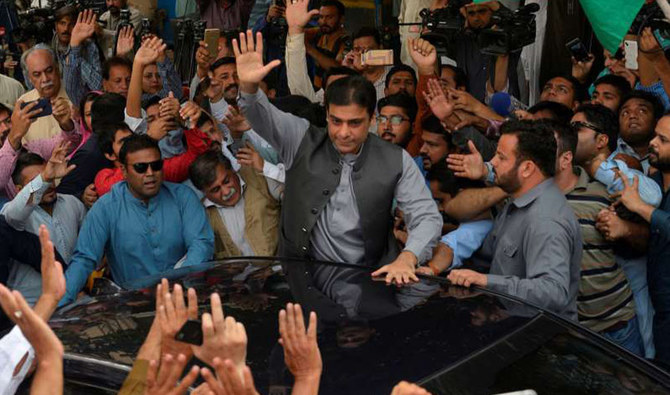
Hamza Shahbaz waves to supporters during the case hearing of his father and opposition leader Shahbaz Sharif in the corruption court in Lahore on Oct. 6, 2018. (AFP/File)
2 / 2
In this file photo Hamza Shahbaz sharif entreating the accountability court in Lahore. The chief justice of the Lahore High Court on Saturday barred Pakistan’s national anti-graft body from taking into custody Hamza Shehbaz after it raided his home for a second day in a row to arrest him in two cases related to money laundering and possession of assets beyond means. (Dunya TV/File)
Updated 30 May 2019
Follow

Court blocks Pakistan's anti-graft agency from arresting Shehbaz Sharif’s son

  • National Accountability Bureau raided house of opposition leader for a second day in a row to arrest son Hamza Shehbaz
  • Lahore High Court grants Shehbaz protective bail until Monday in money laundering and possession of assets beyond means cases

ISLAMABAD: The chief justice of the Lahore High Court on Saturday barred Pakistan’s national anti-graft body from taking into custody Hamza Shehbaz after it raided his home for a second day in a row to arrest him in two cases related to money laundering and possession of assets beyond means.

The NAB team reached 96- H Model Town, an ancestral home of the Sharif family, at 11am on Saturday but as of 330pm, they had failed to enter the house and arrest Shehbaz, blocked by guards and political loyalists. 

Chaudhry Asghar, a National Accountability Bureau (NAB) deputy director leading the raiding team, told reporters the body planned to arrest Shehbaz “without fail today,” but a little after 4pm, Shehbaz’s lawyer, who had petitioned the Lahore High Court, received notice of protective bail until Monday. 

NAB officials had carried out a first raid on the house on Friday but failed to arrest Shehbaz as private guards and loyalists present at the scene scuffled with them.

The bureau said it had arrest warrants for Shehbaz, who is a legislator in the Punjab provincial assembly, and the Supreme Court had made it clear that the anti-graft body did not need to inform suspects prior to their arrests.

Malik Muhammad Ahmed, the spokesman for the Pakistan Muslim League-Nawaz party of which Shehbaz Sharif is the president, said the NAB inspectors did not have arrest warrants.

Speaking to media after the unsuccessful raid, Hamza Shehbaz also reiterated that NAB officials came without warrants and had violated the sanctity of his home.

“I have a court order saying that I will be informed 10 days prior to arrest,” he said. “For the first time, I felt like we are terrorists, the way the raid was conducted,” he added, saying he had always cooperated with NAB authorities and appeared before the body whenever was summoned.

“What was the need for this step?” Shehbaz said. “I am not afraid of arrest but NAB used unlawful tactics because the government asked it to.”

Shahbaz Gill, a spokesman for the Punjab government, said NAB was an autonomous institution and did not require the government’s permission to carry out any action.

NAB has now summoned Sharif and his two sons, Hamza Shehbaz and Salman Shehbaz, to file their replies in the money laundering and possession of assets beyond means cases on April 9.

Shehbaz Sharif was arrested last October in a longstanding corruption case nine days before crucial by-elections were due to be held. His brother, ousted Prime Minister Nawaz Sharif, was sentenced last year to 10 years in prison by a NAB court after the Supreme Court removed him from power.

Nawaz Sharif has denounced corruption cases against him and his party’s leaders as politically motivated, and both brothers deny any wrongdoing.


Islamabad hits back after Indian minister blames Pakistan army for ‘ideological hostility’

Updated 10 sec ago
Follow

Islamabad hits back after Indian minister blames Pakistan army for ‘ideological hostility’

  • Jaishankar tells a public forum most of India’s problems with Islamabad stem from Pakistan’s military establishment
  • Pakistan condemns the remarks, accusing India of waging a propaganda drive to deflect from its destabilizing actions

ISLAMABAD: Pakistan accused India on Sunday of running a propaganda campaign to malign its state institutions, a day after Indian External Affairs Minister Subrahmanyam Jaishankar attributed what he described as Pakistan’s “ideological hostility” toward New Delhi to the country’s powerful army.

Addressing a public forum in New Delhi, Jaishankar said most of India’s problems with Pakistan stemmed from its military establishment, which he argued had cultivated and sustained an entrenched animosity toward India.

His remarks came months after a brief but intense military confrontation between the nuclear-armed neighbors, during which both sides exchanged artillery and missile fire and deployed drones and fighter jets.

Responding to the comments, Pakistan’s Foreign Office spokesperson Tahir Andrabi called them “highly inflammatory, baseless and irresponsible.”

“Pakistan is a responsible state and its all institutions, including armed forces, are a pillar of national security, dedicated to safeguarding the sovereignty and territorial integrity of the country,” Andrabi said in a statement. “The May 2025 conflict vividly demonstrated Pakistan armed forces’ professionalism as well as their resolve to defend the motherland and the people of Pakistan against any Indian aggression in a befitting, effective yet responsible manner.”

“The attempts by Indian leadership to defame Pakistan’s state institutions and its leadership are a part of a propaganda campaign designed to distract attention from India’s destabilising actions in the region and beyond as well as state-sponsored terrorism in Pakistan,” he said, adding that such “incendiary rhetoric” showed the extent of India’s disregard for regional peace and stability.

Andrabi said that rather than making “misleading remarks about the armed forces of Pakistan,” India should confront the “fascist and revisionist Hindutva ideology that has unleashed a reign of mob justice, lynchings, arbitrary detentions and demolition of properties and places of worship.”

He warned that the Indian state and its leadership had become hostage to “this terror in the name of religion.”

India and Pakistan have fought three wars since independence in 1947. They have also engaged in countless border skirmishes and major military standoffs, including the 1999 Kargil conflict.

The four-day conflict in May 2025 ended with a US-brokered ceasefire, after Washington said both sides had expressed willingness to pursue dialogue.

Pakistan said it was ready to discuss all outstanding issues, but India declined talks.


-End