

France ‘will not take back Daesh fighters and their families’

Civilians who streamed out of the Daesh group’s last Syrian stronghold sit at a screening point. (File/AFP)
Updated 05 April 2019
Follow

France ‘will not take back Daesh fighters and their families’

PARIS: France has ruled out the repatriation of French terrorists and their families detained in Syria after the fall of Daesh’s “caliphate,” Interior Minister Christophe Castaner said on Friday.

France and other European nations have been wrestling with how to handle the hundreds of foreign fighters, many of whom are being held by the Kurdish-led Syrian Democratic Forces which led the final push against Daesh.

French daily Liberation reported Friday that in early March the government had been ready to bring home around 250 men, women and children before abandoning the plan given public hostility to the repatriations.

The issue is extremely sensitive in France, where a deadly 2015 attack on the capital claimed by Daesh killed 130 people and set off a wave of other deadly assaults since then.
“It’s logical that our services considered all hypotheses. This was one of the hypothesis they prepared,” Castaner said at a press conference following a meeting of G7 interior ministers in Paris.

“No communal repatriation was under consideration to be carried out,” he said, reiterating that France would nonetheless study bringing back children of jihadist fighters on a “case-by-case basis.”

Last month, French authorities for the first time brought home five orphaned children of French extremists from camps in Syria.

According to the UN children’s agency UNICEF, around 3,000 foreign children from 43 countries are housed at the Al-Hol camp in Syria alone, which has taken in most of the people fleeing Daesh’s self-proclaimed “caliphate” in recent weeks.

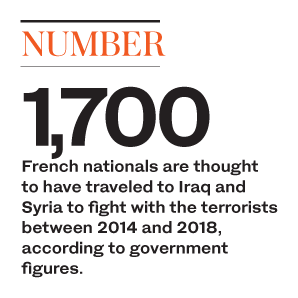
Up to 1,700 French nationals are thought to have traveled to Iraq and Syria to fight with the terrorists between 2014 and 2018, according to government figures. Around 300 are believed to have died in combat.

Kurdish officials have warned they do not have the resources to hold all the captured fighters indefinitely, and Washington is also urging its allies in the anti-Daesh coalition to take home their citizens.

But repatriation is a politically fraught issue, and governments fear they may not have enough evidence to convict IS members who claim they did not fight.

European leaders expected to cement support for Ukraine amid Washington pressure to accept deal

Updated 1 min 57 sec ago
Follow

European leaders expected to cement support for Ukraine amid Washington pressure to accept deal

BERLIN (AP) — European leaders are expected to cement support for Ukraine Monday as it faces Washington’s pressure to swiftly accept a U.S.-brokered peace deal.
After Sunday’s talks in Berlin between U.S. envoys and Ukrainian President Volodymyr Zelenskyy, Ukrainian and European officials are set to continue a series of meetings in an effort to secure the continent’s peace and security in the face of an increasingly assertive Russia.
Zelenskyy sat down Sunday with U.S. President Donald Trump’s special envoy Steve Witkoff and Trump’s son-in-law Jared Kushner in the German federal chancellery in the hopes of bringing the nearly four-year war to a close.
Washington has tried for months to navigate the demands of each side as Trump presses for a swift end to Russia’s war and grows increasingly exasperated by delays. The search for possible compromises has run into major obstacles, including control of Ukraine’s eastern Donetsk region, which is mostly occupied by Russian forces.
Zelenskyy on Sunday voiced readiness to drop his country’s bid to join NATO if the U.S. and other Western nations give Kyiv security guarantees similar to those offered to NATO members. But Ukraine continued to reject the U.S. push for ceding territory to Russia.
Putin wants Ukraine to withdraw its forces from the part of the Donetsk region still under its control among the key conditions for peace.
The Russian president also has cast Ukraine’s bid to join NATO as a major threat to Moscow’s security and a reason for launching the full-scale invasion in February 2022. The Kremlin has demanded that Ukraine renounce the bid for alliance membership as part of any prospective peace settlement.
Zelenskyy emphasized that any Western security assurances would need to be legally binding and supported by the U.S. Congress.
‘Pax Americana’ is over
German Chancellor Friedrich Merz, who has spearheaded European efforts to support Ukraine alongside French President Emmanuel Macron and U.K. Prime Minister Keir Starmer, said Saturday that “the decades of the ‘Pax Americana’ are largely over for us in Europe and for us in Germany as well.”
He warned that Putin’s aim is “a fundamental change to the borders in Europe, the restoration of the old Soviet Union within its borders.”
“If Ukraine falls, he won’t stop,” Merz warned during a party conference in Munich.
Macron, meanwhile, vowed Sunday on social platform X that “France is, and will remain, at Ukraine’s side to build a robust and lasting peace — one that can guarantee Ukraine’s security and sovereignty, and that of Europe, over the long term.”
Putin has denied plans to attack any European allies.