ISLAMABAD: Pakistan has launched an operation against dollar hoarding and currency speculation trade, information minister Fawad Chaudhry said on Friday, in a bid to stabilize the exchange rate which has lost about 25 percent of its value over the past year.
The announcement came just hours after finance minister Asad Umar ruled out a further devaluation of the rupee, urging people to invest in the stock market and not waste money buying dollars.
“Government has directed FIA [Federal Investigation Agency] to launch a full fledged operation against Dollar hoarding, and speculative currency trade,” the information minister said in a Twitter post. “The operation is being launched in coordination with State Bank and Ministry of Finance.”
The FIA is empowered under the Foreign Exchange Regulation Act to initiate action against illegal money changers and export of the dollars through illegal means.
“We have to wait for the government’s instruction for the crackdown against dollar hoarding,” Abid Qamar, a spokesman for the State Bank of Pakistan, told Arab News, declining further comment.
Pakistan’s consumer price inflation rose in March to its highest since November 2013, adding to economic headwinds besetting Prime Minister Imran Khan’s government.
Inflation rose to 9.41 percent year-on-year, up from 8.21 percent in February, lifted by sharp rises in food, fuel and transport costs that have squeezed household budgets.
Last month, the central bank lifted its key policy rate by 50 basis points to 10.75 percent, citing continuing inflationary pressures as well as high fiscal and current account deficits.
Consumer price inflation has also jumped sharply over the past year, climbing from under 4 percent at the start of 2018.
Energy costs in particular have risen sharply, hit by a series of devaluations of the rupee, and the government on Sunday announced a 6 rupee rise in petrol prices to 98.88 rupees a liter.
Traditionally, Pakistan has kept its exchange rate over-valued, incurring losses to the economy, the finance minister said. The rupee should be aligned with its fundamentals and its benchmark should be the real effective exchange rate (REER), finance minister Umar said on Friday.
He added that there were no demands for what the exchange rate should be in the talks with the IMF.
Zafar Paracha, general-secretary of the Exchange Companies Association of Pakistan, said the crackdown against dollar hoarding would not help bring down the exchange rate unless the government controlled it in the interbank market.
“The government should first amend the foreign exchange regulation act to set a certain limit on the amount of foreign currency or rupees that one can keep at home,” he told Arab News.
He said the FIA crackdown against illegal money changers, “who have been enticing people to buy dollars” may be effective for some time but that is not a permanent solution to deal with it.
The Forex Association of Pakistan on Friday urged all exchange companies in the country to sell the US dollar to only “authentic customers who need the dollar genuinely” including people going abroad for medical treatment, education and pilgrimage.
“If people stop buying the dollar for a few days, its exchange rate will come down automatically,” Malik Bostan, president Forex Association of Pakistan, told Arab News.
“The dollar is currently appreciating due to the gap in supply and demand … the supply of the dollar at the moment is four to five million dollars daily against the demand of seven to eight million dollars,” he said, “The government should focus on addressing this gap instead of creating further panic in the market through crackdown.”


Pakistan launches operation against dollar hoarding to stabilize exchange rate
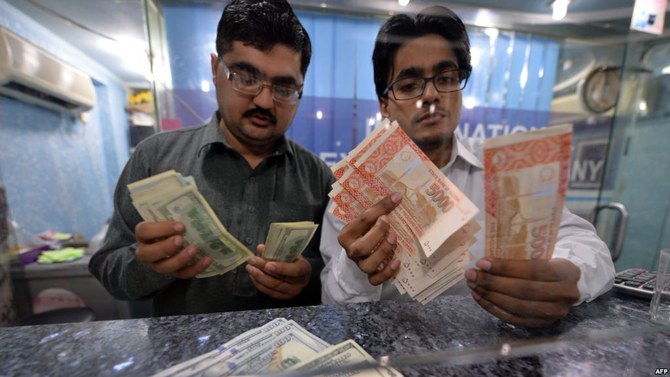
Pakistan launches operation against dollar hoarding to stabilize exchange rate

- Operation aimed at stabilizing the exchange rate which has lost about 25 percent of its value over the past year
- State bank and finance ministry will jointly coordinate the crackdown

IMF says has made ‘considerable progress’ as Pakistan funding talks continue
- Discussions covered the impact of the Middle East conflict on Pakistan, balance of payments and external financing needs
- Pakistan’s program implementation under a $7 billion program remained broadly aligned with authorities’ commitments, IMF says
KARACHI: The International Monetary Fund (IMF) has made “considerable progress” in talks with Pakistan over its funding facilities, the Fund said late Wednesday, adding that discussions will continue in the coming days.
The IMF mission, led by Iva Petrova, had started talks with Pakistani officials on the third review of a $7 billion Extended Fund Facility (EFF) multi-year program and for the second review of the $1.4 billion Resilience and Sustainability Facility (RSF) from Feb. 25 to Mar. 11, according to the IMF.
The mission observed that Pakistan’s program implementation under the EFF remained broadly aligned with the authorities’ commitments through end-Feb., with both sides making progress on policies, including fiscal consolidation, a sufficiently tight monetary policy and advancing energy sector reforms.
“While considerable progress was made in the discussions, these will continue in the coming days, including to more fully assess the impact of recent global developments on Pakistan’s economy and the EFF-supported program,” the IMF quoted Petrova as saying.
Both EFF, secured in Sept. 2024, and the RSF, secured in May 2025, are key programs crucial for stabilizing Pakistan’s fragile economy. The IMF team was in the country to assess fiscal performance, energy-sector reforms, and external financing needs before approving the next disbursement.
The ongoing IMF engagement is seen as vital for Pakistan as geopolitical tensions and rising global oil prices pose renewed risks for its economic recovery.
The IMF mission observed that Islamabad paid “particular attention” to deepening structural reforms and made “good progress” in the implementation of their agenda to strengthen climate resilience, including through the completion of reform measures under the RSF.
“Discussions also covered the impact of the conflict in the Middle East on Pakistan’s economic outlook, the balance of payments and external financing needs amid volatile and rising energy prices and tighter global financial conditions,” Petrova said, adding:
“The IMF team and the authorities will continue these discussions with a view to conclude them in the coming days.”


