

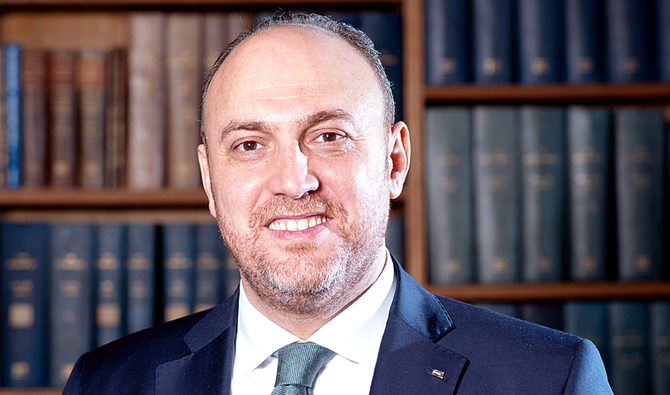

LONDON: Like many Palestinian officials, Husam Zomlot is deeply concerned.
The US is close to unveiling its new Middle East peace plan. But all the signs so far have deepened concerns that President Donald Trump’s “deal of the century” will be heavily biased toward Israel and offer little to the Palestinians.
The plan is being constructed by Jared Kushner, senior adviser and son-in-law to the president, Jason Greenblatt, US special representative for international negotiations, and David Friedman, US ambassador to Israel. It is expected to be announced after the April 9 Israeli elections, and Kushner said last month it would address all core issues of the Israeli-Palestinian conflict, including borders.
Speaking to Sky News Arabia, Kushner added that he wanted to see a unified Palestinian government in the West Bank and Gaza. For Zomlot though, the Fatah member and Palestinian ambassador to the UK, there are warning signs everywhere that the deal weakens the Palestinian position.
“The plan is illegitimate,” he told Arab News, “because they did not consult the Palestinian people, the international community, or revert to international resolutions.”
In September last year, Zomlot was expelled from the US. The Trump administration shut down the Palestinian diplomatic mission to Washington, and he relocated to the UK the following month to head the mission in London.
Trump piled more pressure on the Palestinians last year by moving the US Embassy in Israel to Jerusalem, and by cutting aid to the UN Relief and Works Agency for Palestine Refugees in the Near East (UNRWA).
******
BIO
BORN
Gaza Strip, 1973
EDUCATION
Doctorate in economics, University of London
CAREER
Ambassador, Head of Palestinian Mission to the UK
Former Head of PLO General Delegation to the US
Strategic Affairs Advisor to the Palestinian President
Economist at the UN and as an economic researcher with London School of Economics and the Palestine Policy Research Institute
******
On Monday, Trump recognized Israeli sovereignty over the occupied Golan Heights, seized from Syria in 1967, a move condemned by Arab countries and one that raised concerns in Ramallah over the future of its own territory.
That the deal is being put together solely by lawyers adds to its illegitimacy, Zomlot suggested, adding that the approach being taken was akin to real estate lawyers driving tenants from a building.
“You apply pressure on the tenants to evict them, like cutting water, electricity, heating, parking. This is what they have been doing with us for the last two years, starting with the closing of our diplomatic mission to Washington.”
One of the biggest Palestinian complaints is that they have not been consulted during the process, yet at the same time, the US team have gone out of their way to accommodate Israel.
Saudi Arabia has always unconditionally supported the rights of the Palestinian people, both politically and financially
Husam Zomlot
“It’s only taking into consideration one side, not even that of Israel but of Netanyahu — a clear indication that the Trump administration is supporting him,” Zomlot said.
He added that the US was ignoring decades of “international resolutions, consensus and laws” in the face of growing domestic support for the Palestinian cause. “We see the growing solidarity and awareness in America, and the number of people that voice support from the youth, the Congress, the Jewish community, the media and the intelligence agencies.”
However, the 46-year-old diplomat, who was born in a Gaza refugee camp and later studied in London, appears to feel more at home in the UK, and wants it to spearhead the Middle East peace process, commending Whitehall’s recent decision to double its contribution to UNRWA. “The UK is way more equipped and familiar with the situation than the Trump administration,” he said.
In such uncertain times, though, Ramallah is looking more to its old regional allies, with Zomlot calling Saudi Arabia an “older brother” in his nation’s history.
“Saudi Arabia has always unconditionally supported the rights of the Palestinian people, both politically and financially,” he said, citing King Salman’s defiance of the US embassy move by renaming the Saudi-hosted Arab League Summit the “Jerusalem Summit” last year.
One issue most Palestinians agree on is the need for a unified position — something that came to an end when Hamas seized Gaza in 2007. The hard-line group remains in control while in the West Bank, the Palestinian Authority is viewed as increasingly ineffective under the leadership of the aging President Mahmoud Abbas.
Last month, Abbas named Mohammad Shtayyeh prime minister, and Zomlot claimed the veteran politician had the ability required “to form a national government backed by all parties.”
He said now, more than ever, the Palestinians required “a strong government capable of engaging with the international community and dealing with the reality of colonialism that is not interested in a two-state solution.”
In a matter of weeks, when the Trump administration reveals its “deal of the century,” Abbas, Shtayyeh, Zomlot and others will face one of their greatest tests yet.


