

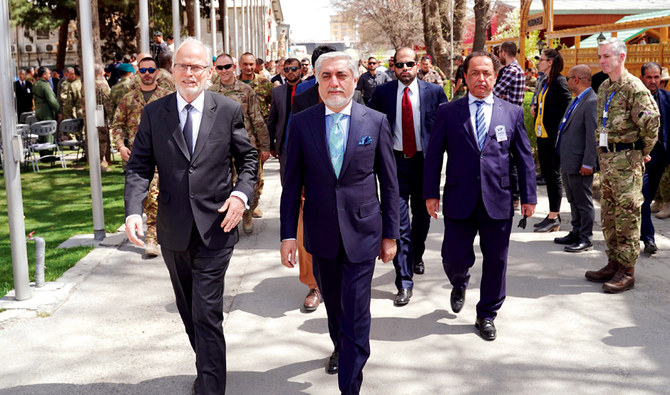
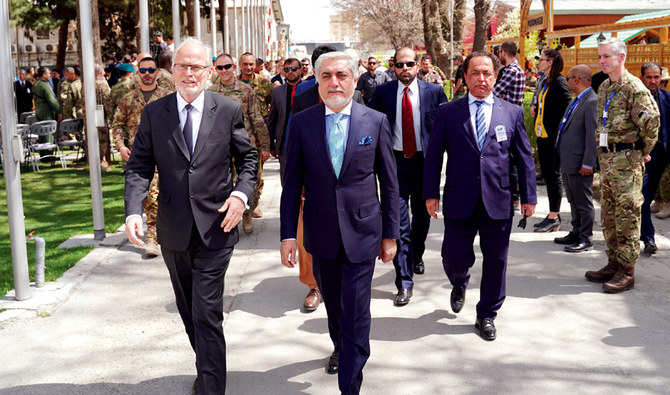
KABUL: US Special Envoy for Afghanistan Zalmay Khalilzad sought to reassure Afghans on Wednesday over fears that Washington is seeking a hasty withdrawal from the country.
In a wide-ranging interview with US-funded Radio Liberty — his first since arriving in Afghanistan to share details of last month’s peace talks with the Taliban — Khalilzad played down tension between Kabul and Washington over the negotiations.
Last month’s marathon talks with the Taliban focused on the complete withdrawal of US troops from the country, with both the militants and Khalilzad saying that the dialogue — held behind closed doors in Doha — had brought significant progress.
“We would like to assure the people of Afghanistan ... who have concerns about the American pullout that we have no intention of a deal for an exit,” Khalilzad said.
“We are seeking a way for peace in Afghanistan so that it can open the way for the withdrawal of American troops,” he added.
Khalilzad said that Washington hopes to have friendly relations with Afghanistan after the peace deal is finalized.
The special envoy has held several meetings with Afghan leaders and politicians recently. On Tuesday, he traveled to the southern city of Kandahar, his first trip to the province since Washington began efforts to engage with the Taliban six months ago.
In the interview, Khalilzad said Washington has no preference as to who should run the country, but Afghans needed to know that no one could rule by force.
“The Taliban says it cannot win the war and is ready for a political settlement. America says war is not the solution and a political solution is needed. And the (Afghan) government says the same thing. Eventually, there will have to be some give-and-take so the sides can come to an agreement and end the war,” he said.
Washington was trying to persuade the Taliban to enforce a truce and hoped to reach an agreement on the issue in the next round of talks.
“The Taliban says the issue of a cease-fire will only be addressed when talks among Afghans begin,” he said. “But we are hopeful that intra-Afghan talks will start as soon as possible and that we can agree to de-escalate the war.”
Khalilzad said it would be ideal if a peace agreement could be clinched before Afghanistan’s presidential elections in September. But he said preparations should be made for the election in which President Ashraf Ghani is seeking re-election.
“It would be good if there was a (peace) agreement between the Taliban and Afghanistan before the election,” he said. “And whatever (deal) is agreed among Afghans, including the government, should be applied.”
The envoy is expected to travel to Pakistan, Uzbekistan and Jordan before ending his trip in Qatar.
Ajmal Hoodmand, an analyst, told Arab News: “Khalilzad has been trying to say to the government that he has not hidden any details of the talks with the Taliban, and has come to share the information with the president and others. But it is unclear if the government is convinced.”
Ghani wants peace talks to be led by Afghanistan, and Khalilzad seems unable to resolve this sensitive matter, he said.
Mushtaq Rahim, a political observer, said Khalilzad’s trip was part of efforts to normalize relations with Afghanistan following remarks by Ghani’s national security adviser, Hamdullah Mohib, who publicly accused the envoy of using the talks with the Taliban to become the head of an interim government when Ghani’s term ends in May.
“America and Khalilzad appear to be looking to stabilize diplomatic ties. However, they continue to ignore Mohib for his harsh public criticism,” he told Arab News.
Khalilzad said in the interview that even if the US succeeded in striking a peace deal with the Taliban, Afghanistan would continue to suffer from attacks by Daesh, and would need foreign aid for reconstruction projects.


