

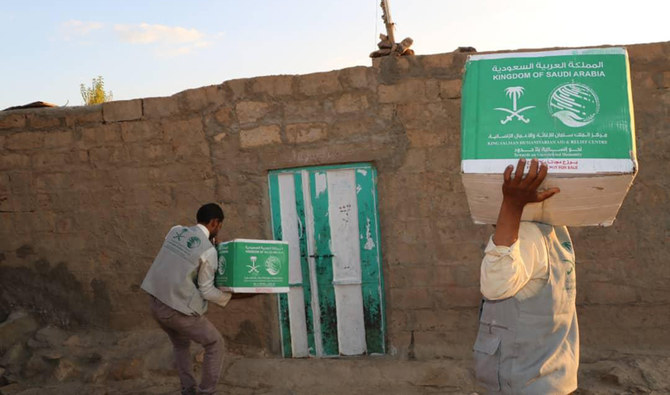
KSRelief distributes aid in Yemen and Jordan

The delivery comes as the center continues to broaden its framework for aid provision. (SPA)
Updated 02 April 2019
Follow

KSRelief distributes aid in Yemen and Jordan

SHABWAH: The King Salman Humanitarian Aid and Relief Center (KSRelief) has distributed 900 food baskets, weighing in excess of 66 tons, in Yemen’s Shabwah region, as part of a distribution project of over 100,000 food baskets to the area.

The delivery comes as the center continues to broaden its framework for aid provision, attempting to reach as many zones in need of assistance as possible in order to avert or alleviate humanitarian crises, chiefly focusing on Yemen and displaced refugees fleeing the conflict in Syria.

KSRelief also distributed 462 food baskets weighing over 34 tons to 2772 people in the Hajjah region of Yemen, and provided relief aid to 861 Syrian refugee families, almost 5,000 people in total, in the Jordanian capital Amman.

The center has also provided treatment for more than 21,000 injured Yemenis, both inside and outside Yemen.

A total of 6,452 Yemenis received treatment in private sector hospitals in Yemen, while 1,000 received treatment in Yemeni medical centers specializing in eye injuries.


Saudi wildlife center releases 140 wild animals into royal reserve

The initiatives aim to enhance ecological balance and restore biodiversity in natural habitats. (SPA)
Updated 07 February 2026
Follow

Saudi wildlife center releases 140 wild animals into royal reserve

  • This milestone reflects significant progress in the management and governance of wildlife across the Kingdom, supporting the goals of the Saudi Green Initiative and aligning with the objectives of Saudi Vision 2030

RIYADH: The National Center for Wildlife released 140 wild animals into the King Salman bin Abdulaziz Royal Reserve as part of ongoing programs to reintroduce endangered species. The initiatives aim to enhance ecological balance and restore biodiversity in natural habitats.

The release, carried out in cooperation with the King Salman bin Abdulaziz Royal Reserve Development Authority, included 30 Arabian oryx, 70 reem gazelles (sand gazelles), and 40 houbara bustards, the SPA reported on Thursday. 

The initiative forms part of efforts to reintroduce species to their natural habitats and establish stable, self-sustaining wildlife populations capable of breeding, contributing to improved ecosystem functioning and sustainability.

The NCW continues to implement its strategic plans for wildlife development, with the total number of animals reintroduced through its specialized programs now exceeding 10,000.

This milestone reflects significant progress in the management and governance of wildlife across the Kingdom, supporting the goals of the Saudi Green Initiative and aligning with the objectives of Saudi Vision 2030.