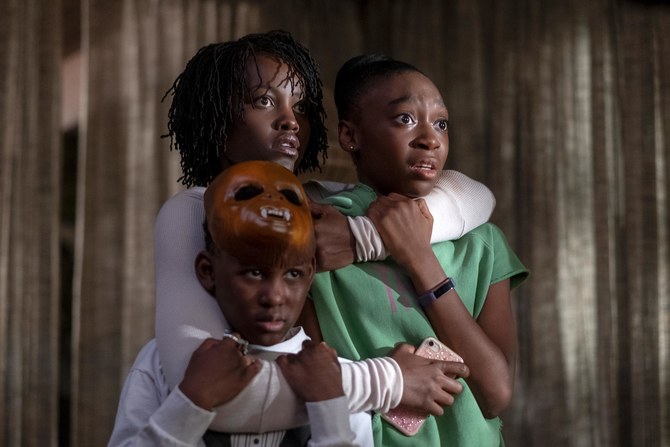
Film Review: ‘Us’ — Jordan Peele’s gripping, gory second act

The movie is filled with dark and mysterious turns. (Us)
Updated 02 April 2019
Follow

Film Review: ‘Us’ — Jordan Peele’s gripping, gory second act

  • The movie tells the story of an African-American family haunted by killer doppelgangers
  • One of the actors who plays a main rule is the Oscar-winner Lupita Nyong’o

DUBAI: All eyes are on Jordan Peele as he attempts to dodge a sophomore slump with his creepy new horror feature, "Us, "after his marvelous debut feature, “Get Out,” earned him an Oscar nod trifecta — Best Director, Best Picture, and Best Screenplay (which he won).

In “Us,” Peele tells the story of an African-American family in California whose idyllic vacation at their holiday home is interrupted by killer doppelgangers who show up dressed in red coveralls, armed with scissors.



(Us)

The horror unravels with the eerie visitors trying to gut the family with their unusual choice of weapon, but this isn’t simply a slasher flick; it takes darker and more mysterious turns along the way.

Peele’s masterful storytelling is enough to overcome the relatively unoriginal premise, and cinematographer Mike Gioulakis brings Peele’s vision to life with compelling high-contrast visuals.

The technique is highlighted early; the film opens with a flashback to 1986, with a young girl wandering into a ramshackle Hall of Mirrors in a beachside funfair. Inside, she sees a reflection that terrifies, and deeply scars, her, kicking off the film’s major narrative arc.

The young girl grows up to be Adelaide (played by Oscar winner Lupita Nyong’o), the matriarch of the family, who plays the role with a compelling energy, matched by “Black Panther” co-star Winston Duke, who plays her husband in the movie. Duke provides some of the film’s best moments, with Peele using his character for some much-needed comic relief.



(Us)

Peele’s wildly imaginative tale employs some tried-and-tested horror-movie tropes, from slow camera movements and tight reaction shots that really highlight Nyong’o’s striking facial expressions to haunting sound design. The film’s deft use of music is on another level, even transforming a hip-hop song into a hair-raising terror tune.

“Us” is not just a horror movie, though. As he did in “Get Out,” Peele delivers a story with social commentary, although this time it’s not as straightforward. “Us” shrouds its message in mind-bending metaphors, and character lines that are often hit-and-miss.

The eccentricities and creativity of the film’s plot are somewhat wasted by its rather predictable climax, but overall “Us” is a thrilling, frightening ride.


Russian cyclist finds warm welcome on Saudi Arabia’s roads 

Updated 20 January 2026
Follow

Russian cyclist finds warm welcome on Saudi Arabia’s roads 

  • Anna Rodnishcheva’s ride through Kingdom is defining chapter in solo expedition
  • Rodnishcheva cycled to Aqaba, crossed the border into Saudi Arabia, and has since traveled through Tabuk, AlUla, Madinah, Jeddah, and Taif on her way to Riyadh

MAKKAH: Solo adventurer Anna Rodnishcheva, 27, has undertaken an ambitious journey that spans countries, climates and cultures — on a bicycle. 

Born and raised in Moscow and trained as a biologist before becoming an event photographer, she now finds herself pedaling thousands of kilometers across unfamiliar landscapes in pursuit of discovery, connection, and the simple joy of movement.

In her conversation with Arab News, Rodnishcheva offered a detailed account of her ongoing route in Saudi Arabia, describing how the expedition is her third major cycling adventure.

After previously riding from Moscow to Sochi and later from Vladivostok to Sochi — a route that stretches across the entirety of Russia — she felt compelled to explore foreign lands by bicycle.

She set off from Moscow heading south last June, passing through Russia, Georgia, and Turkiye before flying from Antalya to Amman. She cycled to Aqaba, crossed the border into Saudi Arabia, and has since traveled through Tabuk, AlUla, Madinah, Jeddah, and Taif on her way to Riyadh.

Rodnishcheva explained that physical preparation played only a small role in her planning. She began slowly and allowed her body to adapt naturally over the first month. 

The true challenge, she said, was in the mental and financial preparation. She spent a year and a half planning the journey, even though she originally intended to postpone it for several more years. 

Ultimately, her belief that “life is short” convinced her to start with the resources she already had. Although she sought medical evaluations and additional vaccinations, she was unable to complete them all and decided to continue regardless.

Her journey through Georgia and Turkiye presented unexpected difficulties. Simple tasks such as finding groceries or locating bicycle repair shops became more challenging outside of Russia, where she knew how to navigate on a budget. 

She also encountered language barriers, though the situation improved when a local cyclist joined her in Georgia. The intense midsummer heat added another layer of difficulty, but she had prepared herself for such conditions.

One of the most striking moments of her trip occurred as she crossed from Jordan into Saudi Arabia. She described the experience as surreal and emotionally overwhelming, likening it to the adventures of a literary hero traveling across the Arabian Peninsula. 

Her anxiety eased unexpectedly when she got a flat tire at the border, bringing her back to the present. 

Despite being warned that crossing by bicycle would be prohibited, the process went smoothly, and she was struck by the friendliness of both Jordanian and Saudi officials. She expressed particular surprise at meeting a female Saudi passport officer, an encounter that challenged her previous assumptions about women’s roles in the Kingdom.

Rodnishcheva said the hospitality she had experienced in Saudi Arabia surpassed anything she had encountered on previous journeys. Drivers frequently stop to offer her water, fruit, or sweets, and several families have generously hosted her in their homes or guest flats. 

She emphasized that she feels completely safe traveling across the Kingdom, especially on the open roads between cities, noting the strong and visible security presence.

She has also observed significant differences in weather. While the stretch from the border to Jeddah was hot despite being winter, the climate changed dramatically after climbing Al-Hada in Taif, turning cooler and windier — a climate she compared to Russian summers.

Rodnishcheva documents her travels primarily through Russian-language platforms such as VK and Telegram. Although she maintains YouTube and Instagram accounts, she explained that her schedule left little time for frequent updates.

Offering a message to women around the world who dream of embarking on similar adventures, she said such journeys were “not as scary as they seem before you start,” though they may not suit everyone.

Her closing advice? “Listen to your heart.”