Landmines take growing toll in Afghanistan conflict

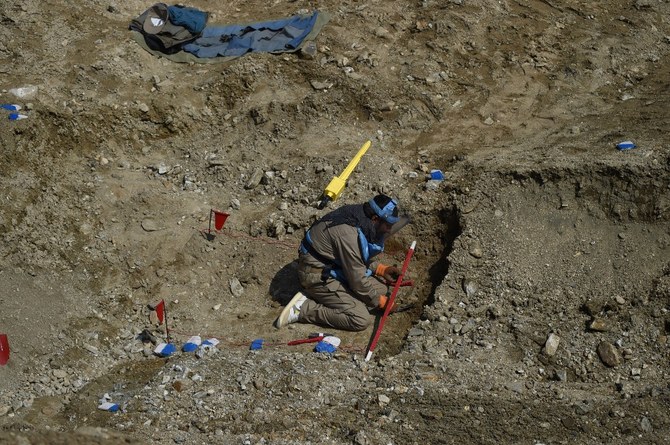
UNMAS program manager in Kabul said they are facing difficulty handling the amount of landmines in the country. (AFP/File)
Updated 02 April 2019
Follow

Landmines take growing toll in Afghanistan conflict

  • UN organization said landmine deaths in Afghanistan multiplied 5 times from 2012 to 2017
  • Landmines and explosive remnants increased as the war between the local government and Taliban intensified

KABUL: At a rehabilitation center in Afghanistan, Imran Gul clasped two parallel bars, cautiously easing his weight onto his new leg.
The 25-year-old nomad had been driving a tractor on hilly farmland when a land mine exploded, making him the latest victim of a scourge that has worsened in recent years as fighting intensifies between the government and the Taliban.
“I did not hear the sound of the bomb,” Gul told AFP as he tried out his prosthetic limb.
“I touched my leg and saw there was no leg, and there were pieces of shrapnel in my eyes. My hands were soaked in blood,” he added.
The blast in the eastern province of Ghazni also took two of Gul’s fingers.
According to the United Nations Mine Action Service (UNMAS), casualties from land mines and so-called “explosive remnants of war” have soared five-fold between 2012 and 2017, the last year full data was available.
Casualties have increased as a result of the intensifying fight between the Afghan government and the Taliban, especially since 2014.
Battlefields have been left strewn with land mines, unexploded mortars, rockets and homemade bombs — many of them picked up by curious children.
“We are struggling to handle significant increases in the number of minefields in Afghanistan,” said Patrick Fruchet, the UNMAS program manager in Kabul.
The Afghanistan government has signed an international anti-landmine treaty, but the Taliban and other militants are bound by no such rules.
The UN hopes to raise attention to the issue Thursday, the annual International Day for Mine Awareness and Assistance in Mine Action.
“In 2012, we were down to about 36 casualties (killed and wounded) per month in Afghanistan — which is still enormous,” said Fruchet.
But those numbers have jumped. In 2017, there were more than 150 casualties a month.

In addition to the new explosive detritus, Afghanistan is still grappling with the legacy of mines from the Afghan-Soviet war in the 1980s and the civil war in the 1990s.
Mohammad Jamshidi, UNMAS deputy program manager, told AFP that a lack of funds means the country will probably miss the UN goal of being mine-free by 2023.
The “deadline seems to be difficult to achieve because all these new contaminations and the lack of sufficient funding for the mine action,” he said.
In an effort to prevent further tragedies, various organizations hold information sessions to warn civilians, including children.
Hashmatullah Yadgari, who works for the Danish Refugee Council, said many Afghans — particularly returning former refugees — have no idea what land mines and other explosives even look like.
People “do not have any information about it,” Yadgari said.
In a tent inside a refugee camp on the outskirts of Kabul, a family was recently shown the various types of explosive device they may well encounter.
“We had no knowledge and awareness about the land mines,” said Sakina Habibi, a mother of three who has just returned to Afghanistan after nearly 30 years in Pakistan and Iran.
Many survivors of blasts go to one of seven orthopaedic rehabilitation hospitals funded by the International Committee of the Red Cross (ICRC).
At the same rehab center where Gul, the nomad who lost a leg, was being treated, other patients tried out their new prosthetics.
Abdul, an Afghan mine clearer who only gave his first name, stood unsupported for the first time since getting fitted with two legs.
He was disarming mines hidden in a house recaptured from the Taliban five months ago when the blast happened.
“I de-activated five pressure mines. The sixth was designed to explode when exposed to light. When I moved my lamp closer — boom,” Abdul said.
“I did my job, I prevented people from being killed by these mines. Even though I lost my legs, I’m lucky to still be alive,” he added.
The resilient father of two wants to keep his job, “to again save lives,” he said, mimicking holding a mine detector in one hand and a walking stick in the other.
Of the 12,000 new patients received annually by the ICRC, between 1,500 and 2,000 are casualties of war, some four-fifths of whom are wounded by land mines, said Najmudin Helal, head of the Kabul center.
Aside from physical rehab, the center works with patients to help them find a new place in society. Nearly half of the 300 staff at the Kabul hospital are disabled.
“They learn easily and they can teach the new disabled easily. It’s a hope (for new patients) to see that life carries on,” Helal said.


Asia rings in 2026 with Australia hosting defiant celebration after mass shooting

Updated 52 min 6 sec ago
Follow

Asia rings in 2026 with Australia hosting defiant celebration after mass shooting

  • Australia holds defiant celebrations after its worst mass shooting in nearly 30 years
  • Hong Kong holds a subdued event after a deadly fire in tower blocks

MELBOURNE, Australia: Auckland was the first major city to ring in 2026 with a fireworks display launched from New Zealand’s tallest structure, Sky Tower, followed by a defiant celebration in Australia in the aftermath of its worst mass shooting.
South Pacific countries were the first to bid farewell to 2025. Clocks stuck midnight in Auckland 18 hours before the famous ball drop in New York’s Times Square. The five-minute display involved 3,500 fireworks.

Defiant celebration in Australia after worst mass shooting

Australia’s east coast welcomed 2026 two hours after New Zealand. In Sydney, the country’s largest city, celebrations were held under the pall of Australia’s worst mass shooting in almost 30 years. Two gunmen targeted a Hannukah celebration at Bondi Beach on Dec. 14, killing 15 and wounding 40.
A heavy police presence monitored the thousands who thronged to the waterfront to watch a fireworks show centered on the Sydney Harbor Bridge. Many officers openly carried rapid-fire rifles, a first for the annual event.
An hour before midnight, the massacre victims were commemorated with a minute of silence while images of a menorah were projected on the bridge pylons. The crowd was invited to show solidarity with Australia’s Jewish community.
New South Wales Premier Chris Minns urged Sydney residents not to stay away through fear, saying extremists would interpret smaller crowds at New Year’s Eve festivities as a victory.
“We have to show defiance in the face of this terrible crime and say that we’re not going to be cowered by this kind of terrorism,” he said.

Indonesia and Hong Kong hold subdued events

In Indonesia, one of Australia’s nearest neighbors, cities scaled back festivities as a gesture of solidarity with communities devastated by floods and landslides that struck parts of Sumatra island a month ago, claiming more than 1,100 lives.
The capital, Jakarta, was not ringing in 2026 with its usual fanfare, choosing subdued celebrations with a program centered on prayers for victims, city Gov. Pramono Anung said last week.
Makassar Mayor Munafri Arifuddin urged residents of one of Indonesia’s largest cities to forgo parties, calling for prayer and reflection. “Empathy and restraint are more meaningful than fireworks and crowds,” he said.
Concerts and fireworks on Indonesia’s tourist island of Bali were canceled and replaced with a cultural arts event featuring traditional dances.
Hong Kong, too, was ringing in 2026 without the usual spectacle in the sky over iconic Victoria Harbor, after a massive fire in November killed at least 161 people.
The facades of eight landmarks were turning into giant countdown clocks presenting a three-minute light show at midnight.
Many parts of Asia welcome the new year by observing age-old traditions.
In Japan, crowds were gathering at a Buddhist temple in Tokyo for a bell striking at midnight. In the South Korean capital, Seoul, a bell tolling and countdown ceremony were being held at the Bosingak Pavilion.

Berliners celebrate in snowfall

Tourists and Berliners alike marked the end of 2025 by enjoying snowfall, taking selfies and making snowmen in front of the German capital’s cathedral and the iconic Brandenburg Gate. The Berlin TV Tower was nearly invisible thanks to the falling flakes and fog.
Quieter celebrations in Greece and Cyprus
Greece and Cyprus were ringing in 2026 by turning down the volume, replacing traditional fireworks with low-noise pyrotechnics, light shows and drone displays in capital cities. Low-noise fireworks avoid the explosive bursts that generate the loud cracks of traditional displays.
Officials in the countries said the change is intended to make celebrations more welcoming for children and pets, particularly animals sensitive to loud noise.

Additional security in New York City

Police in New York City will have additional anti-terrorism measures at the Times Square ball drop, with “mobile screening teams” in search of suspicious activity. It is not in response to a specific threat, according to NYPD Commissioner Jessica Tisch.
After the ball drops in Times Square, it will rise once again, sparking in red, white and blue, to mark the country’s upcoming 250th birthday celebration. It will be one of several patriotic flourishes throughout the night, organizers said.
Zohran Mamdani will take office as mayor at the start of 2026. Two swearing-in ceremonies are planned, starting with a private ceremonial event around midnight in an old subway station.