

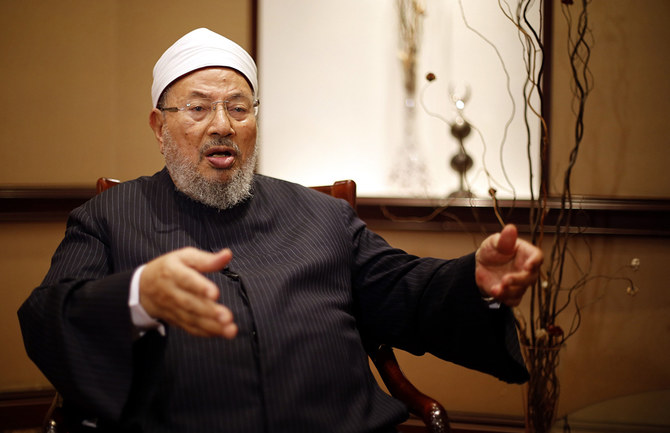


LONDON: It is time for social media companies to get tough with Qatar-based Yusuf Al-Qaradawi, experts on extremism have said, as the controversial cleric is named in Arab News’ ongoing “Preachers of Hate” series.
In media appearances spanning decades, notably on the Doha-based Al Jazeera news channel, Al-Qaradawi has voiced his often extreme views, which have included justifying suicide bombings, praising the Holocaust and authorizing attacks on all Jews. He has also issued fatwas (religious edicts) that demean women.
It is for this reason that Al-Qaradawi was included in this newspaper’s “Preachers of Hate” series, which analyzes extremist preachers from various religions, backgrounds and nationalities.
Despite his weekly show on Al Jazeera no longer airing, and a recent tweet in which Al-Qaradawi claims that he is not a preacher of hate, experts say the renegade cleric still has vast influence. Much of this is via social media, prompting calls for action.
Josh Lipowsky, senior research analyst at the Counter-Extremism Project (CEP), said it was inappropriate for Qatar to have provided Al-Qaradawi with a media platform on Al Jazeera. “It helped raise his profile, to expand his influence. Even though he isn’t making as many appearances as he once did, his words still matter and he still has influence,” Lipowsky said.
“The elevation and prominence given to Al-Qaradawi has enabled him to continue to spread his views. We need to make sure these platforms are no longer available.”
Research by the CEP, a non-profit organization that combats extremist groups, points to Al-Qaradawi’s vast social media network.
-------
READ MORE
Qaradawi and Qatar: the hate preacher who became Doha’s spiritual guide
Preachers of Hate: Arab News launches series to expose hate-mongers from all religions
-------
As of Jan. 15, his main channel on YouTube had almost 6 million followers, while his verified Twitter and Facebook accounts had about 2.3 million followers each.
Blocking the cleric’s YouTube channel, for example, would be “one step” in curtailing his influence, said Lipowsky. “We’d call on the social media companies to seriously review these accounts to determine whether they’re in compliance with these companies’ own terms-of-service agreements.”
“Based on his past rhetoric and support of violence, these social media companies should take a thorough look at his accounts in order to determine that they’re not being used to further spread extremist propaganda.”
Facebook and Twitter did not respond to an Arab News request for comment. Al Jazeera did not respond to questions about its airing of Al-Qaradawi’s weekly show “Shariah and Life.”
Lipowsky pointed to some of Al-Qaradawi’s more extreme comments made on that show, such as claims that the Holocaust was a divine punishment for the Jews.
“His platforms gave him widespread influence across the world. His ‘Shariah and Life’ program on Al Jazeera reportedly had an audience of 60 million people before it ended in 2013. He used the show to espouse many of his hard-line views,” Lipowsky said.
“Even though his TV show has since ended, he continues to maintain influence online, on Twitter … His Facebook (account) has more than 2 million followers,” he said.
“What we need is to apply pressure in order to remove his support. It could be diplomatic, it could be economic,” he said.
“We’ve already seen countries like Saudi Arabia, Bahrain, the UAE and Egypt take action. But I think there needs to be a more concerted effort by governments in the region to identify extremist propaganda and act against it.”
Writer and columnist Abdellatif El-Menawy agreed that investigating whether Al-Qaradawi is in breach of social media sites’ terms and conditions is “part of their responsibility.”
Paul Stott, research fellow at the Center on Radicalization and Terrorism at the Henry Jackson Society in London, said the best approach to combating Al-Qaradawi’s views is to challenge rather than ban them.
Social media companies have been effective at removing pornographic images, but are less effective at taking out extreme political content that advocates violence, he added.
“Probably knowledge among the big social media companies about Islam per se, and then the more extreme currents within it, is probably pretty low,” Stott said.
Al-Qaradawi has “most certainly” encouraged acts of terror in the past, and continues to disseminate messages via social media despite being in his 90s, Stott added.
“Al-Qaradawi’s views are reprehensible … He isn’t someone who mellowed with age. In a way, his danger comes from his ability at certain times to convince people that he’s a sort of ‘man of peace’,” Stott said.
“This is somebody who’s a maker of bomb-makers, rather than being a bomb-maker himself.”


