

Expo 2020 Dubai invites world to ‘welcome the future’

Building on Expo 2020’s theme ‘Connecting Minds, Creating the Future,’ the campaign amplifies the message that everyone on the planet has a contribution to make.
Updated 01 April 2019
Follow

Expo 2020 Dubai invites world to ‘welcome the future’

Expo 2020 Dubai unveiled on Sunday its latest global marketing campaign, called “Welcome the Future.” Celebrating humanity’s many achievements and calling on the world to come together to create a better future, the video-led campaign is an open invitation for all to join Expo 2020 on its journey, with the clear message: “We’re not done yet” in making progress.

Building on Expo 2020’s theme “Connecting Minds, Creating the Future,” the campaign amplifies the message that everyone on the planet has a contribution to make.

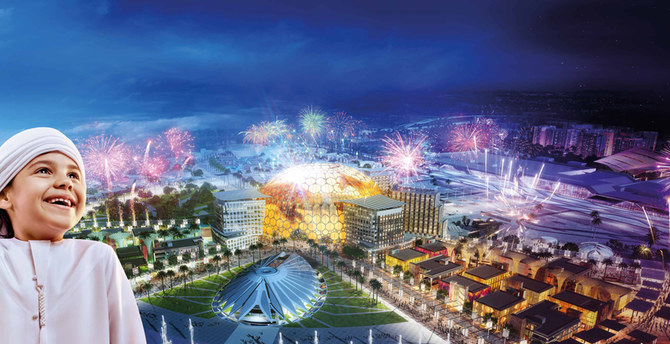
Expo 2020 will host 190 participating countries, each of  which will showcase its innovations, cultures and aspirations. Millions of visitors also will experience world-class architecture such as the Sustainability Pavilion and Al-Wasl Plaza, taste authentic cuisines from around the world, and enjoy more than 60 live performances a day. 

Sanjive Khosla, deputy chief visitor experience officer, Expo 2020 Dubai, said: “We’re excited to launch our first global campaign and to inspire the world to visit Expo 2020. This campaign reflects the positive and progressive spirit that has made the UAE the special hub for innovation and collaboration that the world has come to know.

“Expo 2020 Dubai continues to build on that spirit and will give millions of people from all over the world a once-in-a-lifetime opportunity to see what tomorrow will bring and to be part of creating a better future. We are inviting the world to ‘welcome the future’ while experiencing the extraordinary at the same time.”

Offering a journey of discovery through interactive exhibitions, live shows and entertainment, engaging discussions and educational forums, visitors will be challenged and inspired to become change-makers and be part of creating a sustainable future for generations to come. 

The marketing campaign reflects this voyage of human discovery using compelling cinematic visuals and slam poetry narration.

Between Oct. 20, 2020 and April 10, 2021, Expo 2020 Dubai expects to record 25 million visits, with 70 percent of visitors to come from outside the UAE — the highest proportion of international visitors in the 168-year history of World Expos. There will be more than 200 international participants, including 190 nations, businesses, non-government organizations and educational institutions. 

The expo site covers a total area of 4.38 square kilometer and is located adjacent to Al-Maktoum International Airport in Dubai South.

Expo 2020 Dubai is the first World Expo to take place in the MEASA (Middle East, Africa and South Asia) region. 

World Expos are held under the auspices of the Bureau International des Expositions (BIE), the intergovernmental organization responsible for overseeing and regulating international exhibitions. Today, four types of expos are organized under the BIE’s auspices: World Expos, Specialized Expos, Horticultural Expos and the Triennale di Milano.


Jameel Observatory-CREWSnet advances climate resilience in Bangladesh

Updated 20 January 2026
Follow

Jameel Observatory-CREWSnet advances climate resilience in Bangladesh

The Jameel Observatory Climate Resilience Early Warning System Network, an initiative co-founded by the Massachusetts Institute of Technology and Community Jameel to reinvent climate change adaptation in vulnerable communities into a proactive, integrated and evidence-based process, announced the launch of its Adaptation Fortress initiative, transforming existing cyclone shelters and providing protection from heat waves in Bangladesh for the first time.
The first Adaptation Fortress is under construction in Satkhira district, southwest Bangladesh. If this pilot is successful, the initiative will open a pathway, with additional funding, to scaling up to 1,250 Adaptation Fortresses providing heatwave relief to half a million of the region’s most vulnerable residents.
More than 30 million people live in southwestern Bangladesh. Between 2019 and 2021, including in the midst of the COVID-19 pandemic, multiple cyclones hit the region, devastating land, homes and entire communities. The threats posed by climate change — rising sea levels and more extreme weather — mean that people living in this region are likely to face similar crises in the years ahead. In addition to cyclones, extreme heat is a growing threat, putting people at risk of dehydration and heatstroke. In 2024, the UN found that heat waves caused nationwide school closures for two weeks, with some schools closing for six to eight weeks due to the combined impact of heat waves and flooding.
In Bangladesh, the Jameel Observatory-CREWSnet has used its mid-century climate projections and analysis of local human systems to design a pilot for a multi-purpose, multi-objective structure called an Adaptation Fortress.
By engaging extensively with local communities, the Jameel Observatory-CREWSnet, which includes among its partners BRAC, a global nongovernmental organization established in Bangladesh, is demonstrating a new model of climate adaptation that repurposes schools that are also cyclone shelters to serve as sanctuaries during extreme heat events.
The climate resilient shelter model is the first of its kind in Bangladesh and serves as a blueprint for infrastructure development across South Asia. Designed to protect the most vulnerable community members during government-declared heat emergencies, Adaptation Fortresses feature solar power generation and battery backup systems to ensure the shelter is resilient to outages during extreme heat conditions. The site also includes rainwater harvesting capacity and is designed so that excess energy generated when air conditioning is not in use is made available for community use.
Mohammed Abdul Latif Jameel KBE, founder and chairman of Community Jameel, said: “The Jameel Observatory-CREWSnet’s construction of this first pilot Adaptation Fortress marks a milestone for Bangladesh and the region. It lays the foundation for a proactive response to cyclones and heat stress — emergencies that the team has projected will become frequent events, threatening the lives of millions in Bangladesh. By adapting infrastructure today, we are building the resilience needed for tomorrow.”
Professor Elfatih Eltahir, lead principal investigator of the Jameel Observatory-CREWSnet, said: “Bangladesh built a vast network of cyclone shelters that have been effective in protecting vulnerable populations. For the first time the Jameel Observatory-CREWSnet is introducing the concept of shelter from heat waves as well as cyclones in southwest Bangladesh. This integrated and proactive initiative will significantly improve climate resilience in a region with some of the highest risks from climate change.”
Dr. Deborah Campbell, executive director of the Jameel Observatory-CREWSnet, said: “Bangladesh is getting hotter and will experience more frequent and severe heat waves, leaving many people very vulnerable to heat stress and lacking the resources to adapt. The Adaptation Fortress initiative will provide shelter for the most vulnerable community members in southwest Bangladesh and has the potential to serve as a model for similar proactive climate resilience infrastructure development across Bangladesh and South Asia.”
Dr. Md Liakath Ali, principal investigator of the Jameel Observatory-CREWSnet at BRAC, said: “BRAC is proud to partner with the Jameel Observatory-CREWSnet in pioneering the Adaptation Fortress initiative, an important step toward protecting vulnerable communities from the growing risks of extreme heat in coastal Bangladesh. By transforming existing cyclone shelters into multi-purpose, climate-resilient infrastructure, we are demonstrating how locally grounded solutions can address emerging climate hazards while strengthening community well-being. Alongside the pilot, we are committed to engaging policy makers so that future heat and climate risks are integrated into national planning processes. The lessons from this initiative will not only support communities in the southwest, but also inform long-term, scalable strategies for resilience across the country.”