

Palestinians see little hope in Israeli elections

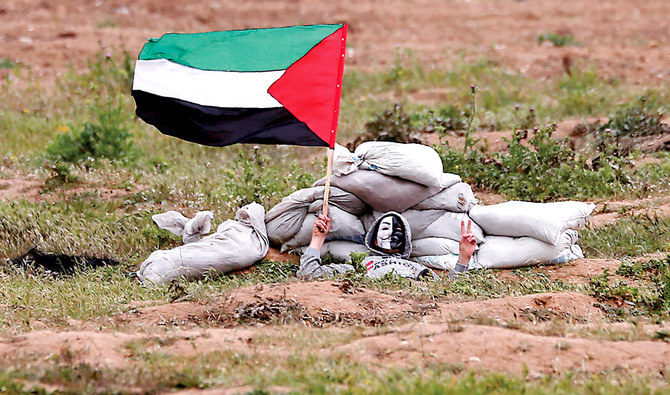
A protester waves the Palestinian flag during clashes with the occupation forces at the border with Israel, east of Gaza City. (AFP)
Updated 01 April 2019
Follow

Palestinians see little hope in Israeli elections

  • Israel’s upcoming elections could have a direct effect on the Palestinians

RAMALLAH: Tayseer Barakat is like many Palestinians when asked about the upcoming Israeli elections. He doesn’t see much hope.

“We have learned from past experience that we are always the victims of Israeli elections, and it doesn’t seem there will be anything new,” said 58-year-old Barakat.

“It is more than likely there will be no meaningful changes, despite our hopes that there will be something new to change the situation,” he added as he walked with bags of groceries in Ramallah in the occupied West Bank.

Israel’s upcoming elections could have a direct effect on the Palestinians, but many have little interest in who wins, having lost hope its more than 50-year occupation will end no matter which party is in charge.

Some who do express concern say they are worried the campaign could lead to an uptick in incitement against Palestinians.

Israeli Prime Minister Benjamin Netanyahu’s current coalition is considered the most right-wing in Israel’s history and includes prominent members who rule out a Palestinian state while seeking aggressive settlement expansion. Some call for annexing large parts of the West Bank. Peace talks have been frozen since 2014.

The Ramallah-based Palestinian Authority has previously made a freeze on settlement building a prerequisite to re-entering peace talks. At the beginning of the election campaign it was widely assumed Netanyahu would win, despite being dogged by corruption allegations.

But former military chief Benny Gantz has emerged as a serious challenger, with polls showing his centrist Blue and White alliance slightly ahead of Netanyahu’s Likud.

Under those polls, Gantz would still fall far short of an outright majority and it is unclear whether he could assemble enough parties to form a coalition.

Early in the campaign, Gantz signalled openness to withdrawing settlers from parts of the West Bank. His alliance’s platform favors “separation from the Palestinians” but does not mention a two-state solution.

Palestinians initially saw encouraging signs, but Saleh Rafat, a member of the Palestine Liberation Organization’s executive committee, said he now believes the policies of Gantz and Netanyahu are similar.

“So far we haven’t seen fundamental differences between the right-wing and the center party,” he said.

“They are proposing a unified Jerusalem and to continue settlement and control over the Jordan Valley.”

Israel seized mainly Palestinian East Jerusalem in the 1967 Six-Day War and considers the entire city its capital. The Palestinians see the city’s eastern sector as the capital of their future state.

Israel occupied the West Bank, including parts of the Jordan Valley, in 1967.

More than 600,000 Israelis live in settlements in East Jerusalem and the West Bank, communities considered illegal under international law.

The international community sees them as one of the largest obstacles to peace, though Israel disputes this while pointing to Palestinian attacks and what it calls incitement to violence.

Hafed Barghouti, a former Palestinian newspaper editor, said relative calm in the West Bank has led to less attention to the conflict in Israeli elections.

Israeli politics have also shifted firmly to the right in recent years.

“There is no Israeli party talking about the Palestinian issue. Those that do talk, do so in the language of a brutal occupation,” he said.

“The right, center and left agree to ignore the Palestinian issue and focus more on the legalization of marijuana.”

Whether to legalize recreational-use marijuana has received unexpected attention in the Israeli campaign.


US and Iran slide towards conflict as military buildup eclipses nuclear talks

Updated 10 sec ago
Follow

US and Iran slide towards conflict as military buildup eclipses nuclear talks

Iran and the United States are sliding rapidly towards military conflict as hopes fade for a diplomatic solution to their standoff over Tehran’s nuclear program, officials on both sides and diplomats across the Gulf and Europe say.

Iran’s Gulf neighbors and its enemy Israel now consider a conflict to be more likely than a settlement, these sources say, with Washington building up one of its biggest military deployments in the region since the invasion of Iraq in 2003.

Israel’s government believes Tehran and Washington are at an impasse and is making preparations for possible joint military action with the United States, though no decision has been made yet on whether to carry out such an operation, said a source familiar with the planning.

It would be the second time the US and Israel have attacked Iran in less than a year, following US and Israeli airstrikes against military and nuclear facilities last June.

Regional officials say oil-producing Gulf countries are preparing for a possible military confrontation that they fear could spin out of control and destabilize the Middle East.

Two Israeli officials told Reuters they believe the gaps between Washington and Tehran are unbridgeable and that the chances of a near‑term military escalation are high.

Some regional officials say Tehran is dangerously miscalculating by holding out for concessions, with US President Donald Trump boxed in by his own military buildup - unable to scale it back without losing face if there is no firm commitment from Iran to abandon its nuclear weapons ambitions.

“Both sides are sticking to their guns,” said Alan Eyre, a former US diplomat and Iran specialist, adding that nothing meaningful can emerge “unless the US and Iran walk back from their red lines - which I don’t think they will.”

“What Trump can’t do is assemble all this military, and then come back with a ‘so‑so’ deal and pull out the military. I think he thinks he’ll lose face,” he said. “If he attacks, it’s going to get ugly quickly.”

Two rounds of Iran-US talks have stalled on core issues, from uranium enrichment to missiles and sanctions relief.

When Omani mediators delivered an envelope from the US side containing missile‑related proposals, Iranian Foreign Minister Abbas Araghchi refused even to open it and returned it, a source familiar with the talks said.

After talks in Geneva on Tuesday, Araghchi said the sides had agreed on “guiding principles,” but the White House said there was still distance between them.

Iran is expected to submit a written proposal in the coming days, a US official said, and Araghchi said on Friday he expected to have a draft counterproposal ready within days.

But Trump, who has sent aircraft carriers, warships and jets to the Middle East, warned Iran on Thursday it must make a deal over its nuclear program or “really bad things” will happen.

He appeared to set a deadline of 10 to 15 days, drawing a threat from Tehran to retaliate against US bases in the region if attacked. The rising tensions have pushed up oil prices.

US officials say Trump has yet to make up his mind about using military force although he acknowledged on Friday that he could order a limited strike to try to force Iran into a deal.

“I guess I can say I am considering that,” he told reporters.

The possible timing of an attack is unclear. US Secretary of State Marco Rubio is due to meet Israeli Prime Minister Benjamin Netanyahu on February 28 to discuss Iran. A senior US official said it would be mid-March before all US forces were in place.