BEIJING: China’s manufacturing sector ended its four-month downward trend in March, official data showed Sunday, but exports continued their long slide in the wake of the Washington-Beijing trade war.
The official Purchasing Managers’ Index, a measure of factory activity, rose to 50.5 in March from the previous month’s contraction and three-year low of 49.2.
The growth was likely driven by seasonal factors as factories ramped up production after February’s Lunar New Year holidays.
Some steel mills and coal power plants also increased output as winter smog restrictions end.
Factory output also grew at its fastest pace in six months in March, China’s National Bureau of Statistics reported, but export orders shrank for the 10th straight month amid slowing global growth and as collateral damage in the trade spat the United States.
Over the last eight months, Washington and Beijing have slapped tariffs on more than $360 billion in two-way goods trade, weighing on the manufacturing sectors in both countries.
US and Chinese negotiators wrapped up trade talks in Beijing on Friday ahead of another round next week, when China’s economic tsar Liu He will head to Washington to continue discussions on a possible deal.
China has announced a raft of stimulus measures to cushion the impact from its cooling economy.
Earlier this month, Premier Li Keqiang announced more spending on roads, railways and other big-ticket infrastructure projects, along with tax cuts worth 2 trillion yuan ($297.27 billion) to ease pressure on companies and spur employment.
China announced a lower growth target of 6.0 to 6.5 percent this year, down from 6.6 percent growth in 2018.

China factory activity up after four-month slide
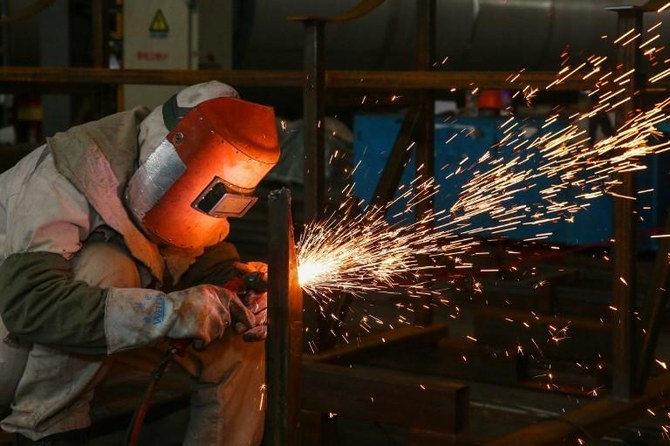
- The growth was likely driven by seasonal factors as factories ramped up production after February’s Lunar New Year holidays
- China announced a lower GDP growth target of 6.0 to 6.5 percent this year, down from 6.6 percent growth in 2018
Saudi energy minister holds series of high-level meetings to cement collaborations
RIYADH: Saudi Arabia’s Minister of Energy held a series of strategic meetings in Riyadh with senior ministers from various counties, in a diplomatic push to bolster international energy collaboration.
Officials from Greece, Brazil, and Morocco were among those to meet with Prince Abdulaziz bin Salman, as well as representatives from Libya and Pakistan.
The discussions centered on expanding cooperation across a wide spectrum of energy sectors, from traditional hydrocarbons to cutting-edge clean technologies, according to the Saudi Press Agency.
The engagements underscored Saudi Arabia’s proactive role in shaping the global energy transition through bilateral partnerships. A consistent theme across the talks was the dual focus on securing energy supplies and advancing climate-related solutions, including renewable power, clean hydrogen, and carbon management.
Deepening European and South American ties
Prince Abdulaziz bin Salman met with Greece’s Minister of Environment and Energy, Stavros Papastavrou. Building upon a previously signed Memorandum of Understanding, the two officials explored avenues for joint cooperation in oil and gas, electricity, and renewables, as well as other related sectors.
In a separate meeting with Brazil’s Minister of Mines and Energy, Alexandre Silveira, the parties discussed prospects for collaboration across various energy domains. They reviewed means to enhance coordination, particularly in electricity, renewables, oil and gas, and the exchange of technical expertise.
Signing a program with Morocco
A key outcome emerged from the meeting with Morocco’s Minister of Energy Transition and Sustainable Development, Leila Benali. Following their discussions on mutual interests, investment opportunities in renewables, and energy efficiency, the two sides signed an executive cooperation program.
This program, falling under an MoU signed in May 2022, aims to concretize the energy partnership. Its goals are boosting mutual investments in renewable projects and enabling national companies to collaborate on renewable energy projects.
It also encompasses using renewables in development projects, establishing joint research and development centers, and facilitating training and knowledge transfer.
Strengthening regional and Islamic cooperation
Prince Abdulaziz also conferred with Libya’s Minister of Oil and Gas, Khalifa Rajab Abdulsadek. Their meeting focused on energy cooperation, including energy technologies and solutions, as well as enhancing investment opportunities in renewables and energy efficiency.
Discussions with Pakistan’s Minister of Petroleum, Ali Pervaiz Malik, covered shared interests in oil and its supplies, renewable energy, energy efficiency, joint investment opportunities, and the exchange of expertise in project, policy, and regulatory development.
This flurry of diplomatic activity highlights Saudi Arabia’s comprehensive energy strategy, which seeks to maintain its leadership in traditional energy markets while pursuing a stake in the future clean energy economy.


