

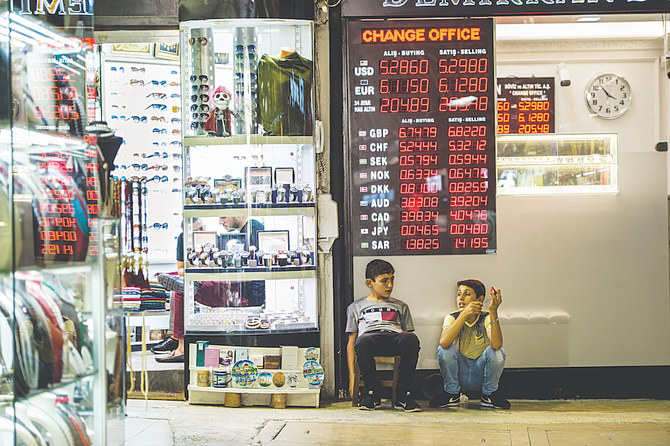

ISTANBUL: The Turkish lira weakened again on Friday and the government promised reforms, after a volatile week that brought back memories of last year’s currency crisis just as Turks head to polls this weekend.
Turkey’s currency was down 1.8 percent after having tumbled 5 percent on Thursday. The weakness, after a strong rebound earlier in the week, reflected a return of liquidity to a key London foreign-exchange market where investors use swaps to hedge and settle positions.
Among an array of tactics used to stabilize things since an initial selloff last Friday, the government had directed banks to temporarily starve the London market of lira liquidity, according to officials.
Finance Minister Berat Albayrak said on Thursday that Turkish banks were providing billions of lira to foreign markets and he promised Turkey would enter a reform period after the elections and give details soon.
But with Turkish stocks having plunged to their lowest levels since January and yields on bonds up to October levels, analysts raised doubts about a quick fix for an economy in the midst of a recession that could last well into this year.
SLOW RECOVERY
“Concerns about Turkey’s economy and financial markets are unlikely to fade even once Sunday’s local elections are out of the way. If anything, we think that they will intensify,” said Jason Tuvey, senior emerging markets economist at Capital Economics.
“The tightening of financial conditions adds to the reasons to think that, even once the economy emerges from recession, the recovery will be slow-going,” he said.
The lira stood at 5.6461 against the dollar at 1445 GMT after closing at 5.5825 on Thursday, when it weakened as much as 5.6465. Last year, it tumbled almost 30 percent against the US currency.
Turkish President Tayyip Erdogan is campaigning hard for his AK Party, which could lose control of Ankara and other major cities after the nationwide municipal elections on Sunday.
On Thursday Erdogan blamed lira weakness on attacks by the West. In another echo of last year’s crisis, when investors were spooked by his unorthodox economic views, the president also renewed calls for lower interest rates despite double-digit inflation and a fragile lira.
The currency has been hit by a lack of confidence among Turks, prompting them to snap up record holdings of dollars and gold. Uneasy relations with the United States and concerns about post-election government policy have also hurt investor sentiment.
The Turkish liquidity squeeze pushed the London swap rate to a record 1,200 percent on Wednesday but it has since slid back to more normal levels and was 23.75 percent on Friday, as lira-starved foreign investors flocked back in.
The weekly swap rate stood at 55 percent.
Separate data showed Turkey’s foreign trade deficit fell 63.1 percent year-on-year in February to $2.13 billion, with a slight increase in exports compared to the same period last year.
Albayrak, in a TV interview late on Thursday, said a reform framework may be announced in the week of April 8 if the plan is ready.
Turkey’s main BITS 100 index was up 1.6 percent on Friday while the banking index, which was hit hardest this week, was up 2.7 percent.
Fitch ratings agency said on Friday Turkish banks have a notable cushion against weaker asset quality.


