Year of Gaza protests leaves lives broken, medical system on brink

So stretched are health care services in Gaza City that thousands of operations have been delayed. (AFP)
Updated 29 March 2019
Follow

Year of Gaza protests leaves lives broken, medical system on brink

  • With major protests expected on the anniversary Saturday, medical professionals are worried

GAZA CITY: A year ago, Ezzedine Al-Baz’s decision to skip work and join tens of thousands at the first day of protests along the Gaza-Israel border nearly cost him his life.

Baz, then 29, said he had been standing a couple of hundred meters from the border fence for only about a half an hour when an Israeli sniper’s bullet pierced his leg.

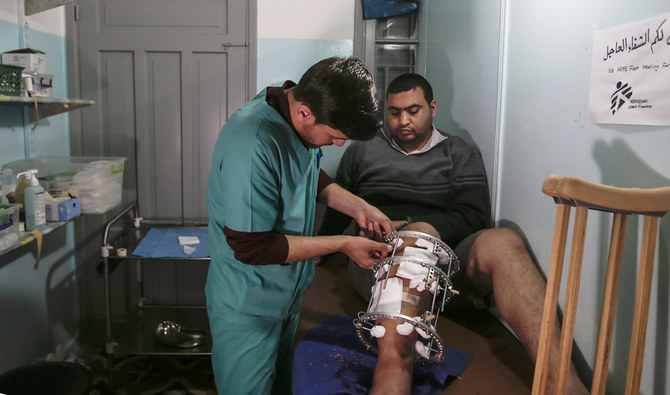
Five operations and multiple infections later, he is missing a chunk of bone, his leg remains strapped in a metal case and he will likely never walk as before.

“It has been a year that I have been suffering, there is still pain,” he said from a clinic run by medical charity Doctors Without Borders (MSF) in Gaza City.

“At night I don’t sleep at all. If I had known, I would have stayed at work.”

A year after the start of protests and clashes on the Gaza-Israel border, more than 200 Palestinians have been killed by Israeli fire.

But beyond those killed, thousands of others wounded have been largely forgotten.

There have also been knock-on impacts for the Palestinian territory’s already beleaguered health system. Hundreds of those shot remain at risk of infection and amputation, while Israel has turned down most applications to leave the strip for treatment.

So stretched are health care services that thousands of operations for other conditions have been delayed, while doctors who can leave are fleeing the strip, Gazan medics say.

With major protests expected on the anniversary Saturday, medical professionals are worried.

“A full-blown escalation would obviously push the system again toward the edge of collapse,” said Gerald Rockenschaub, the World Health Organization (WHO) head in the Palestinian territories.

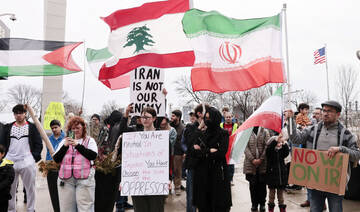
The protests labeled the Great March of Return have called for Palestinian refugees to be allowed to return to their former homes now inside Israel, which Israelis view as advocating for the destruction of the country. They were also billed as an opportunity for protesters to break the decade-long Israeli blockade of Gaza.

The World Bank says the restrictions are the primary cause of desperate economic circumstances in the strip, where seven out of 10 young people are unemployed.

Early on, many protesters remained far back from the fence and demonstrated peacefully. Others approached and clashed with Israeli forces. Those approaching the fence have progressively become more violent.

Explosive devices, stones and fireworks have been used against Israeli forces. There has been occasional gunfire, with one soldier killed by a Palestinian sniper.

Israeli forces’ use of live fire has come under heavy criticism, with Palestinians and rights groups saying protesters have been shot while posing little threat.

Last month, a UN probe said Israeli soldiers had intentionally fired on civilians in what could constitute war crimes.

At the MSF clinic, dozens of young men with casts sit on plastic chairs waiting for treatment.

The organization has treated more than 4,000 Palestinians with gunshot wounds. A few hundred are not healing and risk amputation.

Mohammed Bakr, a 27-year-old fisherman, was also shot on March 30 last year and has had six operations.

“Since that day I have had no hope for the future,” he said.

He accused Israeli soldiers of shooting at protesters who did nothing to provoke them.

“I won’t be able to work like before. The leg won’t carry weight.”

With Gaza’s medical system overstretched, treatment outside the strip could ease pressure.

Around 500 applications have been made by those injured in the marches to cross the Israeli border for treatment, according to figures published by the WHO.

Less than one in five have received the permits in time.

COGAT, the Israeli body responsible for the permits, confirmed it granted around 100 requests.

“The Gaza health system suffers from long years of neglect by the Hamas terror organization, which prefers to invest its citizens’ money in terror and military power,” it said.

More than 8,000 operations for other often serious but not life-threatening conditions — such as gallstones or hip replacements — have been postponed in Gaza hospitals according to the WHO.

Dozens of doctors also left Gaza in 2018, a huge spike from previous years, health officials say.

Neither the WHO nor Gaza health authorities said they had exact figures.

WHO’s Rockenschaub said he recently met a nurse who walked miles to work each day as she didn’t have money for a bus.

“Whenever we talk to health authorities in Gaza, even to individual physicians, many of them talk about their intention to leave,” he told AFP.


As Iran conflict spills over, Iraq’s Kurds say ‘this war is not mine’

Updated 08 March 2026
Follow

As Iran conflict spills over, Iraq’s Kurds say ‘this war is not mine’

  • The Kurds, an ethnic minority with a distinct culture and language, are rooted in the mountainous region spread across Turkiye, Syria, Iraq and Iran
  • “This isn’t my war,” said 58-year-old Satar Barsirini

SORAN, Iraq: On a deserted road not too far from the border between Iran and Iraqi Kurdistan, Satar Barsirini looked up at the sky, now streaked with jets and drones.
Iraq’s Kurdish region has found itself caught in the crossfire of a regional war triggered by US and Israeli attacks on the Islamic republic.
Dressed like the Kurdish fighters he once served alongside, Barsirini still wears the khaki shalwar, fitted jacket and scarf wrapped around his waist.
Though recently retired, he refuses to give up his peshmerga uniform as he tills his small plot of land.
The rumble of jets and hum of drones “come from everywhere. Especially at night,” he told AFP in the hamlet of Barsirini, dozens of kilometers from the border.
He described the “shiver in our flesh” as the drones hit the ground outside.
“I feel bad for the people, because we have paid a lot in blood to liberate Kurdistan... We just want to live.”
Irbil, the autonomous region’s capital, and the valleys leading to the border have been targeted by Tehran and the Iraqi armed groups it supports.
American bases there have come under fire, as have positions held by Iranian Kurdish parties — the same ones US President Donald Trump said it would be “wonderful” to see storm Iran.
But Iran warned on Friday it would target facilities in Iraqi Kurdistan if fighters crossed into its territory.
“This isn’t my war,” said 58-year-old Barsirini.
He recalled the brutal repression and flight into the snowy mountains after the 1991 Kurdish uprising that followed the first Gulf War.

- ‘Dangerous people’ -

The uprising was repressed, leading to an exodus of two million Kurds to Iran and Turkiye.
“When we fled the cities for our lives, we went to Iran. They helped us, they gave us shelter and food,” he said.
The Kurds would not forget that, Barsirini stressed, adding that they could not just “turn against them” now to support the US and Israel.
“I don’t trust (Americans). They are dangerous people,” he said.
The Kurds, an ethnic minority with a distinct culture and language, are rooted in the mountainous region spread across Turkiye, Syria, Iraq and Iran.
They have long fought for their own homeland, but for decades suffered defeats on the battlefield and massacres in their hometowns.
They make up one of Iran’s most important non-Persian ethnic minority groups.
A week of war has gripped daily life in Iraqi Kurdistan, residents told AFP.
“People are afraid,” said Nasr Al-Din, a 42-year-old policeman who, as a child, lived through the 1991 exodus — “thrown on a donkey’s back with my sister.”
“This generation is different from the older ones” that have seen “seen fighting.”
Now, he said, you could be “sitting down in your home... and all of a sudden a drone hits your house.”
“We may have to go into town or somewhere safer,” said Issa Diayri, 31, a truck driver waiting in a roadside garage, his lorry idle for lack of deliveries from Iran.

- ‘Shouldn’t get involved’ -

Soran, a small town of 3,000 people about 65 kilometers (40 miles) from the border, was hit Thursday by a drone that fell in the middle of a street.
There, baker Yussef Ramazan, 42, and his three apprentices, hurriedly made bread before breaking their fast.
But, living so close to the Iranian border, he said “people are afraid to come and buy it.”
He told AFP he did not think it was a good idea “for the Kurdish region to get involved in this war.”
“We are not even an independent country yet. We would like to become one, but we are nothing for now, so we shouldn’t get involved in these situations.”
Across the street, Hajji watched from his empty dry cleaning shop as the road cleared.
Before the war, the town was crowded as evening fell, he said, declining to give his full name.
“But after the drone explosion, no one was here. In five minutes, everyone left the street and no one was out.”