KARACHI: Zahid Saleem was a young boy when his family moved from the crooked shanty where they had always lived into a new house they were allocated in Saudabad in the teeming port city of Karachi.
It was the late fifties and the housing scheme had just been built with largess from Saudi Arabia’s King Shah Saud Bin Abdul Aziz.
“I was a child but I still remember that day,” Saleem, 70, told Arab News at the house where he has lived for over half a century.
Less than ten years after the partition of India, the new neighborhood with its 1,800 homes was a dream come true for thousands of Muslim migrants to Karachi, struggling to settle after leaving everything behind in India, Saleem said.
“Saudi Arabia has been our friend in need from day one,” he added.
King Saud laid the foundation stone of the housing project in April 1954 during a ten-day state visit, according to Pakistan Chronicle, a historical encyclopedia, “to express his resolve of friendship with Pakistan.”
This was not King Saud’s first visit to Karachi. As crown prince, he had visited the seaside metropolis in April 1940, seven years before Pakistan came into being, and was warmly welcomed by leaders of the All India Muslim League, the political party whose advocacy for a separate Muslim-majority nation-state led to the partition of British India in 1947.
It was there that the foundations of Pakistan-Saudi ties were first laid, as the then crown prince met with leaders of the Pakistan Movement, including MAH Ispahani, MA Maniar and Karim Bhai Ibrahim in Karachi.
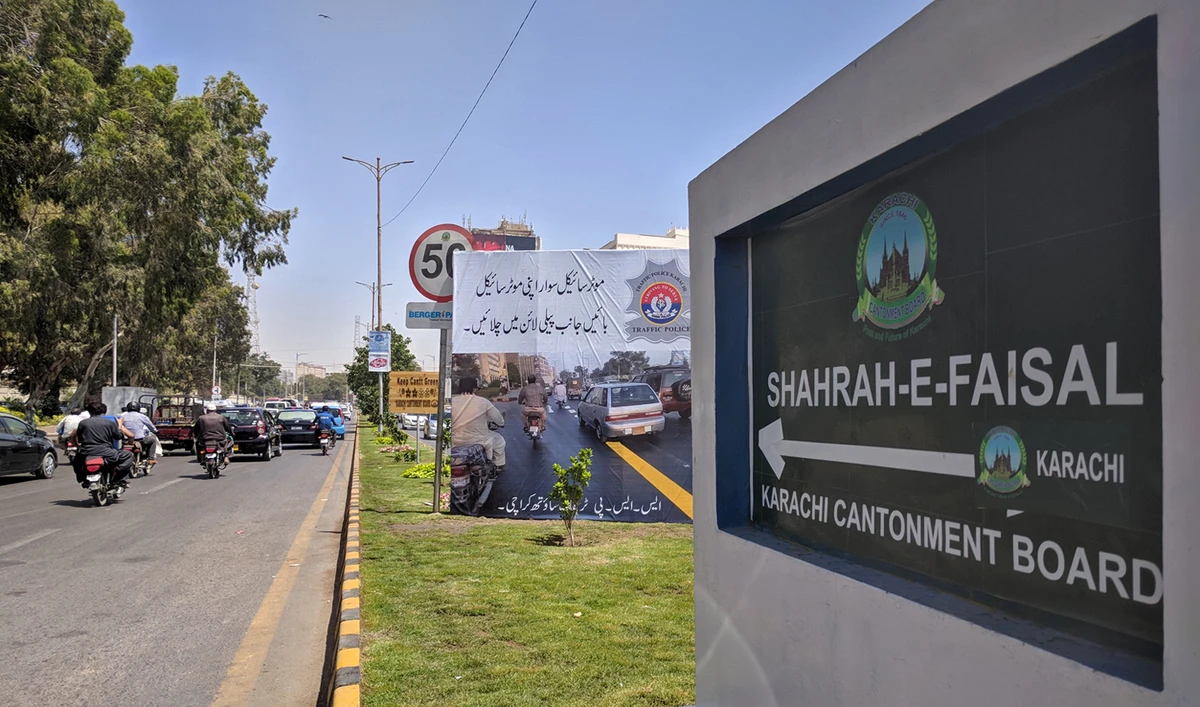
On February 22, 1974, Pakistan hosted some of the most important leaders of the Muslim world at an Islamic Summit Conference at which King Shah Faisal was also present. Soon after the conference, the name of Drigh Road, the main boulevard that runs from the famed Hotel Metropole to Star Gate, was changed to Shahrah-e-Faisal.
“To recognize his remarkable services for the Muslim Ummah, especially Pakistan, the government of Pakistan named Shahrah-e-Faisal in the name of King Faisal Bin Abdul Aziz,” said Yahya Bin Zakria, a journalist who lives in Saudabad.
Another densely populated neighborhood called Drigh Colony, one of Karachi’s early settlements constructed for Muslim migrants in 1952, was also renamed Shah Faisal Town.
Mazhar Ahmed, a 68-year-old resident of Shah Faisal Town, said Shahrah-e-Faisal was initially a one-lane road that saw massive traffic snarls and was inconvenient for commuters.
“King Faisal extended financial help and the 18-kilometer long thoroughfare was reconstructed, making it good for two way traffic,” Ahmed said. “The air base at main Shahrah-e-Faisal was also named Faisal Airbase.”
“Names like Saudabad, Shah Faisal Town, Faisal Airbase and Shahrah-e-Faisal,” Ahmed said, “will keep reminding us of the Saudi Kings who helped the newly created Pakistan settle its homeless migrants and get good roads.”
In Pakistan’s Karachi, many neighborhoods and roads in Saudi Kingdom’s name
- King Saud laid foundation stone for the Saudabad neighborhood in April 1954
- Karachi’s Drigh Road and Drigh Colony renamed Shahrah-e-Faisal and Shah Faisal Town after King Faisal attended Islamic Summit in Pakistan in 1974
Pakistan military says ex-PM Khan’s narrative has become ‘threat to national security’
- Military spokesperson responds to Khan’s fresh criticism of Pakistan’s powerful army chief, whom he accuses of denying him basic rights
- Lt. Gen. Ahmed Sharif Chaudhry warns army will “come bare knuckle” if Khan and his party do not desist from attacking military leadership
ISLAMABAD: Pakistan military spokesperson Lt. Gen. Ahmed Sharif Chaudhry said on Friday that former prime minister Imran Khan’s narrative against the armed forces has become a “national security threat,” warning him and his party to keep the army out of political statements.
Chaudhry’s criticism comes in response to Khan’s latest statement, released by his account on social media platform X on Thursday, in which he blamed Chief of Defense Forces Field Marshal Asim Munir for “the complete collapse of the constitution and rule of law in Pakistan.”
Khan, who was ousted via a parliamentary vote in April 2022, blames the country’s powerful army for colluding with his political rivals to keep him away from power. He blames the military and the incumbent government for keeping him in solitary confinement in a central prison in Rawalpindi. Pakistan’s military and the government have strongly rejected his claims.
“It may seem to you a bit strange coming from me this because that person [Khan] and the narrative he is pushing, it has become a national security threat,” Chaudhry told reporters at a news conference.
“And that is why it is very important that we come clear, without any ambiguity, without any doubt. We need to come clear and we need to say what needs to be said,” he added.
Throughout the press conference, Chaudhry kept referring to the former prime minister as a “mentally ill” person. He played video clips of Indian news channels and Afghanistan’s social media accounts promoting Khan’s statements against the military.
“Why would they not do it? Because sitting in your country, a mindset, a mentally ill person sitting here is saying these things against the military and its leadership,” he said.
The military spokesperson warned Khan and his party against criticizing the military. He added that while the military welcomes constructive criticism, it should be kept away from political statements.
“If someone for the sake of his own self, his delusional mindset and narcissistic thinking attacks this armed forces and its leadership, then we will also come bare knuckle,” he warned.
“There should be no doubt on that.”
Khan, who remains in prison on a slew of charges that he says are politically motivated, continues to be popular among the masses.
His Pakistan Tehreek-e-Insaf (PTI) party has frequently led rallies to demand his release from jail, including one in May 2023 and another in November 2024 that saw clashes with law enforcement personnel.
While the former prime minister continues to remain behind bars, rallies organized by the PTI still draw thousands of people across the country and his party still enjoys a sizable following on social media platforms.