KARACHI: Zahid Saleem was a young boy when his family moved from the crooked shanty where they had always lived into a new house they were allocated in Saudabad in the teeming port city of Karachi.
It was the late fifties and the housing scheme had just been built with largess from Saudi Arabia’s King Shah Saud Bin Abdul Aziz.
“I was a child but I still remember that day,” Saleem, 70, told Arab News at the house where he has lived for over half a century.
Less than ten years after the partition of India, the new neighborhood with its 1,800 homes was a dream come true for thousands of Muslim migrants to Karachi, struggling to settle after leaving everything behind in India, Saleem said.
“Saudi Arabia has been our friend in need from day one,” he added.
King Saud laid the foundation stone of the housing project in April 1954 during a ten-day state visit, according to Pakistan Chronicle, a historical encyclopedia, “to express his resolve of friendship with Pakistan.”
This was not King Saud’s first visit to Karachi. As crown prince, he had visited the seaside metropolis in April 1940, seven years before Pakistan came into being, and was warmly welcomed by leaders of the All India Muslim League, the political party whose advocacy for a separate Muslim-majority nation-state led to the partition of British India in 1947.
It was there that the foundations of Pakistan-Saudi ties were first laid, as the then crown prince met with leaders of the Pakistan Movement, including MAH Ispahani, MA Maniar and Karim Bhai Ibrahim in Karachi.
On February 22, 1974, Pakistan hosted some of the most important leaders of the Muslim world at an Islamic Summit Conference at which King Shah Faisal was also present. Soon after the conference, the name of Drigh Road, the main boulevard that runs from the famed Hotel Metropole to Star Gate, was changed to Shahrah-e-Faisal.
“To recognize his remarkable services for the Muslim Ummah, especially Pakistan, the government of Pakistan named Shahrah-e-Faisal in the name of King Faisal Bin Abdul Aziz,” said Yahya Bin Zakria, a journalist who lives in Saudabad.
Another densely populated neighborhood called Drigh Colony, one of Karachi’s early settlements constructed for Muslim migrants in 1952, was also renamed Shah Faisal Town.
Mazhar Ahmed, a 68-year-old resident of Shah Faisal Town, said Shahrah-e-Faisal was initially a one-lane road that saw massive traffic snarls and was inconvenient for commuters.
“King Faisal extended financial help and the 18-kilometer long thoroughfare was reconstructed, making it good for two way traffic,” Ahmed said. “The air base at main Shahrah-e-Faisal was also named Faisal Airbase.”
“Names like Saudabad, Shah Faisal Town, Faisal Airbase and Shahrah-e-Faisal,” Ahmed said, “will keep reminding us of the Saudi Kings who helped the newly created Pakistan settle its homeless migrants and get good roads.”


![]()
![]()
![]()
![]()

In Pakistan’s Karachi, many neighborhoods and roads in Saudi Kingdom’s name


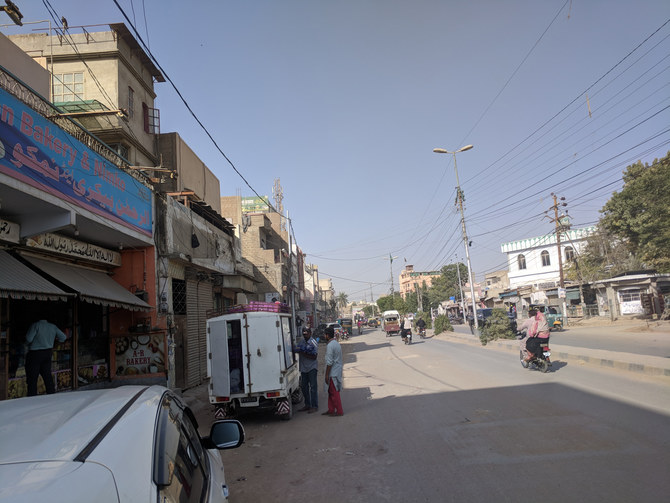

In Pakistan’s Karachi, many neighborhoods and roads in Saudi Kingdom’s name
- King Saud laid foundation stone for the Saudabad neighborhood in April 1954
- Karachi’s Drigh Road and Drigh Colony renamed Shahrah-e-Faisal and Shah Faisal Town after King Faisal attended Islamic Summit in Pakistan in 1974
Latest updates





© 2026 SAUDI RESEARCH & PUBLISHING COMPANY, All Rights Reserved And subject to Terms of Use Agreement.