

Erdogan’s party battles for major cities in Turkey local polls

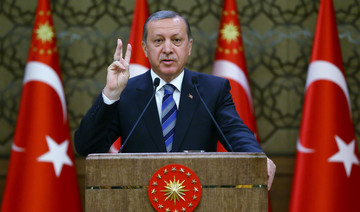
Turkey's President Recep Tayyip Erdogan addresses the supporters of his ruling Justice and Development Party, AKP, during a rally in Adiyaman, Turkey, on March 26, 2019, ahead of local elections scheduled for March 31, 2019. (AP)
Updated 28 March 2019
Follow

Erdogan’s party battles for major cities in Turkey local polls

  • Opposition parties hope economic woes may translate into a victory against Erdogan
  • Erdogan’s party has won every vote since first coming to power in 2002

ISTANBUL: To hear President Recep Tayyip Erdogan on the campaign trail, Turkey’s municipal elections on Sunday may be a fight for survival against foreign and domestic enemies trying to destroy the country.

For many Turks, it may be more about the family finances.

No one expects a major defeat for Erdogan’s AKP. But with Turkey’s economy in recession and inflation in double digits, the ruling party faces a tough battle to capture key cities like Istanbul and the capital Ankara. Sunday’s vote — for 30 major cities, 51 provincial municipalities and district councils — will be a barometer on how well the AKP is faring after building its ballot box success on Turkey’s growth under Erdogan.

The Turkish leader has campaigned hard for AKP, despite not running himself, often speaking more than three times a day and rolling out heavyweight candidates like former premier Binali Yildirim for Istanbul mayor.

Opposition parties hope economic woes may translate into a victory against Erdogan in key municipalities such as Istanbul and Ankara where polls show a tight race.

“Losing either city now would be a huge symbolic blow to his power in Turkey,” said Soner Cagaptay, an analyst with the Washington Institute for Near East Policy. “He has gone for a strategy of pulling out all the stops.”

Erdogan’s party has won every vote since first coming to power in 2002. The next presidential and legislative elections will be in 2023.

After a currency crisis last year partly over US sanctions, Turkey’s economy slipped into recession for the first time since 2009. 

Just weeks before the vote, Erdogan last month ordered city authorities in Istanbul and Ankara to open their own vegetable and food stalls to sell produce at discount prices. Erdogan has sometimes appeared on the defensive over the economy, even arguing long lines forming at the municipal food stalls were a sign of “prosperity,” when the opposition portrayed them as a mark of “poverty.”

Rather than campaigning on the economy or local issues, Erdogan has more often made the vote about Turkey’s national security and survival against enemies looking to undermine the AKP’s progress.

In a patriotic appeal to his electoral base — often more religiously conservative Turks — Erdogan has shown videos trying to associate the main opposition CHP party as linked to PKK Kurdish militants. After the attack on Muslims at two New Zealand mosques, Erdogan played clips of a video made by the gunman at his rallies.

The move, an attempt to tarnish one of Turkey’s main secular opposition leaders, drew international opprobrium. “These elections are not just municipal elections; this is a vote for our survival,” Erdogan said at a rally this week in Mus in eastern Turkey.

Facing the AKP electoral powerhouse, major opposition parties have changed strategy to present common candidates in several cities, including Istanbul and Ankara, in an effort to not split the anti-Erdogan vote.

Main opposition party CHP and smaller nationalist group Iyi party, are supporting the same candidate in Turkey’s two major cities.

The pro-Kurdish opposition HDP party, weakened by the arrests of some of its lawmakers and leader on terrorism charges, has focused its efforts in the Kurdish majority southeast of Turkey.

Erdogan has presented the HDP as linked with the PKK militants, who are listed as a terrorist group by Ankara and its Western allies.

He has threatened to replace mayor posts won by pro-Kurdish parties with state-appointed trustees, a move previously carried out by the government, which was denounced by rights groups for undermining the rule of law.

Faced with Erdogan’s pressure, the HDP, which won six million votes in the last legislative election in 2018, has urged supporters to vote against the AKP in major western cities where Kurdish voters could make a difference.

Israeli-backed group kills a senior Hamas police officer in Gaza, threatens more attacks

Updated 3 sec ago
Follow

Israeli-backed group kills a senior Hamas police officer in Gaza, threatens more attacks

  • Hussam Al-Astal, leader of an anti-Hamas group based in an area under Israeli control east of Khan Younis, claimed responsibility for the killing
CAIRO: An Israeli-backed Palestinian militia said on Monday it had killed a senior Hamas police officer in the southern Gaza Strip, an incident which Hamas blamed on “Israeli collaborators.”
A statement from the Hamas-run interior ministry said gunmen opened fire from a passing car, ​killing Mahmoud Al-Astal, head of the criminal police unit in Khan Younis, in the south of the enclave. It described the attackers as “collaborators with the occupation.”
Hussam Al-Astal, leader of an anti-Hamas group based in an area under Israeli control east of Khan Younis, claimed responsibility for the killing in a video he posted on his Facebook page. The surname he shares with the dead man, Al-Astal, is common in that part of Gaza.
“To those who work with Hamas, your destiny is to be killed. Death is coming to you,” he ‌said, dressed in ‌a black military-style uniform and clutching an assault rifle.
Reuters could ‌not ⁠independently ​verify ‌the circumstances of the attack. An Israeli military official said the army was not aware of any operations in the area.
The emergence of armed anti-Hamas groups, though still small and localized, has added pressure on the Islamists and could complicate efforts to stabilize and unify a divided Gaza, shattered by two years of war.
These groups remain unpopular among the local population as they operate in areas under Israeli control, although they publicly deny they take Israeli orders. Hamas has held public executions ⁠of people it accuses of collaboration.
Under a ceasefire in place since October, Israel has withdrawn from nearly half of ‌the Gaza Strip, but its troops remain in control of ‍the other half, largely a wasteland ‍where virtually all buildings have been levelled.
Nearly all of the territory’s two million people ‍now live in Hamas-held areas, mostly in makeshift tents or damaged buildings, where the group has been reasserting its grip. Four Hamas sources said it continues to command thousands of fighters despite suffering heavy losses during the war.
Israel has been allowing rivals of Hamas to operate in areas it controls. In ​later phases, US President Donald Trump’s plan for Gaza calls for Israel to withdraw further and for Hamas to yield power to an internationally backed administration, ⁠but there has so far been no progress toward those steps.
Prime Minister Benjamin Netanyahu acknowledged Israeli backing for anti-Hamas groups in June, saying Israel had “activated” clans, but has given few details since then.
The ceasefire has ended major combat in Gaza over the past three months, but both sides have accused the other of regular violations. More than 440 Palestinians and three Israeli soldiers have been killed since the truce took effect.
Gaza health authorities said on Monday Israeli drone fire killed at least three people near the center of Khan Younis.
The Israeli military did not have an immediate comment on the drone incident.
The war erupted on October 7, 2023 when Gazan militants invaded Israel, killing about 1,200 people and taking some 250 hostages, according to ‌Israeli tallies.
Israel’s subsequent military assault on Gaza has killed more than 71,000 Palestinians, according to the enclave’s health ministry, and led to accusations of genocide and war crimes, which Israel denies.