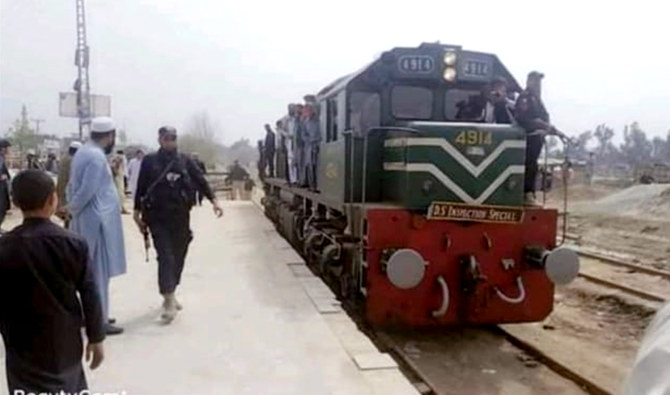

PESHAWAR: After an 18-year-long-gap, the relaunch last week of a train connecting major parts of the northwestern Khyber Pakhtunkhwa province will attract local and foreign commuters and boost tourism, officials and locals said on Tuesday.
On Sunday, Federal Minister for Railways Sheikh Rashid inaugurated the safari train service from Nowshera to Mardan and Dargai. The train will make several ancient Buddhist sites and British era monuments accessible and cross through Takht Bhai where an ancient Buddhist monastery, among the most imposing relics of Buddhism in all of Gandhara, is located. The complex is on the UNESCO’s World Heritage List and has survived successive invasions since it was built in the first century.
Nisar Muhammad, a spokesman for the Khyber Pakhtunkhwa Minister for Tourism, said the train service from Nowshera-Mardan-Takht Bhai, with its last stop in Dargai, had been launched to bring a larger number of tourists to the remote region.
In January, Pakistan announced it had loosened travel restrictions in the hope of reviving tourism by offering visas on arrival to visitors from 50 countries and electronic visas to 175 nationalities.
“We have a good railway track up to Takht Bhai but the onward track will be restored within a month, which will enhance the tourism sector of the province as envisioned by Prime Minister Imran Khan,” he said.
Muhammad said passengers could now travel directly onwards from Dargai, a small hamlet located in the northwestern province.
Amjad Khan at the Railway Control Office in Peshawar, the capital of Khyber Pakhtunkhwa, said the department had acquired the required number of coaches and steam engines to make the service operational within a month.
“The service is expected to run from April 30. We will specifically ensure latest facilities to tourists visiting sacred Buddhist sites,” Khan said.
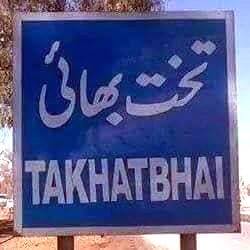
A signboard directs visitors to Takht Bhai, a district in the Khyber Pakhtunkhwa province which is also part of UNESCO's World Heritage List for its well-structured Buddhist monasteries. (AN photo)
The train is expected to run twice a week initially but will eventually turn into a daily service, depending on the volume of travelers, he said.
“It will spur local business, which will improve the national economy,” Khan said. “I am sure the launch of the service will promote Khyber Pakhtunkhwa’s vibrant tourism sector.”
Junaid Zama, a government servant who hails from Takht Bhai, told Arab News that the facility would have a “far-reaching” impact on the businesses of the impoverished area.
“Locals with roadside eateries and stalls in my village, who solely depend on visitors, will be able to make a better living,” he said.
Maqsood Ahmed, a banker in Mardan, said the train service would allow people easy access to remote tourists’ spots within the shortest possible time.
“The train service will for sure attract local and foreign tourists, which in return will enhance local businesses manifold,” he observed.
Haq Nawaz, an elderly resident of Mardan, said that the revival of the train service to Dargai-Malakand via Mardan and Takht Bhai would also ensure the easier transportation of goods to remote areas.
“People will now have the opportunity to see for themselves the genuine beauty of Pakistan because many tourists spots sit in this part of the country,” he added.