CAIRO: Egyptian prosecutors have referred 28 terror suspects in two separate cases to court on charges of joining local affiliates of the Daesh group and Al-Qaeda.
They said Monday the suspects were plotting attacks against security forces and the headquarters of the high state prosecution in Cairo.
They say only 17 of the 28 suspects are in custody. No date has been set for their trials. It was not clear when or where they were arrested.
A Daesh affiliate based in northern Sinai has carried out attacks across Egypt in recent years, mainly targeting security forces and the country’s Christian minority.
Egypt has been battling militants for years, but the insurgency gathered strength after the 2013 military overthrow of an elected but divisive Islamist president.


Egypt refers 28 to court on charges of joining Daesh, Al-Qaeda
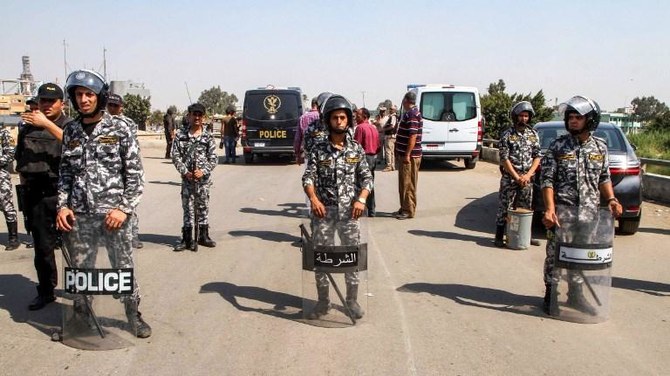
Egypt refers 28 to court on charges of joining Daesh, Al-Qaeda

- Egyptian officials said only 17 of the 28 suspects are actually in custody
- They said the suspects were planning to conduct attacks in Egypt


Syria Kurds chief says ‘all efforts’ being made to salvage deal with Damascus
- Abdi said the Syrian Democratic Forces (SDF), the Kurds’ de facto army, remained committed to the deal
- The two sides were working toward “mutual understanding” on military integration and counter-terrorism
DAMASCUS: Syrian Kurdish leader Mazloum Abdi said Thursday that “all efforts” were being made to prevent the collapse of talks on an agreement with Damascus to integrate his forces into the central government.
The remarks came days after Aleppo saw deadly clashes between the two sides before their respective leaders ordered a ceasefire.
In March, Abdi signed a deal with Syrian President Ahmed Al-Sharaa to merge the Kurds’ semi-autonomous administration into the government by year’s end, but differences have held up its implementation.
Abdi said the Syrian Democratic Forces (SDF), the Kurds’ de facto army, remained committed to the deal, adding in a statement that the two sides were working toward “mutual understanding” on military integration and counter-terrorism, and pledging further meetings with Damascus.
Downplaying the year-end deadline, he said the deal “did not specify a time limit for its ending or for the return to military solutions.”
He added that “all efforts are being made to prevent the collapse of this process” and that he considered failure unlikely.
Abdi also repeated the SDF’s demand for decentralization, which has been rejected by Syria’s Islamist authorities, who took power after ousting longtime ruler Bashar Assad last year.
Turkiye, an important ally of Syria’s new leaders, sees the presence of Kurdish forces on its border as a security threat.
In Damascus this week, Turkish Foreign Minister Hakan Fidan stressed the importance of the Kurds’ integration, having warned the week before that patience with the SDF “is running out.”
The SDF control large swathes of the country’s oil-rich north and northeast, and with the support of a US-led international coalition, were integral to the territorial defeat of the Daesh group in Syria in 2019.
Syria last month joined the anti-IS coalition and has announced operations against the jihadist group in recent days.


