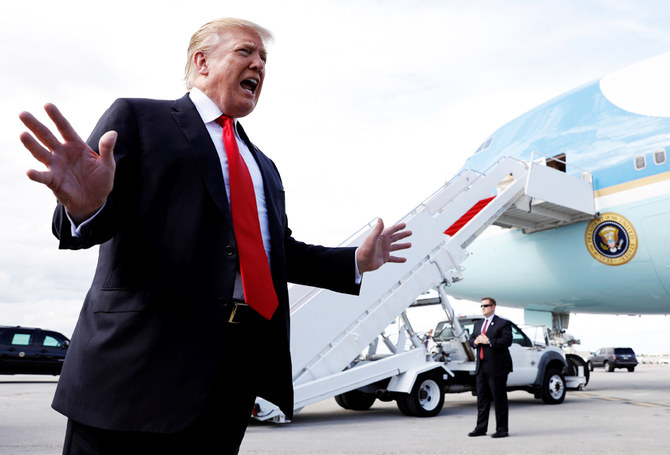
WASHINGTON: US President Donald Trump declared he had been completely exonerated Sunday after his campaign was cleared of colluding with Russia in the 2016 election campaign.
But the final report by Special Counsel Robert Mueller left unresolved allegations that Trump obstructed justice in his attacks on the probe.
“There was no collusion with Russia. There was no obstruction. It was a complete and total exoneration,” Trump said.
“It’s a shame that the country had to go through this,” he added. “This was an illegal takedown that failed.”
In a summary of Mueller’s findings sent to Congress, Attorney General Bill Barr said no Trump campaign official was involved in the Russian conspiracies to hack Democratic computers and flood social media with disinformation to harm Trump’s election rival Hillary Clinton.
“The special counsel did not find that the Trump campaign, or anyone associated with it, conspired or coordinated with the Russian government in these efforts,” Barr wrote.
On the other hand, Barr said Mueller declined to reach a decision on the evidence against the president of obstruction — almost guaranteeing that Democrats in Congress will push to investigate this further.
Mueller wrote that “while this report does not conclude that the president committed a crime, it also does not exonerate him,” Barr said.
Barr though added that his own review of that evidence together with Deputy Attorney General Rod Rosenstein showed it was “not sufficient” to prove whether Trump’s multiple attempts to interfere with Mueller’s investigation rose to an obstruction-of-justice offense.
The White House claimed the cloud over the White House had been lifted after the 22-month probe.
“The special counsel did not find any collusion and did not find any obstruction,” White House spokeswoman Sarah Sanders said in a tweet.
“AG Barr and DAG Rosenstein further determined there was no obstruction. The findings of the Department of Justice are a total and complete exoneration of the president of the United States.”
Barr’s letter marked the conclusion of the disturbing investigation into allegations that Trump’s election campaign coordinated and colluded with Russians to skew the 2016 vote so the billionaire real estate magnate would win.
Mueller’s team indicted 34 individuals, and reached guilty pleas or verdicts against five former Trump aides, including one-time attorney Michael Cohen, national security adviser Michael Flynn and campaign chairman Paul Manafort.
But it marked the beginning of a new phase, the determination of Democrats in Congress to further investigate Trump, using the evidence from the Mueller probe.
Democrats demanded to receive Mueller’s entire report and his underlying evidence to further their own multiple investigations into the president.
“Seems like the Department of Justice is putting matters squarely in Congress’ court,” tweeted Democratic Representative Jerry Nadler, the chairman of the House Judiciary Committee.
“Special Counsel Mueller clearly and explicitly is not exonerating the President, and we must hear from AG Barr about his decision making and see all the underlying evidence for the American people to know all the facts.”

Trump declares ‘complete exoneration’ after Mueller report finds no collusion
- Special Counsel Robert Mueller spent 2 years investigating alleged Russian meddling in the 2016 US Election HisHe submitte
- He submitted his report to the US attorney general, who is tasked to make his report of Mueller's findings to the House of Representatives
US and Mideast countries seek Kyiv’s drone expertise as Russia-Ukraine talks put on ice
KYIV, Ukraine: The United States and its allies in the Middle East are seeking Ukraine's expertise in countering Iran's Shahed drones, according to Ukrainian President Volodymyr Zelenskyy.
Various countries, including the United States, have approached Ukraine for help in defending against the Iranian drones, Zelenskyy said late Wednesday. He said he has spoken in recent days with the leaders of the United Arab Emirates, Qatar, Bahrain, Jordan and Kuwait about possible cooperation.
Russia has fired tens of thousands of Shaheds at Ukraine since it invaded its neighbor just over four years ago, launching a swarm of more than 800 drones and decoys in its biggest nighttime barrage. Iran has responded to joint U.S.-Israeli strikes by launching the same type of drones at countries in the Middle East.
Ukrainian assistance in countering Iranian drones will be provided only if it does not weaken Ukraine's own defenses, and if it adds leverage to Kyiv's diplomatic efforts to stop the Russian invasion, according to the Ukrainian leader.
"We help to defend from war those who help us, Ukraine, bring a just end to the war" with Russia, Zelenskyy said. Later Thursday, Zelenskyy said he had received a U.S. request for support to defend against the drones in the Middle East and had given the order for equipment to be provided along with Ukrainian experts without providing further details.
"Ukraine helps partners who help our security and the protection of our people's lives," he added in a social media post.
Trump, in an interview Thursday with Reuters, said, "Certainly I'll take, you know, any assistance from any country."
Ukraine has battle-tested drone defenses
Ukraine has pioneered the development of cut-price drone killers that cost as little as $1,000, rewriting the air defense rule book and making other countries take notice.
European countries got a wake-up call last September on the changed nature of air defense when Poland scrambled multimillion-dollar military assets, including F-35 and F-16 fighter jets and Black Hawk helicopters, in response to airspace violations by cheap drones.
Ukrainian manufacturers have developed low-cost interceptor drones specifically designed to hunt and destroy Shaheds, and its rapidly expanding drone industry is producing excess capacity.
Zelenskyy announced earlier this year that Ukraine would begin exporting the battle-tested systems.
The European Union's top diplomat, Kaja Kallas, said before chairing a meeting of EU and Gulf foreign ministers via video link Thursday that the talks would look at how Ukraine's experience can help countries counter Iranian drones.
Middle East war delays Russia-Ukraine talks
The Iran war, now in its sixth day, has drawn international attention away from Europe's biggest conflict since World War II, and forced the postponement of a new round of U. S-brokered talks between Russia and Ukraine planned for this week, Zelenskyy said.
Western governments and analysts say the Russia-Ukraine war has killed hundreds of thousands of people, while there is no sign that yearlong U.S.-led peace efforts will stop the fighting any time soon.
"Right now, because of the situation around Iran, there are not yet the necessary signals for a trilateral meeting," Zelenskyy said. "But as soon as the security situation and the overall political context allow us to resume that trilateral diplomatic work, it will be done."
Zelenskyy thanked the United States for the return from Russia on Thursday of 200 Ukrainian prisoners of war. Russia's Defense Ministry also said it received the same number of prisoners from Ukraine and thanked the U.S. and United Arab Emirates for mediating.
Prisoner swaps have been one of the few tangible results of the talks. Vladimir Medinsky, a Russian negotiator, said on social media that a total of 500 prisoners from each side would be exchanged between Thursday and Friday.
Oleksandr Merezhko, the head of Ukraine's parliamentary foreign affairs committee, said Russian President Vladimir Putin is trying to drag out the negotiations so that he can press on with Russia's invasion while escaping further U.S. sanctions.
He urged the U.S. administration to look at the Russia-Ukraine war and the war in the Middle East as linked.
"In reality, Russia and Iran are close allies that act in concert — Iran supplies weapons and Russia helps Iran develop its defense industry. These are interconnected conflicts," Merezhko told The Associated Press.
Ukraine's army has recently pushed back Russian forces at some points along the roughly 1,250-kilometer (750-mile) front line, according to the Institute for the Study of War.
Localized Ukrainian counterattacks liberated more territory than Ukrainian forces lost in the last two weeks of February, the Washington-based think tank said this week, estimating the recovered land at about 257 square kilometers (100 square miles) since Jan. 1.


