
ATHENS: The exhibition “Roads of Arabia: Archaeological Treasures of Saudi Arabia” continues to travel the world, opening in Greece on Wednesday, under the patronage of Greek President Prokopis Pavlopoulos.
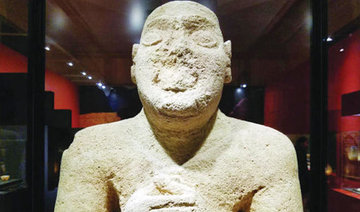
The exhibition was originally developed by the Saudi Commission for Tourism and National Heritage (SCTH) and the Musée du Louvre in Paris, where it was first exhibited in 2010. Since then, it has visited 14 other countries before arriving in Greece. “Roads of Arabia” highlights the cultural heritage of the Kingdom and features ancient artifacts from Saudi Arabia.
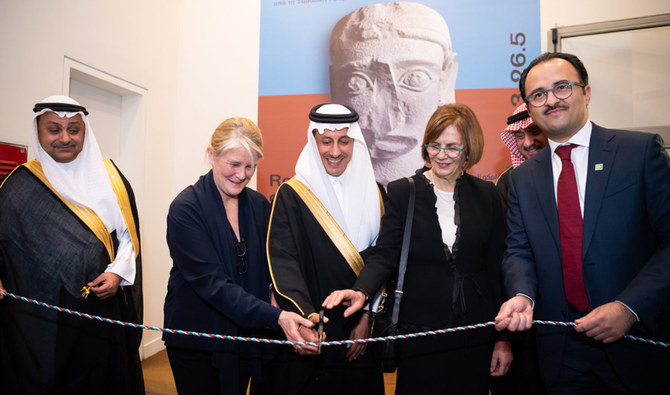
Greek Minister of Culture Lydia Koniordou opened the 16th edition of “Roads of Arabia” — which will run until May 25 at the Benaki Museum in Athens — in front of an audience including SCTH Chairman Ahmad Al-Khateeb, the Kingdom’s Ambassador to Greece, Esam bin Ibrahim Al-Mal, and a number of officials from both countries.
“Greece has contributed to Western civilization since ancient times, while the Kingdom witnessed the emergence of the Islamic civilization,” Al-Khateeb said at the opening. “Both helped shape the past and present of our world. The relation between Greece and Arabia extends over 3,000 years. This is highlighted in some of the antiquities found in the Kingdom, showcasing the historical and cultural links between Arabia, Greece and Byzantium.
“The Kingdom has always been a crossroads for human civilizations due to its strategic location linking global trade roads,” he continued. “The archaeological discoveries have shown that the Kingdom was a witness to many advanced civilizations since the Stone Age.”
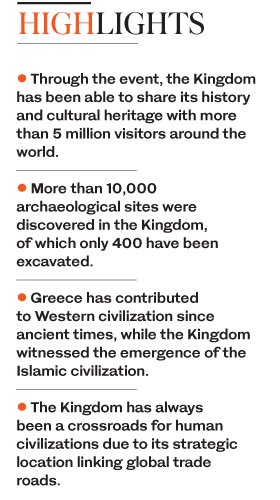 Al-Khateeb said that, through “Roads of Arabia,” the Kingdom has been able to share its history and cultural heritage with more than 5 million visitors around the world.
“More than 10,000 archaeological sites were discovered in the Kingdom, of which only 400 have been excavated. Just imagine the archaeological wealth (to be) found there,” he added.
As well as examining the 466 rare pieces that comprise the traveling exhibition — dating from the Stone Age to the era of King Abdul Aziz, founder of Saudi Arabia — attendees also toured a “virtual museum” set up by SCTH.
Meanwhile, working to uncover the past of the Arabian Peninsula, foreign experts have been carrying out archaeological excavations on Farasan Island since 2017.
So far, a team has revealed 30 sites dating back to pre-Islamic periods, including a number of settlements, animal remains including deer, cows, horses and turtles, and various finds including ancient Arabic inscriptions, and sites dating back to the Roman Empire.
They believe that the future of archaeology in the region is exciting. Experts are aiming to map the entirety of the island’s sites, creating a guide to its historical timeline and development. More local archaeologists, from academics to diggers, are also set for specialized training, to help uncover and preserve some of the Kingdom’s most precious new sites.
At the beginning of the 19th century, the Arabian Peninsula was a mystery to Orientalists, but they didn’t want to venture into the desert sands. However, in the late 19th century they came and got to know the lands and the people.
Many sites were registered at that time, especially in the 1970’s, when a comprehensive archaeological survey was done. The results of that time provided a vast list of archaeological sites.