

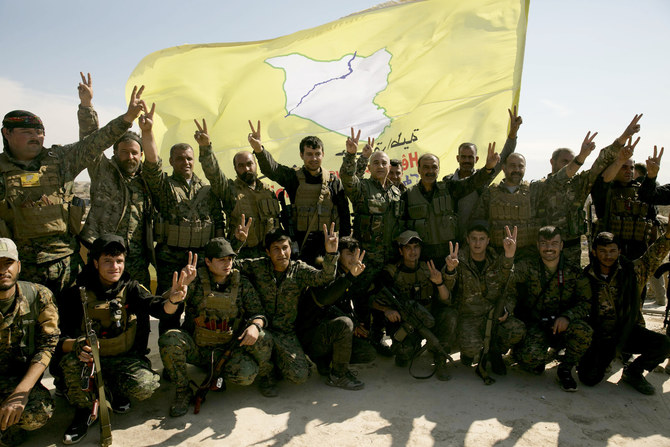


BEIRUT/JEDDAH: Kurdish-led Syrian Democratic Forces (SDF) raised their yellow banner on Saturday from a shell-pocked house where militants once flew the notorious black flag of Daesh.
Around it stretched a field pitted by trenches and bomb craters and littered with scorched tents, the twisted wreckage of burned out vehicles, unspent explosives and few remaining corpses.
Scattered amid empty foxholes and trenches were personal belongings, blankets, generators, oil barrels, water tanks and satellite dishes. Cars and motorcycles were turned to rusted, twisted heaps of metal. There were unused rockets, mortars and grenades, and a pile of suicide vests.
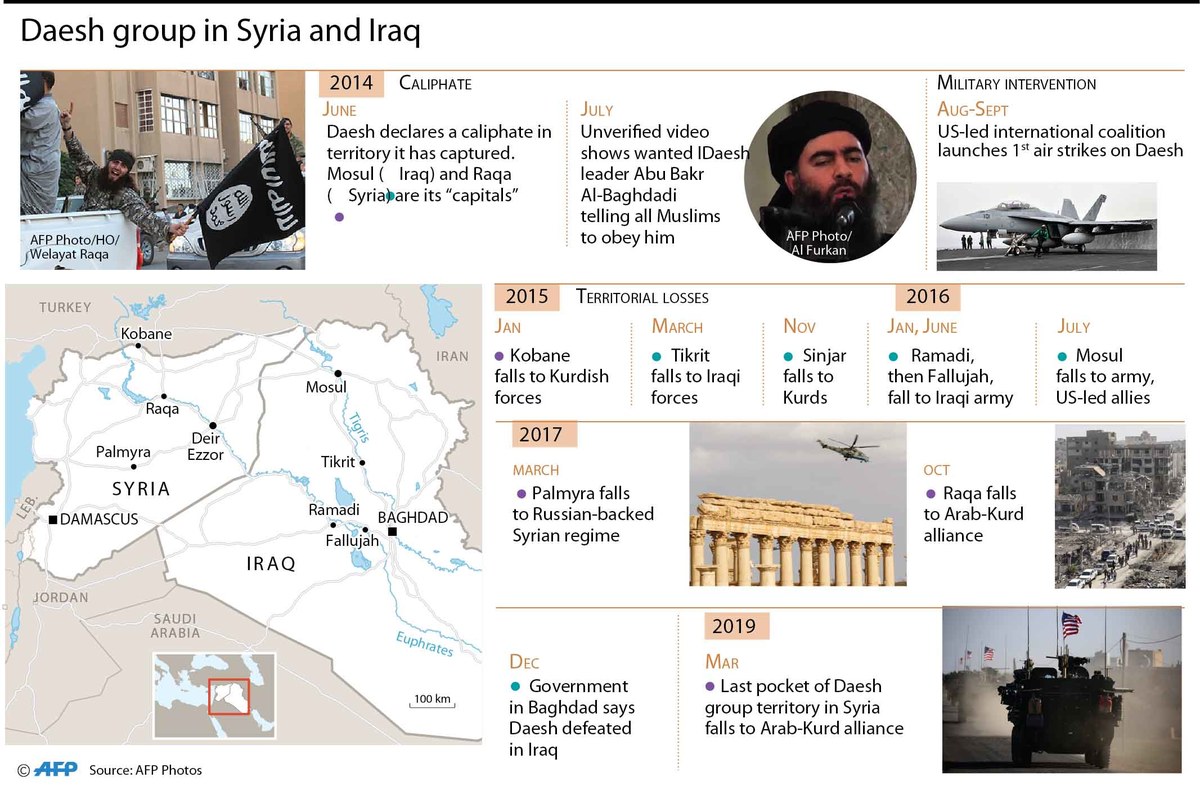
So ended the so-called “caliphate” — the brutal regime carved out by Daesh in large parts of Iraq and Syria in 2014. The five-year war that has devastated cities and towns across north Syria and Iraq ended in Baghouz, a Syrian border village where the cornered militants made their last stand.
“Baghouz is free and the military victory against Daesh has been achieved,” said SDF spokesman Mustafa Bali, adding that the SDH would continue its military and security campaigns against the group's sleeper cells.
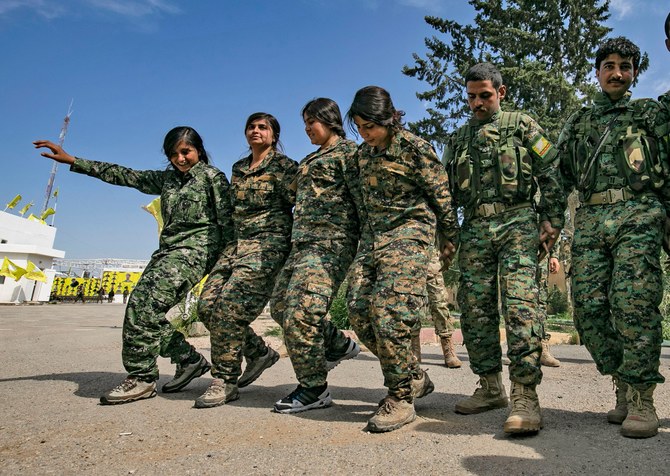
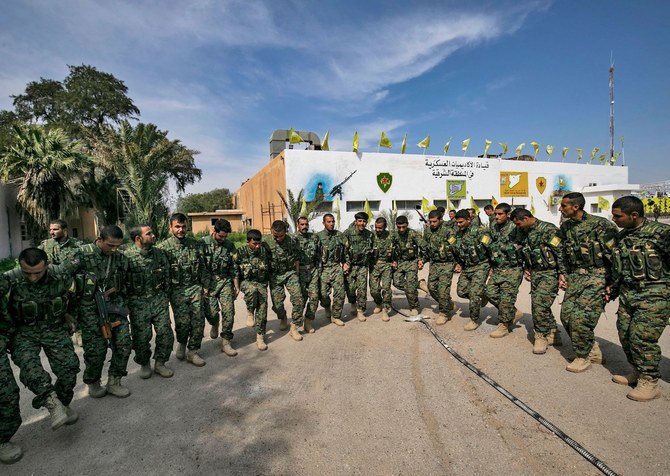
SDF fighters, who besieged Baghouz for weeks while US-led coalition warplanes pounded from above, paraded in a ceremony at the nearby Al-Omar oil field base in memory of 11,000 comrades killed.
At a televised ceremony, its general command called on the Syrian government, which has sworn to retake the whole country, to recognize the autonomous administration that runs areas the SDF controls in northeast Syria.
It also called on Turkey, which regards the SDF as a terrorist organization and has staged incursions into Syria against it, to leave Syrian territory, especially the mostly Kurdish region of Afrin.
The SDF has been battling to capture Baghouz at the Iraqi border for weeks.
Though the defeat of Daesh at Baghouz ends the group’s grip over the extremist quasi-state straddling Syria and Iraq that it declared in 2014, it remains a threat.
Some of its fighters still hold out in Syria’s remote central desert and in Iraqi cities they have slipped into the shadows, staging sudden shootings or kidnappings and awaiting a chance to rise again.
The US believes the group’s leader, Abu Bakr Al-Baghdadi, is in Iraq. He stood at the pulpit of the great medieval mosque in Mosul in 2014 to declare himself caliph, sovereign over all Muslims.
A senior US diplomat said the territorial defeat of Daesh is a "critical milestone" that delivers a crushing and strategic blow to the extremist group.
William Roebuck, the State Department's official in charge of Syria, added, however, that the campaign against Daesh is not over, saying the group remains a significant threat in the region.
"We still have much work to do to achieve an enduring defeat of IS," Roebuck said Saturday at a ceremony in eastern Syria's Al-Omar oil field base, celebrating victory over the group in Baghouz, Daesh's last stronghold in Syria.
Roebuck promised continued support to America's local partners in Syria to continue fighting the terrorist group.
British Prime Minister Theresa May said Saturday the fall of the last bastion held by Daesh terrorist in Syria marked "a historic milestone" as she paid tribute to British forces and coalition partners.
"The liberation of the last (IS)-held territory is a historic milestone that would not have been possible without their commitment, professionalism and courage," she said in a statement.
French President Emmanuel Macron paid tribute to the international coalition and its allies after US-backed forces declared military victory over Daesh in Syria.
Macron tweeted that "a major danger to our country is now eliminated, yet the threat remains and the fight against terrorist groups must continue." He expressed condolences for the victims of Daesh.
France has been a member of the coalition fighting Daesh since 2014. The group claimed responsibility for several attacks in France, including assaults in Paris in 2015 that killed more than 130 people.
President Donald Trump hailed the end of the of Daesh's "caliphate" Saturday, vowing that the United States would remain "vigilant" against the diehard terrorists.
"We will remain vigilant... until it is finally defeated wherever it operates," Trump said in a statement.
"The United States will defend American interests whenever and wherever necessary.” He added that the US will continue to work with its partners and allies to totally crush radical terrorists.
John Spencer, a scholar at the Modern War Institute at West Point, warned that while the geographic caliphate had been dismantled, Daesh was far from defeated. “All they have to do is put down their weapons and try to blend in with the population and just escape,” he said. “They’re not gone, and they’re not going to be gone.”
Bahia Mardini, a human rights campaigner and the founder of Syrian House, an organization dedicated to helping Syrians in the UK, told Arab News: “The real battle has now begun to eliminate Daesh’s dormant cells and destructive ideas. The war against terrorism must continue until full victory is achieved. Free Syria must be built without Daesh or terrorism by Bashar Assad.”
Foreign fighters
SDF fighters last week expelled the last Daesh fighters who refused to surrender from an encampment on the edge of Baghouz and have since been hunting down a few survivors hiding on the reedy banks of the Euphrates.
“Those who lasted the longest were mostly foreigners... Tunisians, Moroccans, Egyptians,” Hisham Harun, a 21-year-old Kurdish fighter, said shortly after the SDF’s yellow flag was raised.
Around him, the former terrorist encampment was littered with bullet-riddled truck carcasses, discarded suicide belts and the torn tents where the caliphate’s last families sheltered for weeks.
The bodies of suspected Daesh fighters could be seen but it was unclear what happened to the few terrorists who were still putting up a fight as late as Friday afternoon.
According to the Syrian Observatory for Human Rights, more than 750 SDF fighters and around twice as many terrorists were killed in the last few months of the Euphrates offensive.
Kurdish officers and aid groups were flummoxed by the number of people who had remained holed up in the last Daesh redoubt of Baghouz, a small village even few Syrians had ever heard of until this year.
As SDF forces pummelled Daesh positions and US warplanes dropped huge payloads on the riverside village, tens of thousands of people fled over a rocky hill and trudged through the plains in biblical scenes.
For weeks, the ghostly figures of the caliphate’s last denizens hobbled out of the besieged village, famished, often wounded but sometimes still defiantly proclaiming their support for Daesh.
The Kurdish-led force and foreign intelligence have screened more than 60,000 people since January, around 10 percent of them terrorists turning themselves in.
Most of the people evacuated from the smoldering ruins of Baghouz in recent days were relatives of Daesh members who now fill overcrowded camps further north in Syria’s Kurdish-controlled region.
The biggest of them, Al-Hol, is struggling to host 74,000 people, including at least 25,000 school-aged children.
Among them are thousands of foreigners from France, Russia, Belgium and 40-plus countries that are in most cases unwilling to take them back.
“The needs are huge and the camp is overwhelmed,” Peter Maurer, president of the International Committee of the Red Cross said Friday upon returning from a five-day visit to Syria.
But while the SDF taking Baghouz marks the end of the Daesh “caliphate,” the terrorists still retain a presence in eastern Syria’s vast Badia desert.
They also have hideouts in parts of Iraq as well as sleeper cells capable of carrying out the kind of deadly guerrilla insurgency that accompanied the rise of the Daesh group.
Daesh fighters who escaped the shrinking rump of the “caliphate” in time and reorganized their group are already re-establishing their former sanctuaries in Iraq.
Even the Pentagon has warned in a recent report that the absence of sustained counterterrorism pressure on Daesh would allow the terrorists to reclaim some territorial control within months.
(With Reuters and AFP)


