

Pompeo urges Lebanon to move away from Iran and Hezbollah’s ‘dark ambitions’

1 / 4
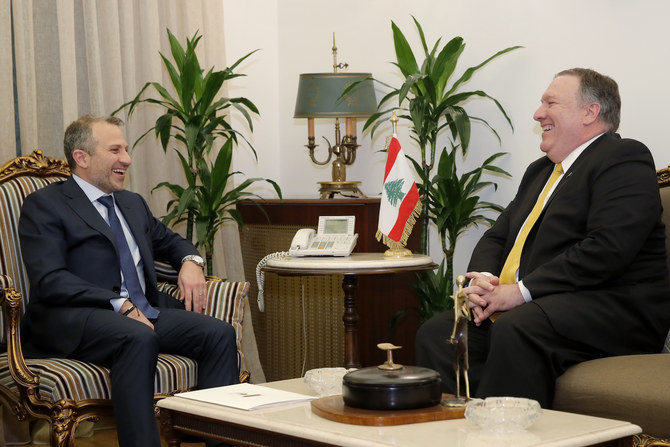
S Secretary of State Mike Pompeo meets with Lebanese Foreign Minister Gebran Bassil in Beirut, Lebanon, Friday, March 22, 2019. (AP)
2 / 4
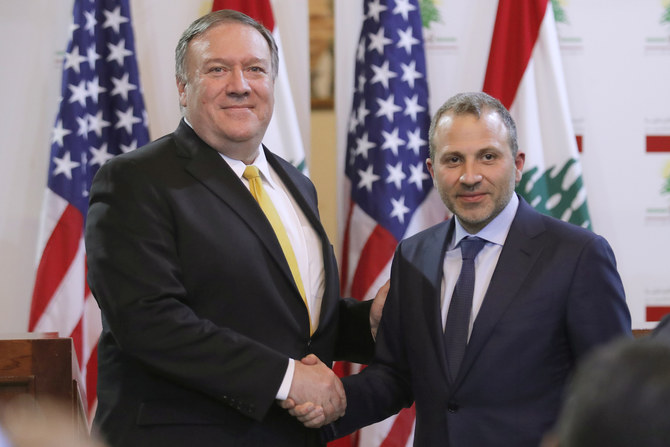
US Secretary of State Mike Pompeo shakes hands with Lebanese Foreign Minister Gebran Bassil after a public statement in Beirut, Lebanon, Friday, March 22, 2019. (AP)
3 / 4
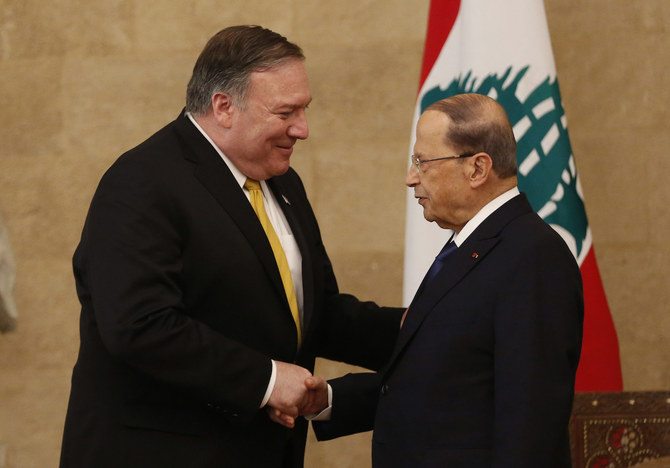
US Secretary of State Mike Pompeo, left, shakes hands with Lebanese President Michel Aoun, right, at the presidential palace, in Baabda east of Beirut, Lebanon, Friday, March 22, 2019. (AP)
4 / 4
US Secretary of State Mike Pompeo arrives at presidential palace to meet with Lebanon's President Michel Aoun in Baabda, Lebanon, Friday, March 22, 2019. (AP)
Updated 24 March 2019
Follow

Pompeo urges Lebanon to move away from Iran and Hezbollah’s ‘dark ambitions’

  • Pompeo said Iran gave Hezbollah as much as $700 million a year
  • The heavily armed Hezbollah has a large militia that has taken part in Syria's civil war alongside President Bashar Al-Assad's government

BEIRUT: On the last leg of his Middle East tour in Beirut, US Secretary of State Mike Pompeo called on Lebanon to stand up to Iran and Hezbollah, whom he accused of "criminality, terror and threats". 

Pompeo met with President Michel Aoun and Parliament Speaker Nabih Berri, Foreign Minister Gebran Bassil, all political allies of Hezbollah. The said they had told him the group was part and parcel of Lebanese politics. 

But Pompeo said Hezbollah and Iran have nothing positive to offer to Lebanon. 

“What did Hezbollah and Iran offer Lebanon but coffins and weapons? Qassem Soleimani (senior Iranian military commander) continues to undermine the legitimate institutions and the Lebanese people,” he said after meeting with Lebanon's political leaders.

“How can storing thousands of missiles on Lebanese territory strengthen this country?” said Pompeo, who was on tour in the Middle East to drum up support for Washington's harder line against Iran.

Pompeo said he believes that Iran does not want the situation in Lebanon to change because change is a threat to Iran’s ambitions to dominate the country. 

He spoke of Iran’s criminal networks of drugs and money laundering that place Lebanon under international monitoring, and he said: “The Lebanese people should not be forced to suffer because of an illegal and terrorist group.” 

Pompeo noted that US sanctions on Iran and Hezbollah are working, citing a speech by Hezbollah leader Hassan Nasrallah this month asking the group's supporters for funds as evidence US pressure was working.

"Our pressure on Iran is simple. It's aimed at cutting off the funding for terrorists and it's working," he said standing alongside Bassil after their meeting. "We believe that our work is already constraining Hezbollah's activities."

Pompeo said Iran gave Hezbollah as much as $700 million a year.

The heavily armed Hezbollah has a large militia that has taken part in Syria's civil war alongside President Bashar Al-Assad's government, but it also has elected members of parliament and positions in the national unity government.

The group's influence over Lebanese state institutions has expanded in the last year. Together with allies that view its arsenal as an asset to Lebanon, it won more than 70 of parliament's 128 seats in an election last year.

The group has taken three of the 30 portfolios in the government formed by the Western-backed Prime Minister Saad Al-Hariri in January, including the health ministry - the first time it has held a ministry with a significant budget.

Pompeo said he shared concerns about "external and internal pressures on the government, including coming from some of its own members, which do not serve an independent thriving Lebanon".

The United States would continue to use "all peaceful means" to choke off financing that "feeds Iran and Hezbollah terror operations", he said, pointing to "smuggling, criminal networks and the missue of government positions".

"Lebanon faces a choice: bravely move forward as an independent and proud nation, or allow the dark ambitions of Iran and Hezbollah to dictate your future," he said.

Lebanese President Michel Aoun earlier told Pompeo that Hezbollah was a Lebanese party with popular support, the Lebanese presidency said.

"Preserving national unity and civil peace is a priority for us," Aoun told Pompeo, the presidency said on its Twitter feed.

Speaker Berri said earlier in a statement that he had told Pompeo that Hezbollah's "resistance" against Israel was a result of continuing Israeli occupation of Lebanese territory.

Israel, the closest US ally in the Middle East, regards Iran as its biggest threat and Hezbollah as the main danger on its borders.


(With  Reuters)


Israeli police kill Bedouin man during raid in southern Israel, local official says

Updated 58 min 48 sec ago
Follow

Israeli police kill Bedouin man during raid in southern Israel, local official says

  • The shooting of 36-year-old Muhammed Hussein Tarabin threatened to worsen the already strained relations between the Israeli government and the country’s Bedouin minority

TEL AVIV: Israeli police shot and killed a Bedouin Arab man during an overnight raid in his village in southern Israel, according to media reports and a local official.
The shooting of 36-year-old Muhammed Hussein Tarabin threatened to worsen the already strained relations between the Israeli government and the country’s Bedouin minority.
Israeli police have been conducting a large-scale operation in the village of Tarabin for the past week in what they describe as a crackdown on local crime.
Talal Alkernawi, the mayor of the nearby town of Rahat, confirmed the man’s death.
Israeli police said they opened fire on a man who had “endangered” forces during an arrest raid.
The Israeli news site Haaretz cited relatives as saying Tarabin, whose family name shares the name of the village, was in his home.
In a video statement, Tarabin’s 11-year-old son, Hussein, said that men in uniform came to their house at night. He heard shots and saw his father’s body lying on the ground.
Israel’s far-right National Security Minister Itamar Ben-Gvir, who oversees the police force, expressed support for the police. “Anyone who endangers our police officers and fighters must be neutralized,” he posted on X.
Prime Minister Benjamin Netanyahu said Sunday that the country would do everything to prevent the Negev desert in southern Israel from becoming the “wild south”. He congratulated Ben-Gvir on leading the initiative and said he would visit the region in the coming days.
Israel’s more than 200,000 Bedouin are the poorest members of the country’s Arab minority, which also includes Christian and Muslim urban communities. Israel’s Arab population makes up roughly 20 percent of the country’s 10 million people. While they are citizens with the right to vote, they often suffer discrimination and tend to identify with Palestinians in the occupied West Bank and the Gaza Strip.
The Bedouin sector has grappled with crime and poverty, and about one-third of its members live in villages that the Israeli government considers illegal. Israel says it is trying to bring order to a lawless area, but Bedouin leaders accuse the government of neglect, trying to destroy their way of life or pushing to relocate them to less desirable areas.
Residents say police have made around two dozen arrests in the village of Tarabin over the past week. Nati Yefet, a spokesman for the regional council of unrecognized villages in the area, said most have been quickly released.
“They’re looking for people, crime-related things, but they didn’t find anything,” Yefet said. He accused Ben-Gvir of intensifying the raids in the run-up to elections expected later this year.
Marwan Abu Frieh, of the Arab rights group Adalah, said Israel has stepped up house demolitions in recent years, leaving thousands of residents without shelter and worsening the plight of communities often denied basic services.