JAKARTA/CHICAGO: Indonesian airline Garuda plans to cancel a $6 billion order for Boeing 737 MAX jets because some passengers say they would be frightened to board the plane after two fatal crashes, although industry analysts said the deal was already in doubt.
Still, Garuda is the first airline to publicly announce plans to scrap a 737 MAX order since the world’s entire fleet of one of Boeing’s signature aircraft was grounded last week.
In the United States, American Airlines pilots prepared to test Boeing Co’s planned software upgrade for an anti-stall system on MAX simulators this weekend, saying they want their own safety guarantees on the fix.
The 737 MAX was Boeing’s fastest selling jet before an Ethiopian Airlines crash near Addis Ababa on March 10, five months after a Lion Air jet plunged into the sea in Indonesia.
Ethiopia and French investigators have pointed to “clear similarities” between the two crashes, which killed 346 people, putting pressure on Boeing and US regulators to come up with an adequate fix.
However, questions have emerged about how much is known about the cause of the Ethiopian crash, 11 days after black box data and voice recorders were found.
Ethiopia has shared limited information with foreign investigators, Reuters reported on Thursday, and an industry source said Boeing had not yet received any data.
None of the parties agreed to comment.
Ethiopia said on Thursday it had started reviewing data with US and French safety investigation authorities.
Garuda CEO Ari Askhara told Reuters on Friday: “Many passengers told us they were afraid to get on a MAX 8.”
However, the airline had been reconsidering its order for 49 of the narrowbody jets before the Ethiopian crash, including potentially swapping some for widebody Boeing models.
Southeast Asia faces a glut of narrowbody aircraft like the 737 MAX and rival Airbus A320neo at a time of slowing global economic growth and high fuel costs.
“They have been re-looking at their fleet plan anyway so this is an opportunity to make some changes that otherwise may be difficult to do,” CAPA Center for Aviation Chief Analyst Brendan Sobie said.
Indonesia’s Lion Air has also said it might cancel 737 MAX aircraft, though industry sources say it is also struggling to absorb the number of planes on order.
RETROFITS
No direct link has been proven between the crashes, which killed a total of 346 people, but attention has focused on whether pilots had the correct information about the “angle of attack” at which the wing slices through the air.
Boeing now plans to make compulsory a light to alert pilots when sensor readings of the angle of attack do not match — meaning at least one must be wrong -, according to two officials briefed on the matter.
Investigators suspect a faulty angle-of-attack reading led the doomed Lion Air jet’s computer to believe it had stalled, prompting its anti-stall system, called MCAS, repeatedly to push the plane’s nose down.
Norwegian Air played down the significance of the compulsory light, saying that, according to Boeing, it would not have been able to prevent erroneous signals that Lion Air pilots received before their new 737 MAX plane crashed in October.
Boeing must be cautious with how it characterizes the safety alert, risking legal claims by saying it could have made a difference in the crash while not wanting to suggest that the retrofit is meaningless, legal experts said.
The Lion Air plane did not have the warning light installed, and Ethiopian Airlines did not immediately comment on whether its crashed plane had the alert.
But the Ethiopian carrier, whose reputation along with Boeing’s is at stake, issued a statement on Friday emphasising the modernity of its safety and training systems, with more than $500 million invested in infrastructure in the past five years.
The Ethiopian crash has set off one of the widest inquiries in aviation history and cast a shadow over the Boeing 737 MAX model intended to be a standard for decades.
Boeing did not comment on the plan to make the safety feature standard, but separately said it was moving quickly to make software changes and expected the upgrade to be approved by the US Federal Aviation Administration (FAA) in coming weeks.
Chicago-based Boeing will also retrofit older planes with the cockpit warning light, the officials told Reuters.
Experts said the change needs regulatory approval and could take weeks or months. Regulators in Europe and Canada have said they will conduct their own reviews of any new systems.
Since the Ethiopian crash, Boeing shares have fallen 14 percent.
Pressure has mounted on the company from US legislators, who are also expected to question the FAA. The company faces a criminal investigation by the US Justice Department as well.
Several lawsuits have already been filed on behalf of victims of the Lion Air crash referring to the Ethiopian accident. Boeing declined to comment on the lawsuits.


![]()

Some Boeing 737 MAX orders in jeopardy, US pilots try software fix
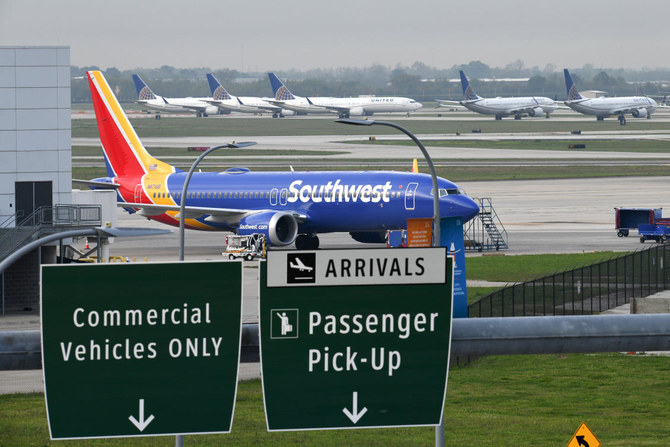
Some Boeing 737 MAX orders in jeopardy, US pilots try software fix
- The Senate hearing would be the first time that a US congressional committee has called Boeing executives to appear for questioning about 737 MAX passenger plane crashes
- Boeing has promised a swift update of software, but regulators in Europe and Canada are shifting away from previous reliance on FAA vetting


Latest updates




© 2026 SAUDI RESEARCH & PUBLISHING COMPANY, All Rights Reserved And subject to Terms of Use Agreement.