

Turkey’s economic woes lift opposition hopes

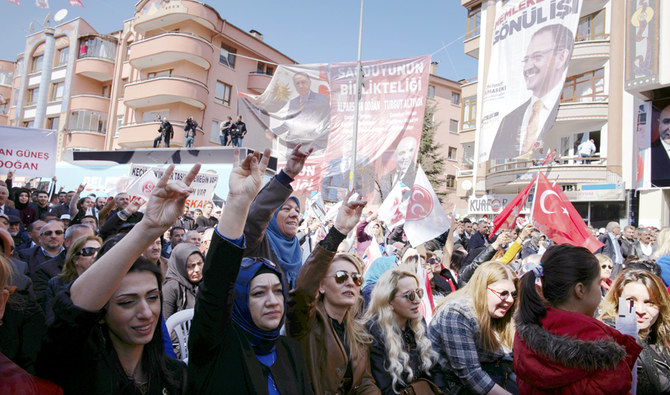
People listen to Mehmet Ozhaseki, the candidate of Turkey's ruling Justice and Development Party, AKP, and opposition Nationalist Movement Party, MHP, for Ankara Metropole, during a rally by MHP in Kecioren district, in Ankara, Turkey, on March 10, 2019. The countrywide local elections scheduled for March 31, 2019 with 57 million registered voters. (AP)
Updated 20 March 2019
Follow

Turkey’s economic woes lift opposition hopes

  • A recent poll by the opposition CHP in 29 provinces found that about 60 percent of voters are frustrated over the country’s economic decline
  • Voter frustration may translate into the loss of some big cities, including the capital Ankara and Istanbul

ANKARA: As Turkey’s March 31 local elections draw closer, economic issues are becoming a major priority for the country’s voters. 

While the ruling Justice and Development Party (AKP) has based its electoral success on the country’s prosperity for almost two decades, declining living standards and an economic downturn may signal a shift to rival parties in the election. 

Turkey was once an attractive option for investors trying to reach out to emerging markets, but the country’s economic outlook has changed significantly in recent years with double-digit inflation and a currency growing weaker by the day. 

Analysts say the economic concerns of middle-class voters, whose purchasing power has been primarily hit, will determine the electoral outcome if they turn against the AKP. 

In the previous local elections, the AKP won 43 percent of the vote, while its nearest rival, the Republican People’s Party (CHP), polled below 25 percent. 

Growing tensions between Turkey and the US are expected to further erode the value of the Turkish lira in the coming months. 

To reduce the impact of economic hardships on impoverished voters, Turkey’s government recently opened market stalls selling cheap produce. Long queues are a common sight at the stalls. 

Voter frustration may translate into the loss of some big cities, including the capital Ankara and Istanbul, where the AKP has ruled for decades.  Istanbul has added significance for President Recep Tayyip Erdogan, who began his political carrier as mayor of the city. Former Prime Minister Binali Yildirim is running for election in the city against his secular rival Ekrem Imamoglu. 

A recent poll by the opposition CHP in 29 provinces found that about 60 percent of voters are frustrated over the country’s economic decline. 

Burhanettin Bulut, a CHP parliamentarian, said Turkish voters’ top priority will be “their empty cooking pot in the kitchen.” 

“Parents cannot give pocket money to their children when sending them to the school. From early morning until night, their main concern is how to feed themselves. Nobody is happy about this trend,” he told Arab News. 

Berk Esen, an international relations professor at Ankara’s Bilkent University, believes the poor economic outlook will make the election results in some cities, such as Ankara and the northwestern industrial hub Bursa, much tighter than in previous polls. 

“Although AKP voters will not split with their parties in a single stroke, some may opt not to vote to show their frustration. Voter turnout will be important in these elections when even 1 percent of votes can determine a candidate’s success,” he said. 

Some analysts said the alliance between the AKP and the nationalistic MHP party could offset the votes lost due to the economic outlook. 

But Esen said that in some cities where MHP candidates were not nominated, nationalistic constituencies may choose not to vote or to vote for opposition parties. 

The use of “religion” card by the government following the New Zealand terror attack is also seen as a strategy to divert attention from its economic failures. 

According to this view, voters in Turkey will not change loyalties because of ideological commitment. 

“If we focus on 30 metropolitan provinces where the majority of voters live, the number of battlefront elections is about 12,” Dr. Emre Erdogan, founder and director of the independent Infakto Research Workshop in Istanbul, told Arab News. 

“The CHP is guaranteed two provinces in the west, including Izmir, and the pro-Kurdish HDP can already list three provinces in the southeast. It seems that the AKP will gain 13 provinces hosting 10 million voters. The remaining provinces where 25 million voters live are accepted as competitive,” he said. 

Erdogan said that declining economic conditions might lead to eight of these provinces, including the southern provinces of Antalya and Mersin, as well as the northwestern province of Balikesir, voting for opposition parties. 

“In Ankara and Istanbul, the two biggest cities, the victory of the opposition will depend on third parties — Kurdish and nationalists votes,” he said. 

The HDP, with electoral support of about 10 percent, did not nominate candidates for Istanbul and Ankara, and is supporting opposition candidates.


Sudan defense minister dismisses ‘intelligence document’ as fabrication after convoy strike

Updated 12 February 2026
Follow

Sudan defense minister dismisses ‘intelligence document’ as fabrication after convoy strike

  • Gen. Hassan Kabroun tells Arab News claims that army hid weapons in aid convoy are “completely false”

RIYADH: Sudan’s defense minister has firmly denied reports attributed to Sudanese intelligence alleging that a convoy targeted in North Kordofan was secretly transporting weapons under the cover of humanitarian aid.

Gen. Hassan Kabroun described the claims as “false” and an attempt to distract from what he called a militia crime.

The controversy erupted after news reports emerged that a document attributed to Sudan’s General Intelligence Service claimed the convoy struck in Al-Rahad on Friday was not a purely humanitarian mission, but was instead carrying “high-quality weapons and ammunition” destined for Sudanese Armed Forces units operating in the state.

The report further alleged that the convoy had been outwardly classified as humanitarian in order to secure safe passage through conflict zones, and that the Rapid Support Forces had destroyed it after gathering intelligence on its route and cargo.

Kabroun categorically rejected the narrative.

“First of all, we would like to stress the fact that this news is false,” he told Arab News. “Even the headline that talks about the security of the regions, such as Al-Dabbah, is not a headline the army would use.”

He described the document as fabricated and politically motivated, saying it was designed to “cover up the heinous crime they committed.”

The minister affirmed that the area targeted by drones is under full control of the Sudanese Armed Forces and does not require any covert military transport.

“Second, we confirm that the region that was targeted by drones is controlled by the army and very safe,” Kabroun said. “It does not require transporting any military equipment using aid convoys as decoys because it is a safe area controlled by the army, which has significant capabilities to transport humanitarian aid.”

According to the minister, the Sudanese military has both the logistical capacity and secure routes necessary to move equipment openly when needed.

“The army is professional and does not need to deliver anything to Kadugli or Dalang on board aid convoys,” he said. “The road between Dalang and Kadugli is open. The Sudanese forces used that road to enter and take control of the region. The road is open and whenever military trucks need to deliver anything, they can do so without resorting to any form of camouflage.”

Kabroun further rejected any suggestion that the military uses humanitarian operations as cover.

“Aid is transported by dedicated relief vehicles to the areas in need of this assistance,” he said. “Aid is not transported by the army. The army and security apparatus do not interfere with relief efforts at all, and do not even accompany the convoys.”

He stressed that the Sudanese Armed Forces maintains a clear institutional separation between military operations and humanitarian work, particularly amid the country’s crisis.

“These are false claims,” he said. “This fake news wanted to cover up the heinous crime they committed.”

Sudan has been gripped by conflict since April 2023, when fighting broke out between the Sudanese Armed Forces and the Rapid Support Forces, plunging the country into what the United Nations has described as one of the world’s worst humanitarian disasters.

The latest dispute over the convoy comes amid intensified fighting in South Kordofan, a strategically sensitive region linking central Sudan with the contested areas of Darfur and Blue Nile.

The false report suggested that intelligence monitoring had enabled the RSF to strike what it described as a military convoy disguised as humanitarian aid. But Kabroun dismissed that version outright.

“The intelligence agency is well aware of its duties,” he said. “The Sudanese Army has enough weapons and equipment to use in the areas of operations. These claims are completely false.”

He argued that the narrative being circulated seeks to shift blame for attacks on civilian infrastructure and humanitarian movements.

“This shows that they are trying to cover up the atrocities,” he added, referring to the militia.

Kabroun maintained that the army has regained momentum on multiple fronts and remains fully capable of sustaining its operations without resorting to deception.

“The region is secure, the roads are open, and the army does not need camouflage,” he said. “We are operating professionally and transparently.”

“These claims are completely false,” Kabroun said. “The Sudanese Army does not use humanitarian convoys for military purposes.”