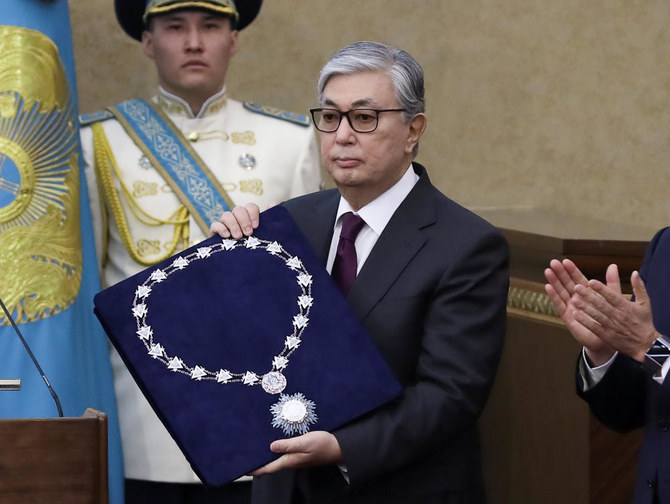
ALMATY: Kazakhstan’s new president was sworn in Wednesday following the shock resignation of the country’s long-time ruler and in his first official act renamed the capital after his predecessor.
Kassym-Jomart Tokayev took office in a pomp-filled ceremony less than 24 hours after Nursultan Nazarbayev, the only leader an independent Kazakhstan had ever known, suddenly announced he was stepping down.
Tokayev immediately proposed changing the name of the Central Asian nation’s capital from Astana to Nursultan, or “Sultan of Light” in Kazakh, and parliament approved the change within hours.
The senate also appointed Nazarbayev’s eldest daughter Dariga Nazarbayeva as speaker, setting her up as a potential contender to succeed her father.
Tokayev, 65, will serve out the rest of Nazarbayev’s mandate until elections due in April next year, though the former president retains significant powers in the country he ruled for nearly three decades.
Tokayev told lawmakers that Nazarbayev had “shown wisdom” by deciding to step down, a rare move in ex-Soviet Central Asia where other leaders have hung on to power until death.
“Yesterday the world witnessed a historic event,” Tokayev said, hailing Nazarbayev as a visionary reformer.
“The results of an independent Kazakhstan are there for all to see,” he added.
Nazarbayev changed the capital from Kazakhstan’s largest city Almaty to Astana in 1997, transforming it from a minor provincial town into a futuristic city of skyscrapers rising from the steppes.
Its name meant “capital” in Kazakh and there had long been speculation of a renaming after the leader who shaped it.
The city is central to government propaganda highlighting the achievements of Nazarbayev’s reign and his journey to build it was recently the subject of a state-funded film, “Leader’s Path: Astana.”
Nazarbayev, 78, ruled Kazakhstan since before it gained independence with the 1991 collapse of the Soviet Union.
He steered the country through a major transformation, developing huge energy reserves and boosting its international influence, but was accused of cracking down on dissent and tolerating little opposition.
Nazarbayev will continue to enjoy significant powers thanks to his constitutional status as “Leader of the Nation,” life-time position as chief of the security council and head of the ruling Nur Otan party.
Tokayev appeared to be in pole position to take over in the long term until senators voted shortly after his swearing-in to name Dariga Nazarbayeva, 55, as their new chief.
She is the most politically prominent of Nazarbayev’s three children and has long been mooted as a potential successor.
Kazakhstan’s deputy prime minister from 2015 to 2016, Nazarbayeva has significant influence over the media.
Analysts said it was too early to declare a clear frontrunner to become the next elected president, with the recently named prime minister, 53-year-old Askar Mamin, another possible contender.
Tokayev, the interim president, has a strong diplomatic record dating back to the Soviet period and has twice been foreign minister.
This should go some way to reassuring Kazakhstan’s major partners including China, the European Union, Russia and the United States that the move will not threaten key relationships.
Tokayev “is a safe pair of hands, he is a loyal presidential lieutenant,” said Kate Mallinson, a Russia and Eurasia expert at the London-based Chatham House think-tank.
Kazakhstan-based analyst Dosym Satpayev described Tokayev as a “heavyweight” but said he lacked popular appeal.
As for Kazakh society’s reaction to Dariga Nazarbayeva, it “would be mixed to say the least,” Satpayev said.
“A candidate from the family would be controversial and Dariga does not speak the state language, Kazakh, as well as her father,” he said.
Satpayev also pointed to another Nazarbayev relative — nephew Samat Abish, a high-ranking security official who rarely appears in public — as a potential contender from inside the family circle.
“This would be something like a Putin scenario, wherein a connected figure appears from the shadows at the last moment,” Satpayev said, referring to Russian President Vladimir Putin’s sudden emergence following Boris Yeltsin’s sudden retirement in 1999.
The new leader will need to tackle growing discontent over falling living standards after Kazakhstan’s economy was hit by the 2014 drop in oil prices and western sanctions against Russia, a key trading partner.


![]()

Kazakhstan renames capital after retiring leader Nazarbayev as new president Tokayev takes office
Kazakhstan renames capital after retiring leader Nazarbayev as new president Tokayev takes office
- Kassym-Jomart Tokayev took office in a pomp-filled ceremony less than 24 hours after Nursultan Nazarbayev stepped down
- Tokayev immediately proposed changing the name of the Central Asian nation’s capital

Latest updates


Recommended



© 2026 SAUDI RESEARCH & PUBLISHING COMPANY, All Rights Reserved And subject to Terms of Use Agreement.