

Pompeo thanks Saudi crown prince for supporting UN Yemen envoy Griffiths during Middle East tour

1 / 4
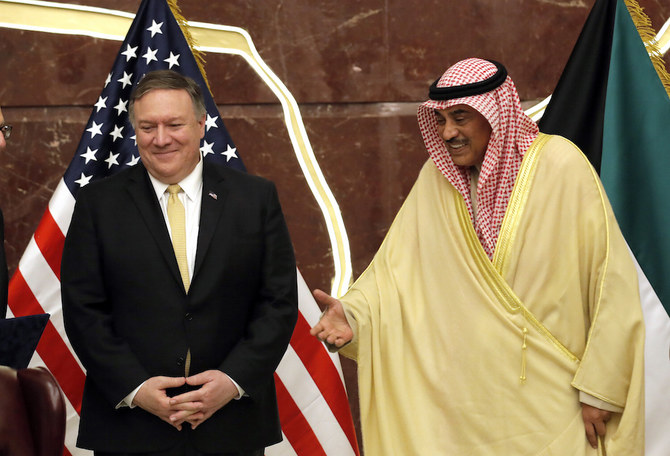
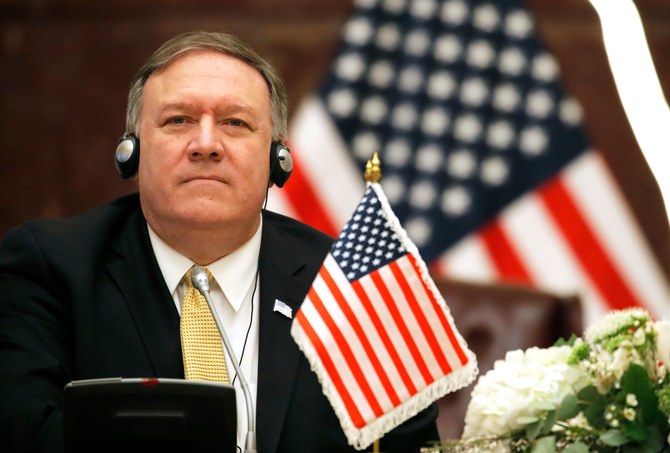
U.S. Secretary of State Mike Pompeo is seen during a news conference with Kuwait's Foreign Minister Sheikh Sabah Al-Khalid Al-Sabah (not pictured) in Kuwait City. (Reuters)
2 / 4
Mike Pompeo and Kuwait's Foreign Minister Sheikh Sabah Al-Khalid Al-Sabah exchange a signed document in Kuwait City. (AP)
3 / 4
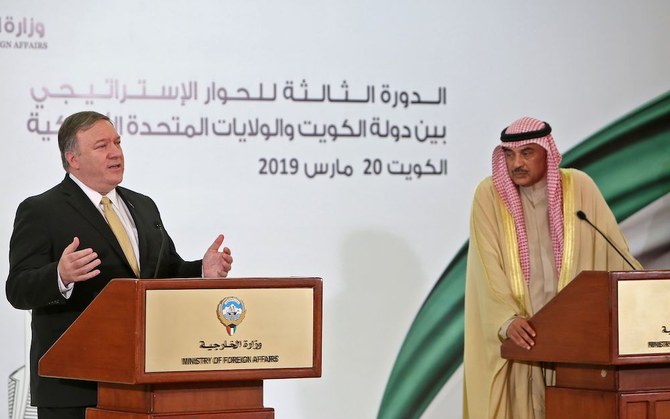
Mike Pompeo and Kuwait's Foreign Minister Sheikh Sabah Al-Khalid Al-Sabah are seen during a news conference in Kuwait City. (AP)
4 / 4
Mike Pompeo (L) and Kuwait's Foreign Minister Sheikh Sabah al-Khalid al-Sabah give a joint press conference in Kuwait City. (AFP)
Updated 20 March 2019
Follow

Pompeo thanks Saudi crown prince for supporting UN Yemen envoy Griffiths during Middle East tour

  • Said he would discuss "strategic dialogue" and the need to combat "the threat posed by Iran"
  • Stops include Kuwait, Israel and Lebanon

LONDON: US Secretary of State Mike Pompeo thanked Saudi Arabia's Crown Prince Mohammed bin Salman for supporting the efforts of the UN envoy to Yemen Martin Griffiths during his stop in Kuwait on a Middle East tour.

Speaking on Wednesday in Kuwait City, Pompeo said he and the crown prince both agreed on the need for both parties in the Yemeni conflict to commit to the regulations of the Sweden agreement of 2018.

Pompeo is visiting the region to bolster a united front against Iran, kicking off his regional trip in Kuwait where he met Emir Sheikh Sabah al-Ahmad Al-Sabah.

Pompeo told reporters on the flight from the US that he would discuss "strategic dialogue" and the need to combat "the threat posed by the Islamic Republic of Iran" with leaders in the region.

After Kuwait Pompeo will fly to Israel before heading to Lebanon.

Pompeo is also pushing for a greater role for the Middle East Strategic Alliance (MESA), a US-sponsored Arab NATO aimed at uniting Washington's Arab allies against Tehran.

"We all have the same set of threats, threats from Al-Qaeda, from Daesh, threats from the Islamic Republic of Iran," Pompeo said at a joint press conference with Kuwaiti Foreign Minister Sheikh Sabah Al-Khaled Al-Sabah.

Pompeo expressed hope that a regional rift between Gulf states and Qatar would abate, saying that resolving the issue would be in the region's best interests.

The foreign minister of Kuwait said he had also discussed with Pompeo the Gulf dispute, as well as the ongoing situations in Syria, Iraq and Yemen.

Sheikh Sabah Khaled Al-Sabah said: "We hope the plan will take into account the situation in the region and all the relevant parties.

"We believe the strong relationship between the United States and several countries will lead to an acceptable resolution to all parties and to reaching a political solution that has been long waited for."

Pompeo said his talks on Wednesday also focused on enhancing defence and cybersecurity cooperation with Kuwait.

(With Agencies)


The West Bank soccer field slated for demolition by Israel

Updated 13 sec ago
Follow

The West Bank soccer field slated for demolition by Israel

  • The move is likely to eliminate one of the few ​spaces where Palestinian children are able to run and play
BETHLEHEM: Israeli authorities have ordered the demolition of a soccer field in a crowded refugee camp in the occupied West Bank, eliminating one of the few ​spaces where Palestinian children are able to run and play.
“If the field gets demolished, this will destroy our dreams and our future. We cannot play any other place but this field, the camp does not have spaces,” said Rital Sarhan, 13, who plays on a girls’ soccer team in the Aida refugee camp near Bethlehem.
The Israeli military ‌issued a demolition ‌order for the soccer field on ‌December ⁠31, ​saying ‌it was built illegally in an area that abuts the concrete barrier wall that Israel built in the West Bank.
“Along the security fence, a seizure order and a construction prohibition order are in effect; therefore, the construction in the area was carried out unlawfully,” the Israeli military said in a statement.
Mohammad Abu ⁠Srour, an administrator at Aida Youth Center, which manages the field, said the ‌military gave them seven days to demolish ‍the field.
The Israeli military ‍often orders Palestinians to carry out demolitions themselves. If they ‍do not act, the military steps in to destroy the structure in question and then sends the Palestinians a bill for the costs.
According to Abu Srour, Israel’s military told residents when delivering ​the demolition order that the soccer field represented a threat to the separation wall and to Israelis.
“I ⁠do not know how this is possible,” he said.
Israeli demolitions have drawn widespread international criticism and coincide with heightened fears among Palestinians of an organized effort by Israel to formally annex the West Bank, the area seized by Israel in the 1967 Middle East war. Israel accelerated demolitions in Palestinian refugee camps in early 2025, leading to the displacement of 32,000 residents of camps in the central and northern West Bank. Human Rights Watch has called the demolitions a war crime. ‌Israel has said they are intended to disrupt militant activity.