New Zealand envoy headed to Turkey to ‘confront’ Erdogan’s mosque shooting comments

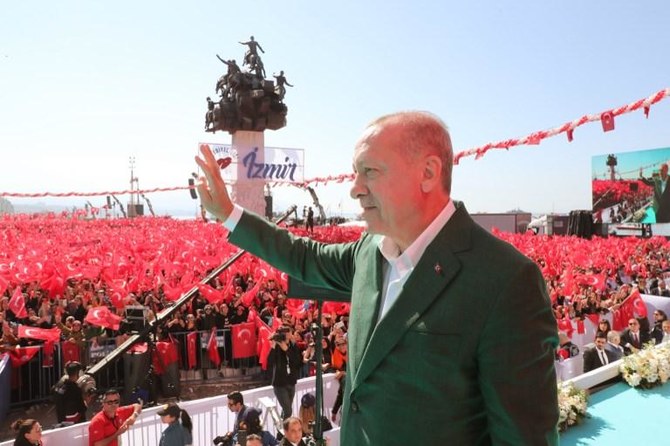
Turkish President Tayyip Erdogan’s comments came at a campaign rally that included video footage of the shootings which the alleged gunman had broadcast on Facebook. (AFP)
Updated 20 March 2019
Follow

New Zealand envoy headed to Turkey to ‘confront’ Erdogan’s mosque shooting comments

  • President Tayyip Erdogan said Turkey would make the suspected attacker pay if New Zealand did not
  • His comments came at a campaign rally that included video footage of the shootings

SYDNEY: New Zealand Prime Minister Jacinda Ardern said on Wednesday Foreign Minister Winston Peters will travel to Turkey to “confront” comments made by Turkish President Tayyip Erdogan on the killing of at least 50 people at mosques in Christchurch.
Australian Brenton Tarrant, 28, a suspected white supremacist, was charged with murder on Saturday after a lone gunman opened fire at the two mosques during Friday prayers.
Erdogan — who is seeking to drum up support for his Islamist-rooted AK Party in March 31 local elections — said Turkey would make the suspected attacker pay if New Zealand did not.
The comments came at a campaign rally that included video footage of the shootings which the alleged gunman had broadcast on Facebook.
Ardern said Peters would seek urgent clarification.
“Our deputy prime minister will be confronting those comments in Turkey,” Ardern told reporters in Christchurch. “He is going there to set the record straight, face-to-face.”
Peters had earlier condemned the airing of footage of the shooting, which he said could endanger New Zealanders abroad.
Despite Peters’ intervention, an extract from Tarrant’s alleged manifesto was flashed up on a screen at Erdogan’s rally again on Tuesday, along with footage of the gunman entering one of the mosques and shooting as he approached the door.
Meanwhile, Australian Prime Minister Scott Morrison said he summoned Turkey’s ambassador for a meeting, during which he demanded Erdogan’s comments be removed from Turkey’s state broadcaster.
“I will wait to see what the response is from the Turkish government before taking further action, but I can tell you that all options are on the table,” Morrison told reporters in Canberra.
Morrison said Australia’s ambassador to Turkey will on Wednesday meet with the members of Erdogan’s government.
Morrison said Canberra is also reconsidering its travel advice for Australians planning trips to Turkey.
Relations between Turkey, New Zealand and Australia have generally been good. Thousands of Australians and New Zealanders travel each year to Turkey for war memorial services.
Just over a century ago, thousands of soldiers from the Australian and New Zealand Army Corps (ANZAC) struggled ashore on a narrow beach at Gallipoli during an ill-fated campaign that would claim more than 130,000 lives.
The area has become a site of pilgrimage for visitors who honor their nations’ fallen in graveyards halfway around the world on ANZAC Day every April 25.


Justice Department faces hurdle in seeking case against Comey as judge finds constitutional problems

Updated 4 sec ago
Follow

Justice Department faces hurdle in seeking case against Comey as judge finds constitutional problems

WASHINGTON: The Justice Department violated the constitutional rights of a close friend of James Comey and must return to him computer files that prosecutors had hoped to use for a potential criminal case against the former FBI director, a federal judge said Friday.
The ruling from US District Judge Colleen Kollar-Kotelly represents not only a stern rebuke of the conduct of Justice Department prosecutors but also imposes a dramatic hurdle to government efforts to seek a new indictment against Comey after an initial one was dismissed last month.
The order concerns computer files and communications that investigators obtained years earlier from Daniel Richman, a Comey friend and Columbia University law professor, as part of a media leak investigation that concluded without charges. The Justice Department continued to hold onto those files and conducted searches of them this fall, without a new warrant, as they prepared a case charging Comey with lying to Congress five years ago.
Richman alleged that the Justice Department violated his Fourth Amendment rights by retaining his records and by conducting new warrantless searches of the files, prompting Kollar-Kotelly to issue an order last week temporarily barring prosecutors from accessing the files as part of its investigation.
The Justice Department said the request for the return of the records was merely an attempt to impede a new prosecution of Comey, but the judge again sided with Richman in a 46-page order Friday that directed the Justice Department to give him back his files.
“When the Government violates the Fourth Amendment’s prohibition on unreasonable searches and seizures by sweeping up a broad swath of a person’s electronic files, retaining those files long after the relevant investigation has ended, and later sifting through those files without a warrant to obtain evidence against someone else, what remedy is available to the victim of the Government’s unlawful intrusion?” the judge wrote.
One answer, she said, is to require the government to return the property to the rightful owner.
The judge did, however, permit the Justice Department to file an electronic copy of Richman’s records under seal with the Eastern District of Virginia, where the Comey investigation has been based, and suggested prosecutors could try to access it later with a lawful search warrant.
The Justice Department alleges that Comey used Richman to share information with the news media about his decision-making during the FBI’s investigation into Hillary Clinton’s use of a private email server. Prosecutors charged the former FBI director in September with lying to Congress by denying that he had authorized an associate to serve as an anonymous source for the media.
That indictment was dismissed last month after a federal judge in Virginia ruled that the prosecutor who brought the case, Lindsey Halligan, was unlawfully appointed by the Trump administration. But the ruling left open the possibility that the government could try again to seek charges against Comey, a longtime foe of President Donald Trump. Comey has pleaded not guilty, denied having made a false statement and accused the Justice Department of a vindictive prosecution.
The Comey saga has a long history.
In June 2017, one month after Comey was fired as FBI director, he testified that he had given Richman a copy of a memo he had written documenting a conversation he had with Trump and had authorized him to share the contents of the memo with a reporter.
After that testimony, Richman permitted the FBI to create an image, or complete electronic copy, of all files on his computer and a hard drive attached to that computer. He authorized the FBI to conduct a search for limited purposes, the judge noted.
Then, in 2019 and 2020, the FBI and Justice Department obtained search warrants to obtain Richman’s email accounts and computer files as part of a media leak investigation that concluded in 2021 without charges. Those warrants were limited in scope, but Richman has alleged that the government collected more information than the warrants allowed, including personal medial information and sensitive correspondence.
In addition, Richman said the Justice Department violated his rights by searching his files in September, without a new warrant, as part of an entirely separate investigation.
“The Court further concludes that the Government’s retention of Petitioner Richman’s files amounts to an ongoing unreasonable seizure,” Kollar-Kotelly wrote. “Therefore, the Court agrees with Petitioner Richman that the Government has violated his Fourth Amendment right against unreasonable searches and seizures.”