

Daesh loses big part of Syrian enclave, SDF sees militants’ defeat ‘very soon’

1 / 2
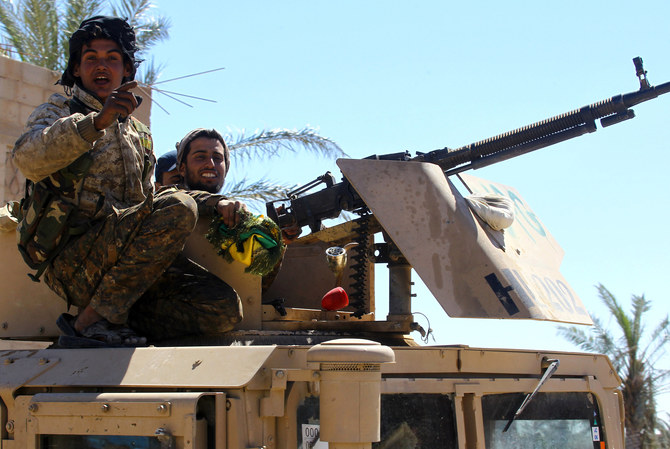
A fighter of Syrian Democratic Forces gestures in the village of Baghouz. (Reuters)
2 / 2
Injured Daesh militants in the village of Baghouz on Thursday, March 14, 2019. (Reuters)
Updated 20 March 2019
Follow

Daesh loses big part of Syrian enclave, SDF sees militants’ defeat ‘very soon’

  • The camp was the biggest remaining area held by Daesh in Baghouz
  • The SDF earlier said it had captured 157 mostly foreign fighters

DEIR AL-ZOR PROVINCE, Syria: US-backed Syrian forces said they were close to capturing Daesh’s last territorial possession in eastern Syria on Tuesday after seizing the militants’ camp at Baghouz, though clashes continued with some remaining militants.

“This is not a victory announcement, but a significant progress in the fight against Daesh,” said Mustafa Bali, a media official with the Syrian Democratic Forces (SDF) militia on Twitter, using an Arabic acronym for Daesh.

Asked by Reuters how long it would take to defeat the remaining militants, Bali said he expected the operation to end “very soon.”

“The battles are not yet over. There are still some pockets next to the river. Some of the terrorists have taken their children as human shields. There are intermittent clashes,” he said.

The camp was the biggest remaining area held by Daesh in Baghouz, itself the last populated area the militant group held from the third of Syria and Iraq it suddenly seized in 2014.

It has been steadily forced back there after years of retreats in the face of military campaigns by the US-backed SDF, the Russia-backed Syrian army and the Iraqi army with allied Iran-backed militias.

Over recent weeks, as the group hemorrhaged supporters fleeing the besieged enclave, diehard militants mounted a desperate last stand in the battered Baghouz camp, shooting from trenches and sending car bombs against their enemies.

Conditions inside were dire, said people who left, with inhabitants facing constant danger from bombardment and with little food, forced to eat grass. Hundreds of wounded militants were captured when the SDF overran the camp, Bali said.

However, while the capture of the previously unknown village of Baghouz near Syria’s border with Iraq, will mark a milestone in the battle against Daesh, regional and Western officials say the group will remain a threat

Some of its fighters hold out in the remote central Syrian desert and others have gone underground in Iraq to stage a series of shootings and kidnappings.

The SDF earlier on Monday said it had captured 157 mostly foreign fighters as they tracked efforts by militants to break out of the enclave and escape their besiegers.

Both the SDF and the US-led coalition that backs it have said the remaining Daesh militants at Baghouz are among its most hardened foreign operatives.

Over the past two months, more than 60,000 people have poured out of the group’s dwindling enclave, nearly half of whom were surrendering supporters of Daesh, including some 5,000 fighters.

Even on the brink of defeat, the group’s propaganda division continued to function. On Monday night Daesh released an audio recording of its spokesman, Abi Al-Hassan Al-MuHajjer, saying the group would stay strong.

“Do you think the displacement of the weak and poor out of Baghouz will weaken the Daesh? No,” he said.

It also put out a video recording from inside the Baghouz camp, showing fighters shooting out at the encircling forces and a mess of stationary vehicles and makeshift shelters around them.


Thousands of Libyans gather for the funeral of Qaddafi’s son who was shot and killed this week

Updated 4 sec ago
Follow

Thousands of Libyans gather for the funeral of Qaddafi’s son who was shot and killed this week

  • As the funeral procession got underway and the crowds swelled, a small group of supporters took Seif Al-Islam’s coffin away and later performed the funeral prayers and buried him
  • Authorities said an initial investigation found that he was shot to death but did not provide further details

BANI WALID, Libya: Thousands converged on Friday in northwestern Libya for the funeral of Seif Al-Islam Qaddafi, the son and one-time heir apparent of Libya’s late leader Muammar Qaddafi, who was killed earlier this week when four masked assailants stormed into his home and fatally shot him.
Mourners carried his coffin in the town of Bani Walid, 146 kilometers (91 miles) southeast of the capital, Tripoli, as well as large photographs of both Seif Al-Islam, who was known mostly by his first name, and his father.
The crowd also waved plain green flags, Libya’s official flag from 1977 to 2011 under Qaddafi, who ruled the country for more than 40 years before being toppled in a NATO-backed popular uprising in 2011. Qaddafi was killed later that year in his hometown of Sirte as fighting in Libya escalated into a full-blown civil war.
As the funeral procession got underway and the crowds swelled, a small group of supporters took Seif Al-Islam’s coffin away and later performed the funeral prayers and buried him.
Attackers at his home
Seif Al-Islam, 53, was killed on Tuesday inside his home in the town of Zintan, 136 kilometers (85 miles) southwest of the capital, Tripoli, according to Libyan’s chief prosecutor’s office.
Authorities said an initial investigation found that he was shot to death but did not provide further details. Seif Al-Islam’s political team later released a statement saying “four masked men” had stormed his house and killed him in a “cowardly and treacherous assassination,” after disabling security cameras.
Seif Al-Islam was captured by fighters in Zintan late in 2011 while trying to flee to neighboring Niger. The fighters released him in June 2017, after one of Libya’s rival governments granted him amnesty.
“The pain of loss weighs heavily on my heart, and it intensifies because I can’t bid him farewell from within my homeland — a pain that words can’t ease,” Seif Al-Islam’s brother Mohamed Qaddafi, who lives in exile outside Libya though his current whereabouts are unknown, wrote on Facebook on Friday.
“But my solace lies in the fact that the loyal sons of the nation are fulfilling their duty and will give him a farewell befitting his stature,” the brother wrote.
Since the uprising that toppled Qaddafi, Libya plunged into chaos during which the oil-rich North African country split, with rival administrations now in the east and west, backed by various armed groups and foreign governments.
Qaddafi’s heir-apparent
Seif Al-Islam was Qaddafi’s second-born son and was seen as the reformist face of the Qaddafi regime — someone with diplomatic outreach who had worked to improve Libya’s relations with Western countries up until the 2011 uprising.
The United Nations imposed sanctions on Seif Al-Islam that included a travel ban and an assets freeze for his inflammatory public statements encouraging violence against anti-Qaddafi protesters during the 2011 uprising. The International Criminal Court later charged him with crimes against humanity related to the 2011 uprising.
In July 2021, Seif Al-Islam told the New York Times that he’s considering returning to Libya’s political scene after a decade of absence during which he observed Middle East politics and reportedly reorganized his father’s political supporters.
He condemned the country’s new leaders. “There’s no life here. Go to the gas station — there’s no diesel,″ Seif Al-Islam told the Times.
In November 2021, he announced his candidacy in the country’s presidential election in a controversial move that was met with outcry from anti-Qaddafi political forces in western and eastern Libya.
The country’s High National Elections Committee disqualified him, but the election wasn’t held over disputes between rival administrations and armed groups.