

China says played 'constructive role' in reducing Pakistan, India tension

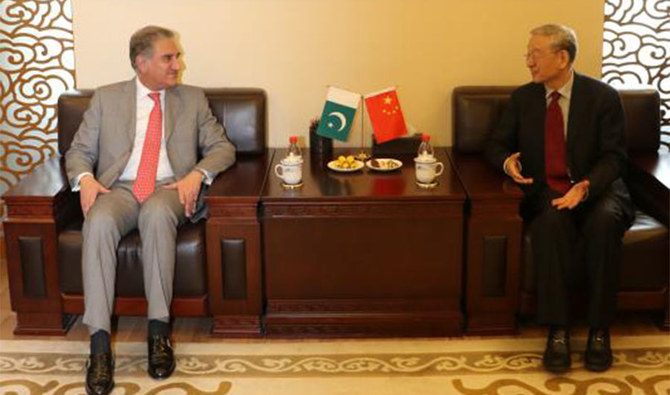
Foreign Minister Shah Mahmood Qureshi is in China on three-day visit, on Monday, he met with Chairman of China’s Institute of Strategic Studies of Maj Gen (R) Gong Xianfu in Beijing – (Photo Courtesy Pakistan Foreign Office)
Updated 19 March 2019
Follow

China says played 'constructive role' in reducing Pakistan, India tension

  • China and Pakistan call each other "all-weather" friends
  • Pakistan's foreign minister is currently in China to hold strategic talks

BEIJING: China played a "constructive role" in reducing tension between Pakistan and India, the Chinese foreign ministry said, after the nuclear-armed rivals almost came to blows last month following an attack on an Indian paramilitary convoy in disputed Kashmir.

The sparring threatened to spiral out of control and only interventions by US officials, including National Security Adviser John Bolton, headed off a bigger conflict, five sources familiar with the events have told Reuters.

At one stage, India threatened to fire at least six missiles at Pakistan, and Islamabad said it would respond with its own missile strikes "three times over", said Western diplomats and government sources in New Delhi, Islamabad and Washington.

A Pakistani minister said China and the United Arab Emirates also intervened to lessen tension between the South Asian neighbours.

In a faxed statement to Reuters late on Monday, responding to a question on China's role in reining in the crisis, its foreign ministry said peaceful coexistence between Pakistan and India was in everyone's interest.
"As a friendly neighbour of both India and Pakistan, China pro-actively promoted peace talks and played a constructive role in easing the tense situation," it said.

"Some other countries also made positive efforts in this regard," the ministry added.

China is willing to work with the international community to continue to encourage the neighbours to meet each other half way and use dialogue and peaceful means to resolve differences, it said, without elaborating.
The Chinese government's top diplomat, State Councillor Wang Yi, is set to meet Pakistan Foreign Minister Shah Mahmood Qureshi in Beijing later on Tuesday.

The Feb. 14 attack that killed at least 40 Indian paramilitary soldiers was the deadliest in Kashmir's 30-year-long insurgency, escalating tension between the neighbours, who said they shot down each other's fighter jets late last month.
China and Pakistan call each other "all-weather" friends, but China has also been trying to improve ties with New Delhi.

Indian Prime Minister Narendra Modi and Chinese President Xi Jinping held an informal summit in China last year agreeing to reset relations, and Xi is expected to visit India sometime this year, diplomatic sources say.

At UNSC, Pakistan warns competition for critical minerals could fuel global conflict

Updated 06 March 2026
Follow

At UNSC, Pakistan warns competition for critical minerals could fuel global conflict

  • The demand for critical minerals has surged worldwide due to rapid expansion of electric vehicles, advanced electronics and clean energy technologies
  • Pakistan’s representative says all partnerships in critical minerals sector must be ‘cooperative and not exploitative’ and respect national ownership

ISLAMABAD: Ambassador Asim Iftikhar Ahmad, Pakistan’s permanent representative to the United Nations (UN), has warned that intensifying global competition over critical minerals could become a new driver of global conflict, urging stronger international cooperation and equitable access to resources vital for the world’s energy transition.

The warning comes as demand for critical minerals and rare earth elements surges worldwide due to the rapid expansion of electric vehicles, advanced electronics and clean energy technologies, with governments and companies increasingly competing to secure supply chains while raising concerns that this may lead to geopolitical rivalries in the coming years.

Speaking at a Security Council briefing on ‘Energy, Critical Minerals, and Security,’ Ahmad said experience showed that the risks of instability increased where mineral wealth intersected with weak governance, entrenched poverty and external interference.

“Access to affordable, reliable and sustainable energy is essential for development, stability and prosperity. The global transition toward renewable energy, electric mobility, battery storage and digital infrastructure has sharply increased the demand for critical minerals,” he said.

“This upsurge has generated new geopolitical and geo-economic pressures. If not managed responsibly, competition over natural resources can affect supply chains, aggravate tensions, undermine sovereignty and contribute to instability.”

In several conflict-affected settings, he noted, illicit extraction, trafficking networks and opaque financial flows have fueled armed conflict and violence, weakened state institutions and deprived populations of legitimate revenues.

“The scramble for natural resources and its linkage to conflict and instability is therefore not new,” Ahmad told UNSC members at the briefing. “Pakistan believes that natural resources must serve as instruments of economic development and shared prosperity, and not coercion or conflict.”

He urged the world to reaffirm the right of peoples to permanent sovereignty over their natural resources, saying all partnerships in the critical minerals sector must be cooperative and not exploitative, respect national ownership, ensure transparent contractual arrangements and align with host countries’ development strategies.

“In order to prevent the exploitation of mineral-producing countries and regions, particularly in fragile and conflict-affected settings, support their capacity-building for strengthening domestic regulatory institutions, combating illicit financial flows, ensuring environmental safeguards, and promoting equitable benefit-sharing with local communities,” he asked member states.

“Promote equitable participation in global value chains. Developing countries must be enabled to move beyond extraction toward processing, refining and downstream manufacturing. Technology transfer, skills development and responsible investment are essential to avoid perpetuating structural imbalances.”