


DUBAI: Young Arabs are taking the region’s offline markets online, from fitness and recruitment to car repairs and chalet hire.
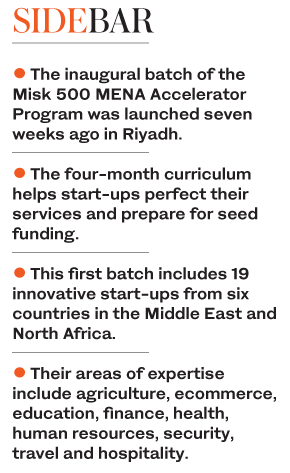
Nineteen start-ups have been chosen so far to take part in the Misk 500 MENA Accelerator Program.
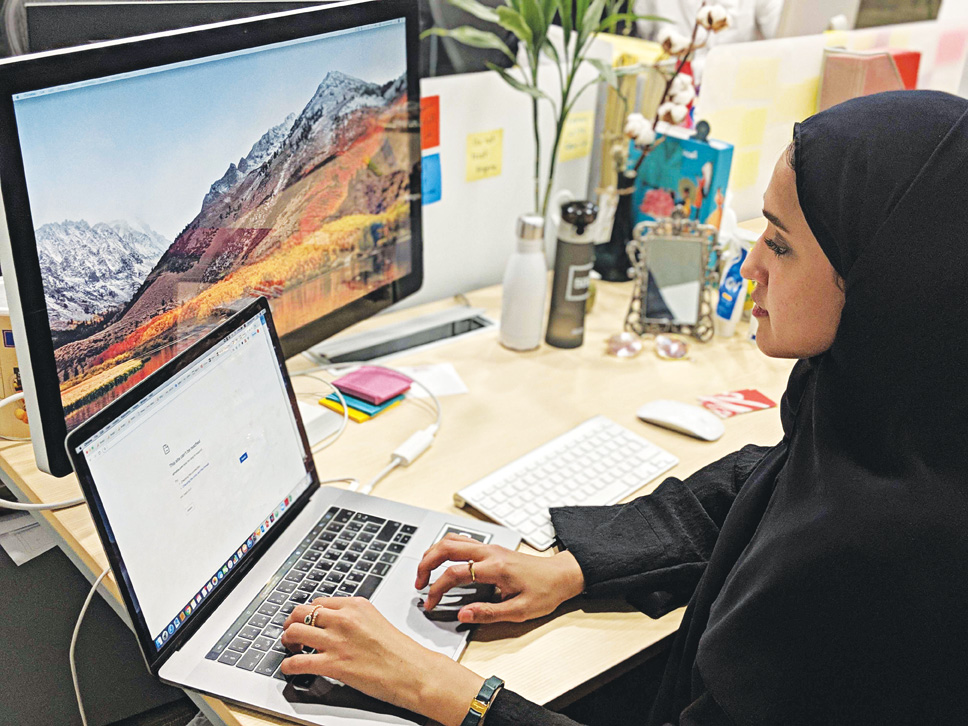
Anwaar Alrefae, a 26-year-old Kuwaiti, is one of them, with her Project 5 Miles (P5M) health and fitness app.

Anwaar Alrefae of P5M
“We help people get fit and support them in staying fit,” she said.
“What’s important for the community in the region is family, friends and work, and because fitness isn’t an integral part of these pillars in people’s lives, when things get stressful, the first thing to drop is a healthy lifestyle because it’s not an integral part of their lives.”
Launched last year, the app’s name stems from pushing through the hardest first 5 miles.
“In those first 5 miles, it’s a new experience and you’re trying to discover what works for you and what doesn’t,” Alrefae said.
“Once you push through them, you know what works for you and how to fit it into your life, and it’s easier for you to get active.”
 Her objective is to combine fitness and socializing, as her app allows members to book classes in multiple gyms with friends and family.
“It allows people to be social in an active way, and it’s less likely for them to drop being active because they can be social with friends and family while being active, which brings in the element of entertainment,” she said.
“The practice of anything is finding a routine without boredom, so by being able to find that flexibility in such activities, people won’t get bored.
“It’s human nature, and we want to keep people on their toes and engaged.”
Having grown up in Kuwait and studied in Boston, Alrefae hopes to dispel the misconception that the region is generally “lazy,” being extremely active herself.
“By adding this physical component to people’s lives, they’ll really be able to have a sense of independence and confidence, and set a goal and achieve it ... Besides the health aspect, it will also have a huge mental effect.”
Mohamed Ibrahim, a Sudanese who was raised in Riyadh, is one of Alrefae’s classmates in the Misk program.

Mohamed Ibrahim of Sabbar
He created Sabbar earlier this year as a recruitment solution that focuses on jobs in the retail and service industry.
It provides businesses in Saudi Arabia with a platform that automates their recruitment process, halving their recruitment time and cost.
It also offers potential workers a mobile app that allows them to find nearby jobs.
The start-up is timely, with a recent labor law in the Kingdom pushing businesses to hire more Saudis.
“It’s a unique offering where we find jobs in a geographical way,” Ibrahim said.
Sabbar helps Saudis find nearby jobs in the retail and service industry, while also helping automate businesses’ recruitment process. (Supplied photo)
“There’s no platform for Saudis to find retail jobs, like baristas or cashiers, so this helps businesses in their challenge today to hire faster and easier.”
The platform allows businesses to access quality candidates through a matching algorithm built on jobseekers’ personality and desire, and to ensure that potential hires are retained longer.
“There’s a high turnover in Saudi Arabia in this (retail and service) industry — up to 70 percent — compared to the global average of 24 percent,” he said.
“You have businesses today that are struggling to meet the demand of filling vacancies quickly due to the hire turnover, and there’s a struggle to grow because of it, so when the labor law came out I saw retailers go through a lot of challenges, so it’s a niche market I can definitely grow.”
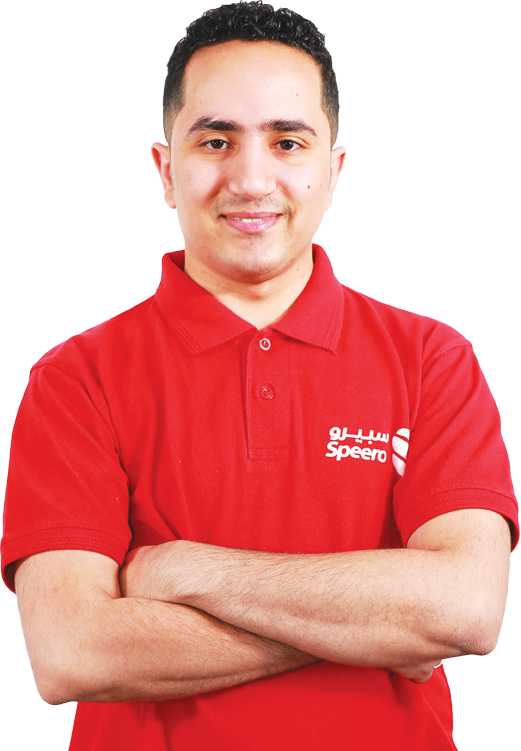
Abdullah Shamlan of Speero
For Abdullah Shamlan, a 29-year-old Yemeni who was born and raised in Riyadh, the Misk program has provided him with invaluable mentorship to grow his business Speero.
“You learn from the best, and the quality of the network of founders you’re exposed to is great,” he said.
“It’s the largest in the MENA (Middle East and North Africa) region, which definitely helps.”
Speero is an online marketplace that helps businesses and individuals find spare parts for cars in a more convenient way.
“We connect spare-parts stores with customers. It helps organize some complicated industries, like spare parts,” Shamlan said.
 “There’s no single solution that tells you about spare-parts prices and their validation in the market, so we’re doing the tough job for the government on the ground.”
With more than 8,000 suppliers in the Kingdom, Speero has started helping 150 of them manage their inventory while providing almost instant quotations to customers on the search, before delivering the parts to their doorstep.
“We serve more than 5,000 people in Saudi Arabia, and we’re taking a totally offline market online,” Shamlan said.
“There’s a need for this because it’s a daily struggle, and we already crossed $1 million in sales in less than 18 months.”
Renting chalets in the Kingdom is another practice that has been made easier, thanks to Latifah Altamimi, a 30-year-old Saudi from Riyadh who created GatherN in November 2016.
“It’s a platform that helps people search and book chalets in Saudi Arabia,” she said.
“We also help chalet owners list their properties and manage them, so it’s like a combination of a Saudi Airbnb and Booking.com.”

Latifah Altaimi of GatherN
The start-up stemmed from Altamimi’s own experience as a regular customer, spending every weekend in a chalet in Riyadh for social and family gatherings.
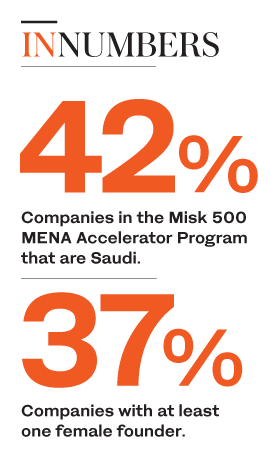
In one year alone, the app’s customer base grew 500 percent.
“There’s demand for it. We have more than 6.2 million transactions every year in this market, but 99.99 percent are done manually, for walk-in customers or calling the reception of the (chalet),” she said.
“It’s a concept developed in Saudi Arabia, with more than 100,000 resorts in the Kingdom.
“We now have more than 1,000 chalets, with huge room for improvement.”
Altamimi said the Misk program has been extremely beneficial, adding: “We already know a lot, but there’s a huge difference between knowing and doing. It’s a great opportunity to expand, and we’re working on our growth. We already grew 40 percent in the seven weeks we’ve been with them (the program).”
One of the challenges she is working on is converting her leads into bookings.
“We now have more than 15 employees, 8 percent of whom are Saudis, and we’re planning to reach 25 employees,” she said.
“I was an employee for seven years and I’m a proactive person. I like to try different things and experiment. I worked in an international company where I didn’t have the space to be creative and do more than what I was expected to, so having my own company gives me huge space to experiment, be creative and contribute to the country’s economy.”
The Misk program began on Jan. 27, 2019.
It will conclude with a demo day on May 13 in Riyadh.


