NAIROBI: Pakistan has lodged an official complaint with the United Nations over damage caused to a protected forest reserve during an air strike by India last month, Pakistan’s climate change minister Malik Amin Aslam Khan said on Monday.
The air strike in the Massar Jabba Forest Reserve had damaged a forest ecosystem which “could take up to a century to recover,” said Khan, Prime Minister Imran Khan’s adviser for climate change.
Khan said he handed over a dossier detailing the damage at the UN Environment Assembly (UNEA) in Nairobi, calling on the global body to condemn India and seek compensation.
“We think what happened was a strike on nature — it was a strike on the Massar Jabba Forest Reserve which is a protected ecosystem and a globally important carbon sink,” Khan told the Thomson Reuters Foundation in an interview.
“We are speaking for the voiceless trees of the Massar Jabba forest reserve which became a target of this operation.”
India and Pakistan are amidst their biggest stand-off in years, with the United States and other global powers mediating to de-escalate tensions between arch-foes who have fought three wars since independence from British colonial rule in 1947.
Indian warplanes on Feb. 26 bombed the hilly forest area near the northern Pakistani town of Balakot, about 40 km (25 miles) from India’s border in the Himalayan region of Kashmir.
India said it destroyed a militant training camp, adding Pakistan’s accusation of environmental damage was “misguided.”
“It is unfortunate that the Pakistan delegation has misused this forum and wasted the time on matters not relevant,” Rahul Chhabra, Permanent Representative to UN Environment told the world’s environment ministers at the UNEA last week.
“The air strike by India in Balakot in Pakistan was a precision and accurate strike directed at terrorists located in a terrorist training camp and the strike was not aimed at any environmental damage.”
Pakistan denies there were any such camps in the area.
The Jabba Massar Reserve Forest is located in Pakistan’s northwestern Khyber Pakhtunkhwa province and was established as a protected area in 2015 as part of the “Billion Trees Afforestation Project” which promotes forest regeneration.
A report by Pakistan after the air strike found damage to an area of 1.2 acres which included 19 pine trees valued at 2.7 million Pakistani rupees ($20,000) and soil erosion.
“The recovery of biomass lost due to this destructive action will take about a century to recover,” said the report, produced by a team of experts, including staff from the International Union for Conservation of Nature and World Wide Fund for Nature.
Khan said India had violated international rules such as a UN resolution which states “destruction of the environment, not justified by military necessity and carried out wantonly, is clearly contrary to existing international law.”
The damage contravened International Humanitarian Law, with additional protocols to the Geneva Convention prohibiting warfare which is intended to cause “long-term” and “severe” environmental damage, he added.
“In terms of the extent of damage, I mean, the whole forest did not go up in flames — but the fact is that the only victim of this atrocity was the environment,” said Khan.
“Nature paid a price for somebody’s madness. We want compensation, retribution and condemnation of this act.”


Pakistan lodges formal complaint to UN over forest damage by Indian air strike
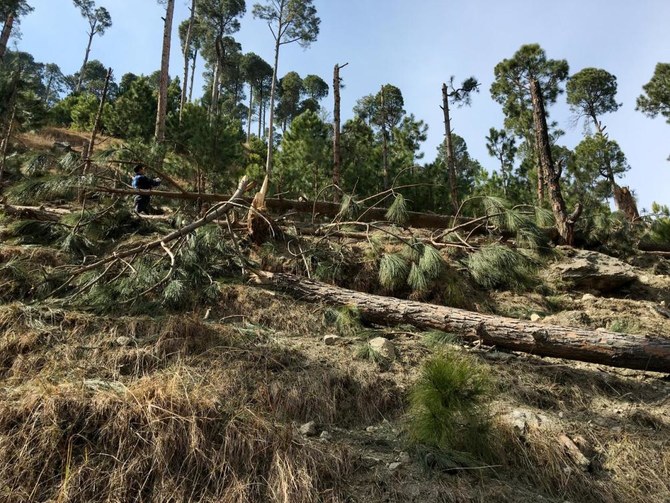
Pakistan lodges formal complaint to UN over forest damage by Indian air strike
- The air strike in the Massar Jabba Forest Reserve had damaged a forest ecosystem which “could take up to a century to recover”


Venezuela advances amnesty bill that could lead to mass release of political prisoners
- Such an amnesty is a central demand of the country’s opposition and human rights organizations with backing from the United States
CARACAS: Venezuela’s legislature on Thursday advanced an amnesty bill proposed by acting President Delcy Rodríguez that could lead to the release of hundreds of opposition leaders, journalists and human rights activists detained for political reasons.
Such an amnesty is a central demand of the country’s opposition and human rights organizations with backing from the United States. But the contents of the bill have not been released publicly, and rights groups have so far reacted with cautious optimism — and with demands for more information.
The bill, introduced just weeks after the US military captured then-President Nicolás Maduro, still requires a second debate that has yet to be scheduled. Once approved, it must be signed by Rodríguez before it can go into effect.
In announcing the bill late last month, Rodríguez told a gathering of justices, magistrates, ministers, military brass and other government leaders that the ruling party-controlled National Assembly would take up the legislation with urgency.
“May this law serve to heal the wounds left by the political confrontation fueled by violence and extremism,” she said in a pre-taped televised event. “May it serve to redirect justice in our country, and may it serve to redirect coexistence among Venezuelans.”
Rights groups, fearing some political detainees will be excluded, want more details about the requirements for amnesty before any final vote.
The Venezuelan Program for Education-Action in Human Rights, or PROVEA, issued a statement emphasizing that the bill must be made public urgently due to its potential impact on victims’ rights and broader Venezuelan society.
Based on what is known so far about the legislation, the amnesty would cover a broad timeline, spanning the administration of the late Hugo Chávez from 1999 to 2013 and that of his political heir, Maduro, until this year. It would exclude people convicted of murder, drug trafficking, and serious human rights violations, reports indicate.


