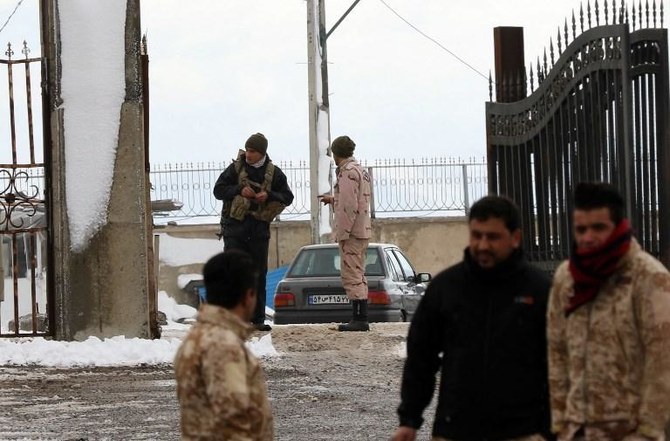
LONDON: An Iranian guard was killed in a fight with an armed group near the western border with Iraq, local media reported on Monday.
Iran’s armed forces have been stepping up their presence along its borders to prevent smuggling, illegal immigration and militant infiltration.
“Last night around 9 p.m., the border guards who were trying to stop armed smugglers entering the country had a fight with armed bandits,” Tasnim news agency quoted Kiumars Sheikhi, commander of the border guards in Kermanshah province as saying.
He said a member of the Baneh county border patrol had been killed in the fight.
Sheikhi said members of the armed group were planning a sabotage operation in Iran, but did not give details or say whether they were connected to militant groups.
In July, militants killed 10 Iranian Revolutionary Guards in an attack on a post on the Iraqi border, an area where armed opposition Kurdish groups are active.
Daesh militants have also entered Iran via the border with Iraq, which is left porous by poor coordination between Iranian and Iraqi security forces.
Attacks against police officers and border guards are also common along Iran’s border with Pakistan. A suicide bomber from a Sunni militant group killed 27 members of the elite Revolutionary Guards last month in a southeastern region which has seen a rise in attacks by Sunni militants based in Pakistan.
Border guards trying to defend against militant groups in the impoverished provinces have faced criticism for shooting at smugglers.

Iranian border guard killed in fight with armed group near Iraq
- Iranian forces were guarding the border against smuggling, illegal immigration and militant infiltration
- Iran’s commander of border guards said the soldier was killed by an armed group
UN warns clock ticking for Sudan’s children
- UNICEF says in parts of North Darfur, more than half of all children are acutely malnourished
- UN-backed experts have said famine is spreading in Sudan’s western Darfur region
GENEVA: The United Nations warned Tuesday that time was running out for malnourished children in Sudan and urged the world to “stop looking away.”
Famine is spreading in Sudan’s western Darfur region, UN-backed experts warned last week, with the grinding war between the army and paramilitary forces leaving millions hungry, displaced and cut off from aid.
Global food security experts say famine thresholds for acute malnutrition have been surpassed in North Darfur’s contested areas of Um Baru and Kernoi.
Ricardo Pires, spokesman for the UN children’s agency UNICEF, said the situation was getting worse for children by the day, warning: “They are running out of time.”
In parts of North Darfur, more than half of all children are acutely malnourished, he told a press conference in Geneva.
“Extreme hunger and malnutrition come to children first: the youngest, the smallest, the most vulnerable, and in Sudan it’s spreading,” he said.
Fever, diarrhea, respiratory infections, low vaccination coverage, unsafe water and collapsing health systems are turning treatable illnesses “into death sentences for already malnourished children,” he warned.
“Access is shrinking, funding is desperately short and the fighting is intensifying.
“Humanitarian access must be granted and the world must stop looking away from Sudan’s children.”
Since April 2023, the conflict between Sudan’s army and the paramilitary Rapid Support Forces has killed tens of thousands, displaced 11 million and triggered what the UN calls one of the world’s worst humanitarian crises.
Shible Sahbani, the World Health Organization’s representative in Sudan, said the country was “facing multiple disease outbreaks: including cholera, malaria, dengue, measles, in addition to malnutrition.”
At the same time, health workers and health infrastructure are increasingly in the crosshairs, he told reporters.
Since the war began, the WHO has verified 205 attacks on health care, leading to 1,924 deaths.
And the attacks are growing deadlier by the year.
In 2025, 65 attacks caused 1,620 deaths, and in the first 40 days of this year, four attacks led to 66 deaths.
Fighting has intensified in the southern Kordofan region.
“We have to be proactive and to pre-position supplies, to deploy our teams on the ground to be prepared for any situation,” Sahbani said.
“But all this contingency planning... it’s a small drop in the sea.”
Famine is spreading in Sudan’s western Darfur region, UN-backed experts warned last week, with the grinding war between the army and paramilitary forces leaving millions hungry, displaced and cut off from aid.
Global food security experts say famine thresholds for acute malnutrition have been surpassed in North Darfur’s contested areas of Um Baru and Kernoi.
Ricardo Pires, spokesman for the UN children’s agency UNICEF, said the situation was getting worse for children by the day, warning: “They are running out of time.”
In parts of North Darfur, more than half of all children are acutely malnourished, he told a press conference in Geneva.
“Extreme hunger and malnutrition come to children first: the youngest, the smallest, the most vulnerable, and in Sudan it’s spreading,” he said.
Fever, diarrhea, respiratory infections, low vaccination coverage, unsafe water and collapsing health systems are turning treatable illnesses “into death sentences for already malnourished children,” he warned.
“Access is shrinking, funding is desperately short and the fighting is intensifying.
“Humanitarian access must be granted and the world must stop looking away from Sudan’s children.”
Since April 2023, the conflict between Sudan’s army and the paramilitary Rapid Support Forces has killed tens of thousands, displaced 11 million and triggered what the UN calls one of the world’s worst humanitarian crises.
Shible Sahbani, the World Health Organization’s representative in Sudan, said the country was “facing multiple disease outbreaks: including cholera, malaria, dengue, measles, in addition to malnutrition.”
At the same time, health workers and health infrastructure are increasingly in the crosshairs, he told reporters.
Since the war began, the WHO has verified 205 attacks on health care, leading to 1,924 deaths.
And the attacks are growing deadlier by the year.
In 2025, 65 attacks caused 1,620 deaths, and in the first 40 days of this year, four attacks led to 66 deaths.
Fighting has intensified in the southern Kordofan region.
“We have to be proactive and to pre-position supplies, to deploy our teams on the ground to be prepared for any situation,” Sahbani said.
“But all this contingency planning... it’s a small drop in the sea.”
© 2026 SAUDI RESEARCH & PUBLISHING COMPANY, All Rights Reserved And subject to Terms of Use Agreement.