

Khyber Pakhtunkhwa’s first Child Protection Court inaugurated in Peshawar

1 / 8
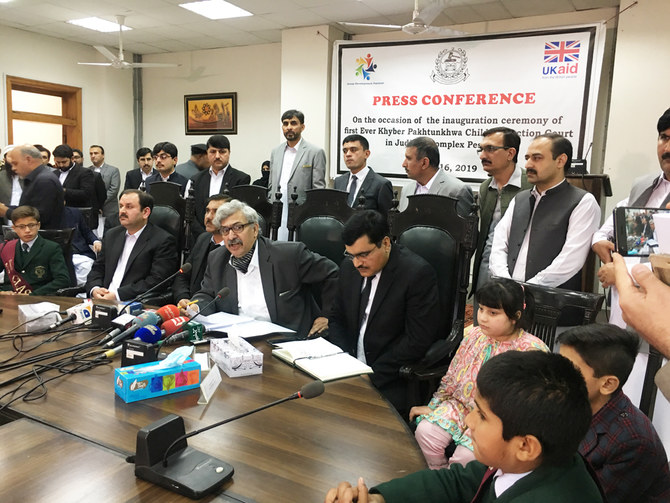
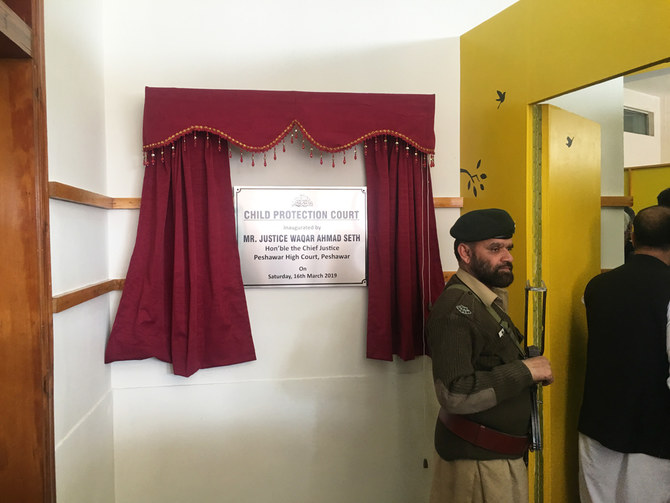
Khyber Pakhtunkhwa’s first Child Protection Court was inaugurated in Peshawar on Saturday. (Supplied photo)
2 / 8
Peshawar High Court’s Registrar gave a detailed briefing to the media about the new court’s jurisdiction and responsibilities on Saturday, saying it would bring about a positive change in the lives of KP’s children. (Supplied photo)
3 / 8
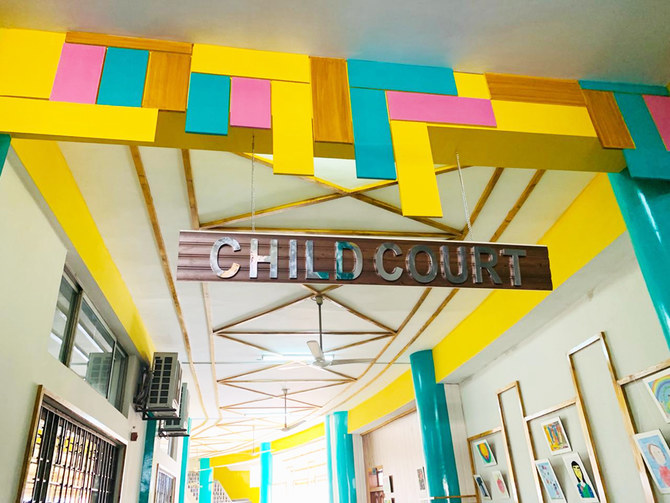
In terms of its design and decoration, the facility looks more like a school than a typical Pakistani judicial facility. (Supplied photo)
4 / 8
5 / 8
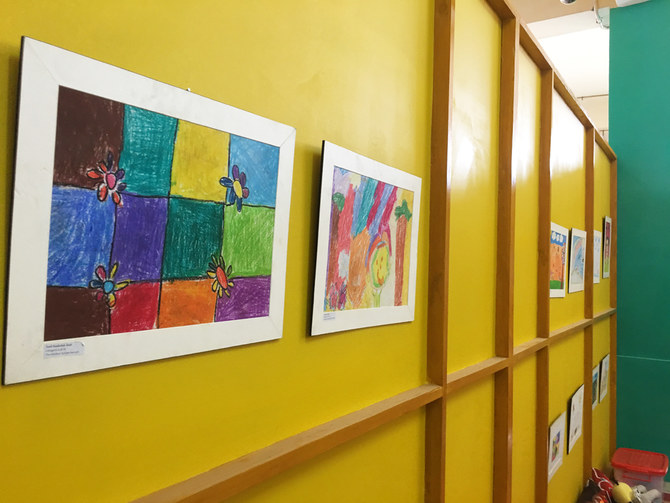
To reduce psychological pressure on children, the administration of the court has tried to create a friendly environment. (Supplied photo)
6 / 8
The Child Protection Court has been designed in a way that it should provide a friendly environment to children. (Supplied photo)
7 / 8
Sixty-two juvenile cases were shifted to the court on the day of its inauguration. (Supplied photo)
8 / 8
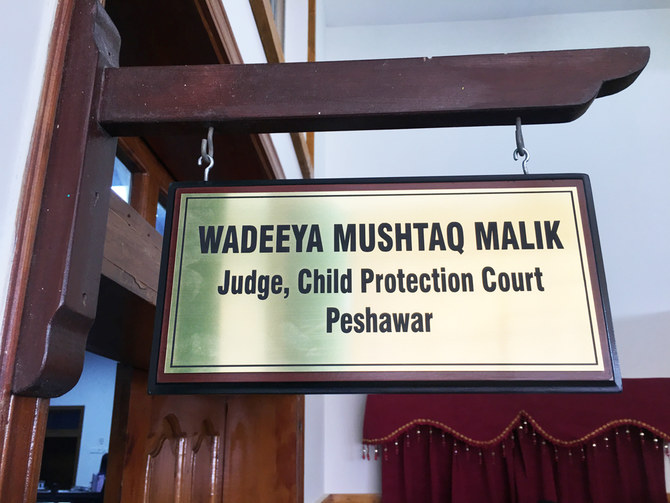
Additional District and Sessions Judge Wadeeya Mushtaq Malik has been appointed as the presiding officer of the Child Protection Court. (Supplied photo)
Updated 17 March 2019
Follow

Khyber Pakhtunkhwa’s first Child Protection Court inaugurated in Peshawar

  • Child rights activists applaud the development
  • KP still needs juvenile prison facilities

PESHAWAR: Chief Justice Peshawar High Court Waqar Ahmad Seth inaugurated Khyber Pakhtunkhwa’s first Child Protection Court at the city’s Judicial Complex on Saturday.

Under the province’s Child Protection and Welfare Act, 2010, and Federal Juvenile Justice System Act, 2018, the court will handle all kinds of issues related to children.

Addressing a news conference, the high court’s registrar, Khwaja Wajih-ud-Din, said that the new court would uphold the rights of children, help young people, and protect the properties of orphans.

“The Peshawar High Court has already requested the provincial administration to set up 34 Child Protection Courts in KP to provide speedy justice to children,” he informed, adding that 62 juvenile cases had already been shifted to the newly established court on the day of its inauguration.

In collaboration with a local non-governmental organization, Group Development Pakistan (GDP), and an international donor, UKAid, the management of the new facility has adorned courtrooms with cartoons and paintings.

Imran Takkar, a child rights activist, described the development as a landmark moment in KP’s history. “Instead of prisons, juveniles should be treated in segregated rehabilitation centers because education is the fundamental right of every child,” he said. “Almost 49 percent population of our country is below the age of 18. Hence, setting up child courts is necessary to ensure the well-being of a very large segment of our society.”

Valerie Khan, GDP’s chief executive, also advocated reformative and constructive approach while dealing with children.  “Even in cases where children violate any law, they should not be treated like common criminals,” she said. “It is everyone’s responsibility to work for the protection of children.”

The staff members of the Child Protection Court have also been trained to be sensitive while dealing with children. The facility’s management will also ensure that children do not come face to face with the offenders during a trial since that can put them under tremendous pressure.

“It is not just the duty of parents to take care of their children’s well-being. The state must also play a role to provide a friendly environment to children within and outside the courtroom,” Sharafat Ali, a lawyer, told Arab News.

However, Imran Takkar lamented there were still “no jails for children,” and about 500 juveniles were kept with hardened criminals in the province’s prison facilities.


Pakistan FM discusses developments in Asia, Middle East with Bangladeshi, Malaysian counterparts

Updated 6 sec ago
Follow

Pakistan FM discusses developments in Asia, Middle East with Bangladeshi, Malaysian counterparts

  • Ishaq Dar speaks to foreign ministers of both countries amid tensions in Yemen, strained ties between Delhi, Dhaka
  • Dar reaffirms commitment to enhance cooperation with Bangladesh, Malaysia in telephone call with both counterparts 

ISLAMABAD: Pakistan’s Foreign Minister Ishaq Dar discussed evolving developments in the Asia and Middle East regions with his counterparts from Bangladesh and Malaysia, the foreign office said on Sunday, reaffirming Islamabad’s resolve to enhance cooperation with both states. 

Tensions escalated in Yemen this week after a Saudi-led coalition carried out a “limited” airstrike targeting weapons shipments from the UAE to the port city of Mukalla in southern Yemen. 

The coalition forces spokesperson said the weapons were meant to support the Southern Transitional Council (STC) forces, backed by the UAE, in Yemen’s Hadramaut and Al-Mahra “with the aim of fueling the conflict.”

Pakistan has expressed solidarity with Saudi Arabia and called on regional powers to resolve tensions with dialogue and diplomacy. 

“DPM/FM Senator Mohammad Ishaq Dar held a telephone conversation with FM of Malaysia, Mohamad bin Hajji Hasan,” Pakistan’s foreign office said in a statement. 

“They also exchanged views on recent regional developments, including the evolving situation in Asia and the Middle East.”

In a separate statement, the foreign office said Dar held a telephonic conversation with Bangladesh’s Foreign Adviser Touhid Hossain. 

The two leaders also discussed developments in the Middle East and Asia, agreeing to remain in close contact. 

“The two leaders reviewed Pakistan–Bangladesh relations and reaffirmed their commitment to enhancing cooperation across various sectors,” the statement said. 

The developments also take place in light of Bangladesh’s rising political tensions with Pakistan’s arch-rival India. 

Tensions between the two countries have surged in recent weeks after a 25-year-old Hindu man was lynched and burned publicly in Bangladesh following allegations of blasphemy. India’s foreign ministry last month condemned what it called “unremitting hostility against minorities” in Bangladesh.

A few days later, Hindutva activists tried to storm the Bangladesh High Commission in New Delhi, rallying against the neighboring nation for what they said was Dhaka’s failure to protect its Hindu minorities.

Ties between Dhaka and New Delhi have remained strained ever since the ouster of former Bangladeshi PM Sheikh Hasina in 2024, when she fled to India after her ouster in violent protests in the country. 

India has so far not accepted Bangladesh’s request to extradite Hasina, further stoking tensions between the countries.
