

King Salman patronizes the Grand Horse Race of the Founder’s Cup

1 / 6
King Salman at the King Abdulaziz Racecourse in Janadriyah on March 16, 2019. (SPA)
2 / 6
King Salman at the King Abdulaziz Racecourse in Janadriyah on March 16, 2019. (SPA)
3 / 6
King Salman at the King Abdulaziz Racecourse in Janadriyah on March 16, 2019. (SPA)
4 / 6
King Salman at the King Abdulaziz Racecourse in Janadriyah on March 16, 2019. (SPA)
5 / 6
Entertainers perform a dance at the King Abdulaziz Racecourse in Janadriyah on March 16, 2019. (SPA)
6 / 6
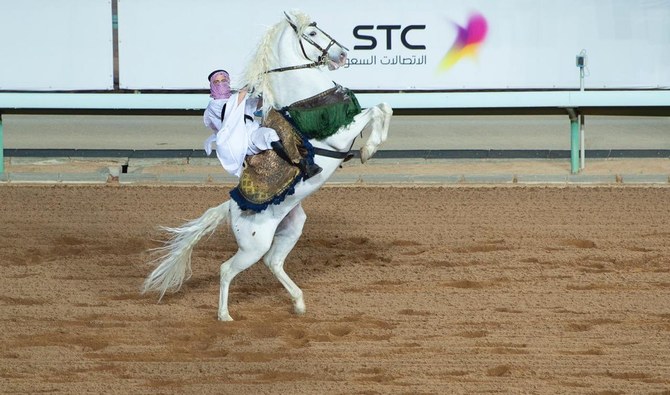
An equestrian display takes place at the King Abdulaziz Racecourse in Janadriyah on March 16, 2019. (SPA)
Updated 18 March 2019
Follow

King Salman patronizes the Grand Horse Race of the Founder’s Cup

  • King Salman patronized the annual Grand Horse Race of the Founder’s Cup at the King Abdulaziz Racecourse in Janadriyah on Saturday
  • The king watched a number of equestrian displays

RIYADH: Saudi Arabia’s King Salman arrived at the King Abdulaziz Racecourse in Janadriyah on Saturday evening to patronize the annual Grand Horse Race of the Founder’s Cup. 


The king, the Honorary President of the Equestrian Club, watched a number of equestrian displays from different countries. 

King Salman awarded the Founder’s Cup to Prince Saud bin Salman bin Abdulaziz after his horse won first place.


Jeddah and Taif earn World Region of Gastronomy 2027 title

Updated 6 sec ago
Follow

Jeddah and Taif earn World Region of Gastronomy 2027 title

  • Recognition opens new avenues for international collaboration in food culture, research and tourism, says culinary commission CEO

RIYADH: Jeddah and Taif have been awarded the World Region of Gastronomy 2027 title according to the criteria set by the International Institute of Gastronomy, Culture, Arts and Tourism.

A recent report issued by the institute highlighted efforts to “preserve culinary heritage, support local biodiversity, empower youth and entrepreneurs in the food sector, and promote sustainable environmental practices.”

Mayada Badr, CEO of Culinary Arts Commission, said: “The award also reflects the ongoing legacy of excellence initiated by the Asir region, which held the same title in 2024.”

The two Saudi cities received the prestigious title following a comprehensive field visit by an international jury of IGCAT experts, who met key local stakeholders and assessed the region’s commitment to holistic sustainable development standards linking gastronomy, culture, responsible tourism, and economic and social development.

The commission led a broad national coalition to achieve the milestone, with participation from strategic partners including King Abdulaziz University, Dar Al-Hekma University, Jeddah Development Authority, Al-Balad Development Co., Azka Foods, Queen Taste, Aysh Academy, the Tour Guides Cooperative and the Abdullah Al-Thagafi Cultural Center.

“These efforts converged to support education, innovation and skills development, strengthen cultural identity and link gastronomy with responsible tourism,” she said.

By receiving the title, Jeddah and Taif join an exclusive global network of leading World Regions of Gastronomy, opening new opportunities for international collaboration in food research and development, cultural exchange and attracting responsible tourism that values authentic heritage.

The recognition will also serve as a catalyst for developing long-term plans that place culinary arts at the heart of the creative economy, contribute to income diversification and promote intercultural dialogue.

Badr told Arab News that the designation represents a high-level international acknowledgment of the richness of Saudi Arabia’s culinary heritage and its commitment to holistic sustainable development across economic, social, cultural and environmental sectors.

The achievement is part of a continuous journey building on the success of the Asir region in 2024, reflecting a national strategic vision to strengthen Saudi Arabia’s presence on the global gastronomy map and highlighting the role of cuisine as a bridge for preserving identity and empowering communities, Badr said.

She also highlighted that the international jury observed firsthand the efforts to support food and biodiversity, protect heritage, and empower youth to contribute to innovations advancing the creative economy and sustainable tourism development.

“Through this inclusion in the global platform, Jeddah and Taif will collaborate with their counterparts worldwide to promote sustainable food practices, support local food systems, advance food research and education, and establish gastronomy as an effective means of cultural exchange,” she added.

The title will act as a strong catalyst for developing long-term plans that position culinary arts as a core pillar for preserving intangible cultural heritage, diversifying economic sources, and promoting dialogue and understanding among cultures and peoples, Badr said.