

Economic uplift in focus as Pakistan prime minister addresses newly merged tribal belt

1 / 3
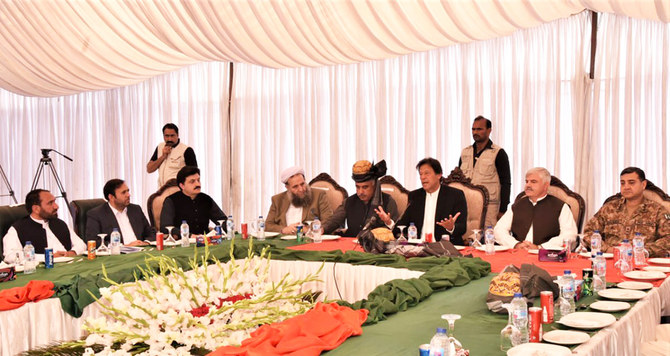
Prime Minister Imran Khan meets with tribal elders in the Mohmand tribal district ahead of his public rally in the adjacent Bajaur tribal district on Friday. (Photo courtesy: PTI Media)
2 / 3
Prime Minister Imran Khan is presented a turban upon his arrival in the Bajaur tribal district on Friday. Khan addressed a huge gathering in the area where he announced a number of development projects as well. (Photo courtesy: PTI Media)
3 / 3
Prime Minister Imran Khan meets with tribal elders in the Mohmand tribal district ahead of his public rally in the adjacent Bajaur tribal district on Friday. (Photo courtesy: PTI Media)
Updated 16 March 2019
Follow

Economic uplift in focus as Pakistan prime minister addresses newly merged tribal belt

  • Says time to compensate for the “unspeakable tragedy” suffered by the people of Pakistan’s long disenfranchised tribal regions
  • Says even ready to negotiate with Indian Prime Minister Narendra Modi for the benefit of Pakistan

PESHAWAR: Prime Minister Imran Khan said on Friday all four provinces of the country should give three percent of their share of the National Finance Commission award, a programme aimed at fixing financial imbalances among the centre and provinces, to the northwestern tribal belt, a region that has for decades suffered from a lack of national investment.
Last year, Pakistan’s parliament passed legislation to merge the country’s tribal regions along the Afghan border with Khyber Pakhtunkhwa (KP) province, a key step in ending the area’s colonial era governance system and giving equal rights and resources to its five million population.

Without provincial status, the tribals regions have remained backward and underdeveloped. Much of the area lacks clean water and has little to no health care, education, telecommunication and infrastructure facilities.

“Let me assure you that KP and Punjab will pay their due share [from the National Finance Commission Award] since [the ruling Pakistan Tehreek-e-Insaf party] is in power in both the provinces,” Prime Minister said in Bajaur at his first rally in the newly merged tribal areas. “But I want to tell Balochistan and Sindh that they should give a portion of their share as well to honour the sacrifices rendered by the tribal people for the country.”

The old system of colonial laws in the tribal regions denied basic legal rights to its people. Coupled with the lack of economic development, the regulations led to an enduring sense of neglect and disenfranchisement.

Due to their lawless, the tribal regions also became an easy haven for militants, gun runners and drug smugglers. The Pakistani military has carried out dozens of military operations to flush out militants in the last decade, causing mass internal displacement of tribal populations.

“Everyone knows that the tribal people faced unspeakable tragedies, and it is now time for them to see development [in their area],” he said. “Our government has approved Rs. 2 billion in loans for the tribal youth on zero markup and easy installments. The idea is to help these young people to establish their own businesses.”

Commenting on recent tensions with arch-rival India, Khan said Pakistan wanted peaceful coexistence with all its neighbours and had repeatedly asked New Delhi to come to the negotiating table and pushed to promote trade and commerce in the region.

Pakistan and India have fought three wars, two of them over the disputed Kashmir region that both administer in part but claim in full. Last month, the two countries almost went to war after India blamed Pakistan for a suicide attack in Indian-administered Kashmir in which at least 40 Indian troopers were killed.

“We want peace with all our neighbours because we want to move ahead in the world,” the prime minister said. “We don’t want war but no one should take that as our weakness. We want amicable resolution of the Kashmir issue since the entire world is watching how atrocities are perpetrated against the Kashmiri people,” Khan added.

“I’m ready to do anything for my country. I can even negotiate with [Indian Prime Minister] Narendra Modi for the benefit of Pakistan,” he said.

The prime minister also expressed optimism about ongoing talks between the US and Afghan Taliban to find a negotiated settlement to a 17-year-long war in Afghanistan.

Pakistan Supreme Court halts trial of prominent lawyer over alleged anti-military tweets

Updated 57 min 11 sec ago
Follow

Pakistan Supreme Court halts trial of prominent lawyer over alleged anti-military tweets

  • Top court orders lower court to pause proceedings after lawyers allege due-process breaches
  • Mazari-Hazir, husband face charges under cybercrime law that carry up to 14 years in prison

ISLAMABAD: Pakistan’s Supreme Court on Thursday halted the cybercrime trial of prominent human rights lawyer Imaan Mazari-Hazir and her husband, Hadi Ali Chattha, after their lawyers argued that a lower court had recorded witness testimony in their absence, violating due-process rules.

Mazari-Hazir, one of Pakistan’s most outspoken civil liberties lawyers, and Chattha are being prosecuted under the Prevention of Electronic Crimes Act (PECA) over posts on X that authorities say incited ethnic divisions and portrayed the military as involved in “terrorism.” Both reject the allegations. If convicted under the relevant PECA provision, they face a prison term of up to 14 years.

The case has drawn broad attention in Pakistan’s legal community because Mazari-Hazir, who has been repeatedly detained over her criticism of the security establishment, argues that the trial court ignored basic procedural guarantees despite her medical leave request. The case also comes as Pakistan faces sustained scrutiny over the use of PECA against activists, journalists and political dissenters, with lawyers arguing that lower courts often move ahead without meeting minimum fair-trial standards.

The couple’s lawyer, Riasat Ali Azad, said his clients filed a petition in the Supreme Court because the lower court had moved ahead improperly.

“Today, the Supreme Court of Pakistan has stayed the lower court proceedings, the trial court proceedings and has said that the [Islamabad] High Court should decide our pending revision petition for which a date has already been fixed,” he told reporters.

Azad said the violation was clear under Pakistan’s Code of Criminal Procedure, which requires evidence to be recorded in the presence of the accused.

“Yet, on that very day, evidence of four witnesses was recorded in their absence, and a state counsel was appointed to conduct cross-examination on their behalf,” he said. “All these things are against the right to a fair trial under Articles 10 and 10-A.”

A three-judge bench led by Justice Muhammad Hashim Khan Kakar ordered the trial court to pause proceedings and instructed the Islamabad High Court to hear the couple’s pending criminal revision petition first.

The trial had been scheduled to resume on Dec.15, but the Supreme Court’s stay now freezes proceedings before both the additional sessions judge and the special PECA court. 

The Islamabad High Court is expected to hear the criminal revision petition next week.

Chattha, who is also a lawyer, said the SC ruling underscored the need for procedural safeguards.

“It is a victory for the constitution and the law,” he said, arguing that the trial court had ignored their request to re-record witness statements in their presence.