

The day peaceful, welcoming New Zealand lost its soul

1 / 5
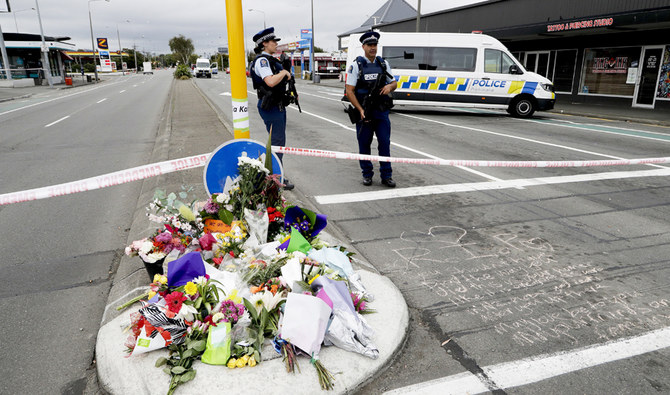
People write on a sign at a memorial as a tribute to victims of the mosque attacks, near a police line outside Masjid Al Noor in Christchurch, New Zealand, on March 16, 2019. (REUTERS/Jorge Silva)
2 / 5
Police stand by makeshift memorial near the Masjid Al Noor mosque in Christchurch, New Zealand, Saturday, March 16, 2019, where one of the two mass shootings occurred. (AP Photo/Mark Baker)
3 / 5
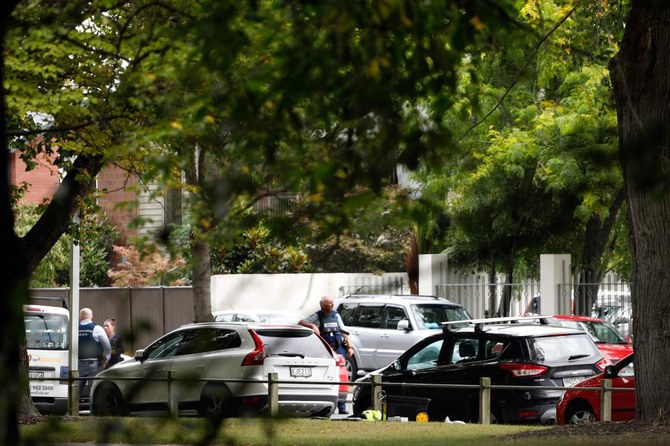
Police officers stand guard in front of the Masjid al Noor mosque after a shooting incident in Christchurch on March 15, 2019. (AFP)
4 / 5
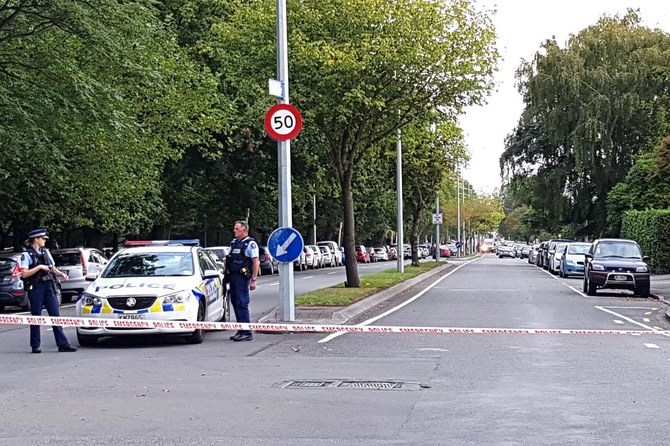
Police corden off the areas close to the mosque after a gunman filmed himself firing at worshippers inside in Christchurch on March 15, 2019. A gunman opened fire inside the Masjid al Noor mosque during afternoon prayers, causing multiple fatalities. (AFP)
5 / 5
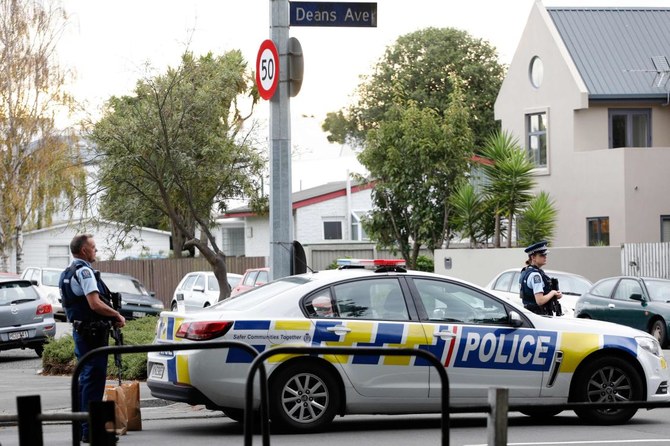
Police officers secure the area in front of the Masjid al Noor mosque after a shooting incident in Christchurch on March 15, 2019. (AFP)
Updated 16 March 2019
Follow

The day peaceful, welcoming New Zealand lost its soul

  • NZ legal procedures mean it might take several days for the bodies to be removed from the mosque
  • Police, who are not armed while on normal duty, had few details of how the attack was coordinated

CHRISTCHURCH: When Brenton Tarrant walked into Al-Noor mosque and opened fire, it was if a whole nation’s soul died.
“The worst of the world has visited our shores, and we’ll never be the same again,” New Zealand Foreign Minister Winston Peters said.
He spoke for New Zealand’s 4.9 million people, avowedly multicultural and welcoming.
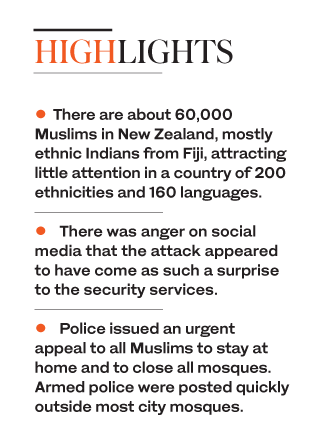
There are about 60,000 Muslims in New Zealand, mostly ethnic Indians from Fiji, attracting little attention in a country of 200 ethnicities and 160 languages. Most of the victims of Friday’s terrorist attack were from Fiji’s islands, but there were also Afghans, and Muslims from Turkey and Somalia.
There was anger on social media that the attack appeared to have come as such a surprise to the security services. New Zealand police, who are not armed while on normal duty, had few details of how the attack was coordinated.
When Tarrant’s live video footage of his attack emerged on Facebook, authorities quickly —and mostly successfully — appealed to people not to share it on social media. New Zealanders quickly rejected a rambling, ranting manifesto posted by Tarrant. It was given little space and was mostly dismissed.
One prominent security analyst, Paul Buchanan, director of 36th Parallel Assessments, said the focus of New Zealand’s intelligence and security services had been on the threat from Islamist extremism, and limited resources meant they had neglected the threat from other sources.
Right-wing extremists have been visible and vocal in Christchurch recently. Terrible as Friday’s attack was, it was not surprising, Buchanan said, and Tarrant’s manifesto was “straight out of the white supremacist playbook.”
During the attack, police issued an urgent nationwide appeal to all Muslims to stay at home and to close all mosques. Armed police were posted quickly outside most city mosques.
Mulki Abdiwahab had been praying in a mosque with her mother when she heard gunshots. “I didn’t know what it was,” she said, “I’d never heard a gunshot, ever. I thought at first it must have been somebody banging on the window.
“My mum grabbed my hand and then we just we ran outside. Everyone was in chaos, just running for their lives. We just kept running, and running. The gunshots kept going on for about a good 10 minutes.”
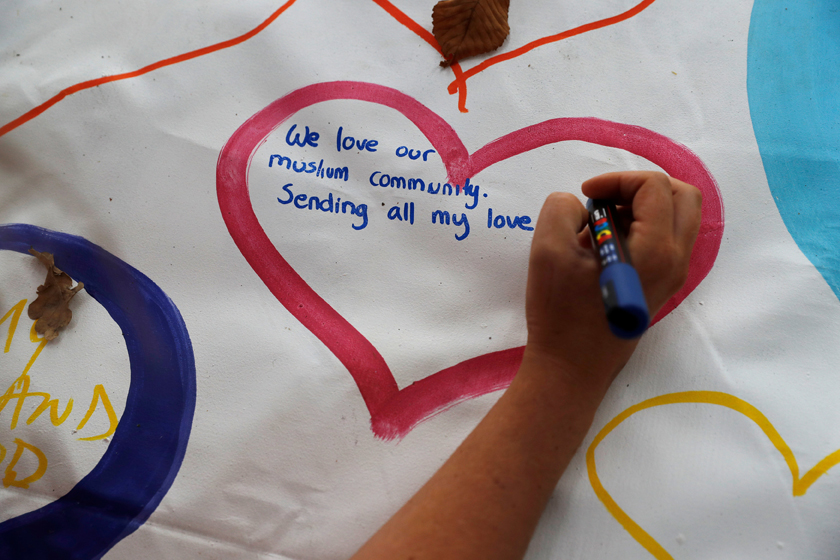


People write on a sign at a memorial as a tribute to victims of the mosque attacks, near a police line outside Masjid Al Noor in Christchurch, New Zealand, on March 16, 2019. (REUTERS/Jorge Silva)

Idris Khairuddin said prayers were just about to begin when he heard gunshots. His uncle Tamizi was one of six people he knew who was shot. “The gunshots sounded like pop, pop, pop,” he said. “I heard over 50.”
Carl Pomare, who had been driving past the mosque as the attack began, saw people running, and saw a five-year-old girl shot. “We looked at it thinking, we’ve got to get this little girl to the hospital now otherwise she’s going to die,” he said. “It was a pretty scary situation because there were still other shots being fired at the time inside the mosque.”
New Zealand legal procedures mean it is likely to be several days before the bodies of the victims are removed from the mosque. Identification is likely to take several days.
Friday’s terrorist attack was the worst in New Zealand history. The last was in 1985 when French secret agents blew up a ship in Auckland harbor, killing one person.
Christchurch has only recently recovered from a series of severe earthquakes, including one in 2011 that killed 187 people.


US immigration agent fatally shoots woman in Minneapolis, mayor disputes government claim of self-defense

Updated 10 sec ago
Follow

US immigration agent fatally shoots woman in Minneapolis, mayor disputes government claim of self-defense

  • A visibly angry mayor said federal immigration agents were responsible for sowing chaos in the city

MINNEAPOLIS: A US immigration agent shot and killed a 37-year-old woman in her car in Minneapolis on Wednesday amid an immigration enforcement ​surge, according to local and federal officials, the latest violent incident during President Donald Trump’s nationwide crackdown on migrants.
Minneapolis Mayor Jacob Frey adamantly rejected the Trump administration’s claim that the agent fired in self-defense, saying he has seen video of the shooting that directly contradicts what he called the government’s “garbage narrative.”
“They’re already trying to spin this as an action of self-defense,” he said at a press conference. “Having seen the video myself, I want to tell everybody directly — that is bullshit.”
A visibly angry Frey said federal immigration agents were responsible for sowing chaos in the city, telling ICE: “Get the f*** out of Minneapolis.” But he also urged residents to remain calm.
The shooting drew protesters into the streets near the scene, some of whom were met by heavily armed federal agents wearing gas masks who fired chemical irritants at the demonstrators.
Tricia McLaughlin, a spokeswoman for the Department of Homeland Security said ‌in a post on ‌X that the US Immigration and Customs Enforcement (ICE) officer began firing after a “violent rioter” attempted ‌to ⁠run ​over ICE officers.
“The ‌alleged perpetrator was hit and is deceased,” she wrote. “The ICE officers who were hurt are expected to make full recoveries.”
Frey said the woman did not appear to be trying to ram anyone in the video he had reviewed. The city police chief, Brian O’Hara, told reporters that the preliminary investigation indicated the woman’s vehicle was blocking traffic when a federal officer approached on foot.
“The vehicle began to drive off,” he said. “At least two shots were fired. The vehicle then crashed on the side of the roadway.”
Trump, a Republican, has deployed federal immigration agents to Democratic-led cities across the US through his first year in office in a crackdown against illegal immigration, leading to backlash from some residents.
The administration planned to send approximately 2,000 agents to Minneapolis, according to news reports, following allegations ⁠of wide-scale welfare fraud involving Somali immigrants, whom Trump has called “garbage.”
The identity of the shot woman was not publicly disclosed. US Senator Tina Smith, a Minnesota Democrat, said on X that she was ‌a US citizen. The police chief said the woman, who was married, was not a ‍target of immigration operations.

WITNESSES DESCRIBE SHOOTING
A dark-colored SUV with a bullet hole ‍through its windshield and blood splattered across the headrest was seen rammed into a pole on the snowy street where the shooting took ‍place.
Venus de Mars, a 65-year-old Minneapolis resident who lives near the site of the shooting, described seeing paramedics perform CPR on a woman collapsed next to a snowbank near the crashed car. Shortly after, they loaded her into an ambulance that drove away without its sirens on.
“There’s been lots of ICE activity but nothing like this,” de Mars said. “I’m so angry. I’m so angry, and I feel helpless.”
The deployment of agents to Minneapolis follows Trump’s recent attacks on Democratic Minnesota Governor ​Tim Walz and the state’s large population of Somali Americans and Somali immigrants over allegations of fraud dating back to 2020 by some nonprofit groups that administer childcare and other social services programs.
At least 56 people have pleaded guilty since ⁠federal prosecutors started to bring charges in 2022 under Trump’s Democratic predecessor, Joe Biden. Walz, the Democratic vice presidential nominee in 2024, announced this week he would not seek a third term as governor, saying he did not have time both to address the fraud scandal and to campaign.
Immigration agents have been involved in other similar shootings during the Trump administration’s crackdown.
During “Operation Midway Blitz,” Trump’s immigration enforcement surge in Chicago last fall, ICE agents shot and killed Silverio Villegas Gonzalez, a 38-year-old Mexican national in a Chicago suburb. Gonzalez, a cook and father of two with no criminal record, was shot in his car after agents attempted to arrest him.
A DHS statement said Gonzalez had steered his car at agents, dragging one officer and causing him to fire out of fear for his life. Police bodycam footage obtained by Reuters complicated that narrative, with the ICE agent saying his injuries were “nothing major.”
Border Patrol agents also shot a woman in Chicago in October. DHS said the shooting was in self-defense after the woman, Marimar Martinez, rammed into the agents’ vehicle. But her lawyer said video footage showed the agents hit her car before opening fire.
In December, ICE agents fired at a van carrying two men they were targeting for arrest, ‌leaving one with bullet wounds. A DHS statement said the men drove the van at ICE officers, prompting them to fire in self-defense.